 Add to Chrome
 Add to Firefox
 Add to Edge
DGSeg: Dynamic Gating of Semantic-Spatial Guided Predictions for Reasoning Segmentation
Jul 06, 2026
Reasoning segmentation aims to predict pixel-wise masks for targets given complex language queries. Existing approaches leverage Multimodal Large Language Models (MLLMs) for vision-language reasoning and generate intermediate target cues (e.g., points or boxes) to guide a segmentation model. However, compressing rich reasoning into sparse cues often introduces ambiguity and noise, preventing these cues from accurately preserving the reasoning intent. While multiple complementary cues can enrich target information, existing methods typically feed them jointly into a single segmentation process, allowing ambiguous or erroneous cues to affect the entire prediction. Therefore, we propose DGSeg, a reasoning segmentation framework that learns to fuse predictions guided by semantic and spatial cues. Specifically, the MLLM jointly reasons about both target identity and spatial location, producing complementary semantic and spatial cues that are fed into separate segmentation branches. Their predictions are adaptively integrated by a lightweight dynamic gating module trained with relative branch-quality supervision to suppress noisy or conflicting regions. Extensive experiments demonstrate that DGSeg consistently outperforms strong baselines on multiple benchmarks and achieves 69.6% and 67.3% gIoU on the challenging ReasonSeg validation and test splits. Code is available at https://github.com/RZZeng/DGSeg.

Towards Temporal Compositional Reasoning in Long-Form Sports Videos
Apr 24, 2026Sports videos are a challenging domain for multimodal understanding because they involve complex and dynamic human activities. Despite rapid progress in Multimodal Large Language Models (MLLMs), long-horizon reasoning in sports videos remains difficult, as answering questions requires both locating temporally sparse evidence and integrating it into reasoning. We attribute this limitation to two closely coupled factors: insufficient supervision over temporally dispersed evidence, and the lack of methods that require models to identify, localize, and justify temporal evidence. To address these gaps, we introduce SportsTime, a large-scale benchmark for long-form sports video understanding, comprising 14K+ open-ended QA pairs and 50K+ step-wise temporal evidence annotations. Building on SportsTime, we propose Chain-of-Time Reasoning (CoTR), which treats reasoning as a process of temporally grounded evidence composition. Specifically, during training, CoTR introduces a temporal-reward GRPO to encourage temporally grounded reasoning. During inference, it employs an anchor-observe-infer evidence-seeking loop to iteratively localize, verify, and compose temporal evidence before producing the final answer. Experiments demonstrate the usefulness of SportsTime as a benchmark and the effectiveness of CoTR, which consistently improves temporal compositional reasoning and step-wise grounding quality over strong MLLM baselines.
Boosting Open-Vocabulary Object Detection by Handling Background Samples
Oct 11, 2024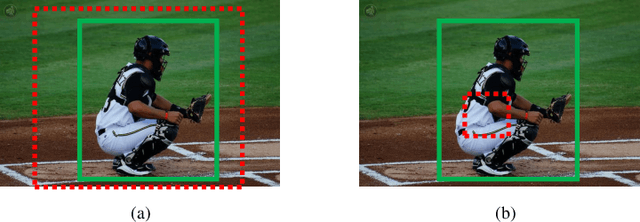
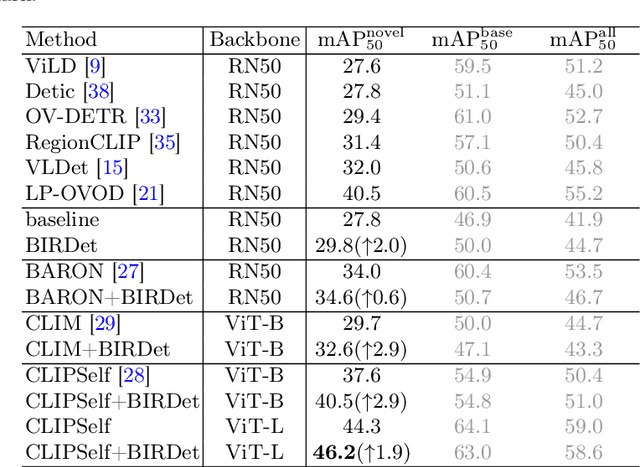
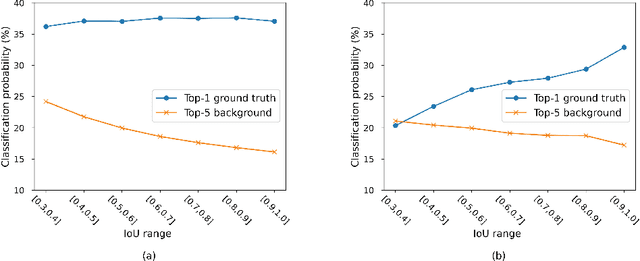
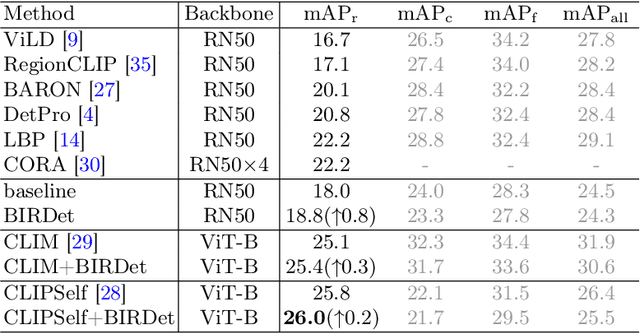
Open-vocabulary object detection is the task of accurately detecting objects from a candidate vocabulary list that includes both base and novel categories. Currently, numerous open-vocabulary detectors have achieved success by leveraging the impressive zero-shot capabilities of CLIP. However, we observe that CLIP models struggle to effectively handle background images (i.e. images without corresponding labels) due to their language-image learning methodology. This limitation results in suboptimal performance for open-vocabulary detectors that rely on CLIP when processing background samples. In this paper, we propose Background Information Representation for open-vocabulary Detector (BIRDet), a novel approach to address the limitations of CLIP in handling background samples. Specifically, we design Background Information Modeling (BIM) to replace the single, fixed background embedding in mainstream open-vocabulary detectors with dynamic scene information, and prompt it into image-related background representations. This method effectively enhances the ability to classify oversized regions as background. Besides, we introduce Partial Object Suppression (POS), an algorithm that utilizes the ratio of overlap area to address the issue of misclassifying partial regions as foreground. Experiments on OV-COCO and OV-LVIS benchmarks demonstrate that our proposed model is capable of achieving performance enhancements across various open-vocabulary detectors.