 Add to Chrome
 Add to Firefox
 Add to Edge
HyPASE: Hyperbolic Geometry for Parameter-Efficient Speech Emotion Fine-Tuning Framework for Large Audio-Language Models
Aug 05, 2026
Large Audio-Language Models (LALMs) excel at general speech understanding; however, adapting them to fine-grained tasks like Speech Emotion Recognition (SER) remains a significant bottleneck. Current Parameter-Efficient Fine-Tuning (PEFT) methods typically operate in flat Euclidean space, and this geometry fails to capture the multi-granularity nature of emotion cues, which range from low-level prosody to high-level semantics. To address this, we propose HyPASE, a hyperbolic PEFT framework for LALM-based SER. HyPASE leverages the Poincare ball model, using the hyperbolic radius as an explicit proxy for representational granularity. The framework consists of two core components: a Hyperbolic Geometric Adapter (HGA) for layer-adaptive weight modulation, and an Emotion-aware Multi-capacity Cross-modal Aggregator (EMCA) that compresses multi-scale features into compact audio prefixes. Empirical results on standard benchmarks show that HyPASE outperforms Euclidean PEFT baselines across all metrics on MELD and achieves a notable Unweighted Accuracy gain on IEMOCAP, particularly in class-imbalanced emotion recognition, with the accompanying slight Weighted Accuracy trade-off reflecting hyperbolic space's geometric prioritization of minority-class representations; furthermore, HyPASE achieves robust zero-shot cross-dataset generalization within a constrained parameter budget. By grounding the adaptation process in hyperbolic geometry, HyPASE offers a highly efficient path for LALM fine-tuning.

From Representations to Behaviors: Exploring the Person-Situation-Behavior Triad in LLMs
Jul 29, 2026Human personality theories characterize traits not as isolated attributes captured by a single score, but as stable individual tendencies expressed through the interplay among persons, situations, and behaviors. Existing studies of personality-related behavior in LLMs have primarily focused on outputs elicited under personality conditioning, characterizing observable trait-related expressions while lacking mechanistic evidence for the existence of internal personality-related representations, their cross-situational expression, and how these representations shape specific behaviors. Building on Funder's personality triad framework, we adapt its three components for LLM analysis: Person as personality-related internal representations, Situation as contexts that afford trait-relevant responses, and Behavior as response patterns on broader social tasks. We introduce a framework for discovering, controlling, and validating trait-like representations in LLMs. First, using contrastive behavior pairs grounded in shared situations, we identify sparse internal features associated with opposing poles of personality traits through SAE decomposition. We validate their trait relevance through effects on behavior to situation, token-level activation patterns, and robustness to paraphrasing. Second, feature-level interventions induce bidirectional trait-related shifts across a separate, diverse set of situations while preserving response validity, demonstrating consistent expression across contexts. Third, applying the same interventions to social intelligence tasks reveals behavioral changes with benefit-tradeoff patterns consistent with findings from human personality research, providing behavioral-level validation beyond personality scores. Our findings provide evidence that LLMs contain controllable trait-like representations linking internal states, situational expression, and behavioral outcomes.
LitSeg: Narrative-Aware Document Segmentation for Literary RAG
May 26, 2026Retrieval-Augmented Generation (RAG) enhances Large Language Models (LLMs) by incorporating external knowledge, particularly for long-tail domains such as literary works. However, the critical step of document segmentation in RAG remains largely underexplored. Existing strategies are typically semantically blind and overlook the complicated narrative structures of literary works, often resulting in fragmented plots and unclear references that severely hinder retrieval and generation performance. To address this, we propose LitSeg, a novel narrative-theory-guided segmentation framework. By employing multi-stage prompting, LitSeg explicitly extracts valid events, untangles narrative threads, clarifies narrative structures, and locates turning points to inform segmentation. To alleviate the computational overhead of multi-stage inference with large-scale models, we further introduce LitSeg-Lite, a lightweight single-pass chunker fine-tuned on LitSeg-generated data via a two-stage training strategy, distilling the complex process into a single inference pass. Extensive experiments demonstrate that with structurally independent text chunks, our methods significantly improve retrieval accuracy and context relevance over baselines, ultimately enhancing downstream QA performance, while ablation studies validate the efficacy of narratological guidance and data distillation.
AnomalyAgent: Agentic Industrial Anomaly Synthesis via Tool-Augmented Reinforcement Learning
Apr 09, 2026Industrial anomaly generation is a crucial method for alleviating the data scarcity problem in anomaly detection tasks. Most existing anomaly synthesis methods rely on single-step generation mechanisms, lacking complex reasoning and iterative optimization capabilities, making it difficult to generate anomaly samples with high semantic realism. We propose AnomalyAgent, an anomaly synthesis agent with self-reflection, knowledge retrieval, and iterative refinement capabilities, aiming to generate realistic and diverse anomalies. Specifically, AnomalyAgent is equipped with five tools: Prompt Generation (PG), Image Generation (IG), Quality Evaluation (QE), Knowledge Retrieval (KR), and Mask Generation (MG), enabling closed-loop optimization. To improve decision-making and self-reflection, we construct structured trajectories from real anomaly images and design a two-stage training framework: supervised fine-tuning followed by reinforcement learning. This process is driven by a three-part reward mechanism: (1) task rewards to supervise the quality and location rationality of generated anomalies; (2) reflection rewards to train the model's ability to improve anomaly synthesis prompt; (3) behavioral rewards to ensure adherence to the trajectory. On the MVTec-AD dataset, AnomalyAgent achieves IS/IC-L of 2.10/0.33 for anomaly generation, 57.0% classification accuracy using ResNet34, and 99.3%/74.2% AP at the image/pixel level using a simple UNet, surpassing all zero-shot SOTA methods. The code and data will be made publicly available.
Mechanistic Knobs in LLMs: Retrieving and Steering High-Order Semantic Features via Sparse Autoencoders
Jan 06, 2026Recent work in Mechanistic Interpretability (MI) has enabled the identification and intervention of internal features in Large Language Models (LLMs). However, a persistent challenge lies in linking such internal features to the reliable control of complex, behavior-level semantic attributes in language generation. In this paper, we propose a Sparse Autoencoder-based framework for retrieving and steering semantically interpretable internal features associated with high-level linguistic behaviors. Our method employs a contrastive feature retrieval pipeline based on controlled semantic oppositions, combing statistical activation analysis and generation-based validation to distill monosemantic functional features from sparse activation spaces. Using the Big Five personality traits as a case study, we demonstrate that our method enables precise, bidirectional steering of model behavior while maintaining superior stability and performance compared to existing activation steering methods like Contrastive Activation Addition (CAA). We further identify an empirical effect, which we term Functional Faithfulness, whereby intervening on a specific internal feature induces coherent and predictable shifts across multiple linguistic dimensions aligned with the target semantic attribute. Our findings suggest that LLMs internalize deeply integrated representations of high-order concepts, and provide a novel, robust mechanistic path for the regulation of complex AI behaviors.
Regrowth-free AlGaInAs MQW polarization controller integrated with sidewall grating DFB laser
Nov 07, 2022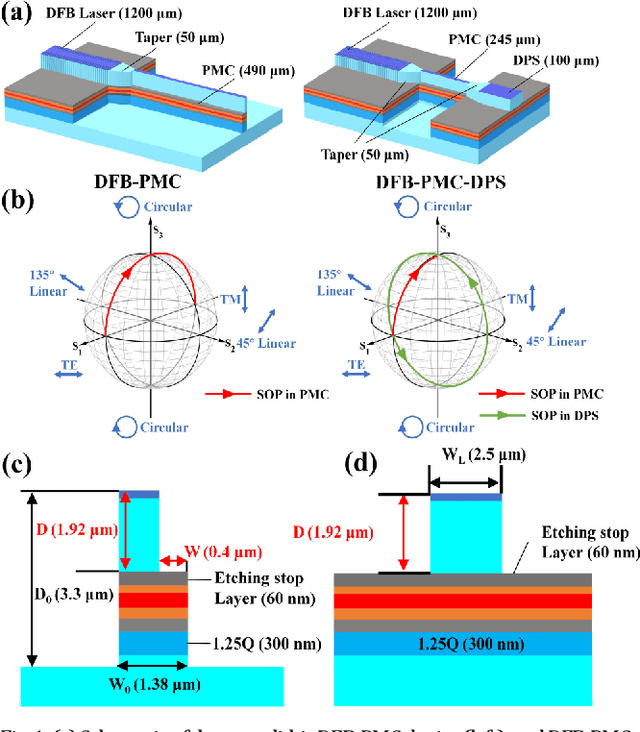
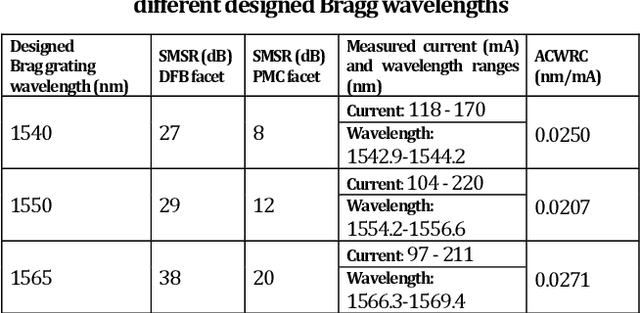
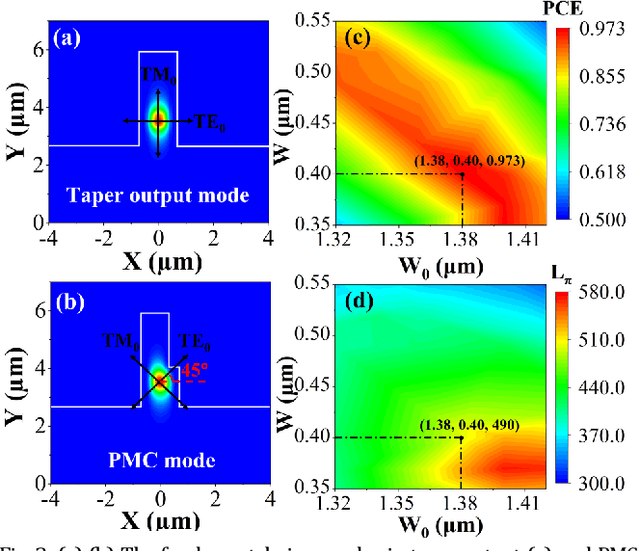
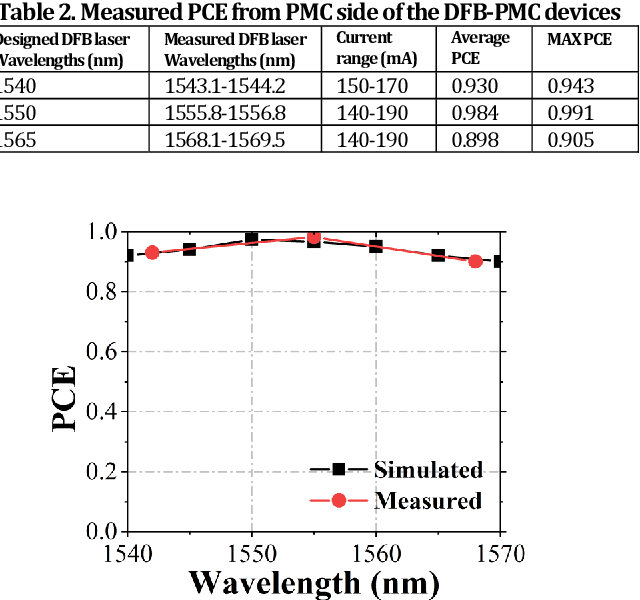
We report an AlGaInAs multiple quantum well integrated source of polarization controlled light consisting of a polarization mode converter PMC, differential phase shifter(DPS), and a side wall grating distributed-feedback DFB laser. We demonstrate an asymmetrical stepped-height ridge waveguide PMC to realize TE to TM polarization conversion and a symmetrical straight waveguide DPS to enable polarization rotation from approximately counterclockwise circular polarization to linear polarization. Based on the identical epitaxial layer scheme, all of the PMC, DPS, and DFB laser can be integrated monolithically using only a single step of metalorganic vapor phase epitaxy and two steps of III V material dry etching. For the DFB-PMC device, a high TE to TM polarization conversion efficiency 98% over a wide range of DFB injection currents is reported at 1555 nm wavelength. For the DFB-PMC-DPS device, a 60 degree rotation of the Stokes vector was obtained on the Poincar\'e sphere with a range of bias voltage from 0 V to -4.0 V at IDFB is 170 mA.