 Add to Chrome
 Add to Firefox
 Add to Edge
RPWithPrior: Label Differential Privacy in Regression
Jan 30, 2026
With the wide application of machine learning techniques in practice, privacy preservation has gained increasing attention. Protecting user privacy with minimal accuracy loss is a fundamental task in the data analysis and mining community. In this paper, we focus on regression tasks under $ε$-label differential privacy guarantees. Some existing methods for regression with $ε$-label differential privacy, such as the RR-On-Bins mechanism, discretized the output space into finite bins and then applied RR algorithm. To efficiently determine these finite bins, the authors rounded the original responses down to integer values. However, such operations does not align well with real-world scenarios. To overcome these limitations, we model both original and randomized responses as continuous random variables, avoiding discretization entirely. Our novel approach estimates an optimal interval for randomized responses and introduces new algorithms designed for scenarios where a prior is either known or unknown. Additionally, we prove that our algorithm, RPWithPrior, guarantees $ε$-label differential privacy. Numerical results demonstrate that our approach gets better performance compared with the Gaussian, Laplace, Staircase, and RRonBins, Unbiased mechanisms on the Communities and Crime, Criteo Sponsored Search Conversion Log, California Housing datasets.

Bridging Fairness Gaps: A (Conditional) Distance Covariance Perspective in Fairness Learning
Dec 01, 2024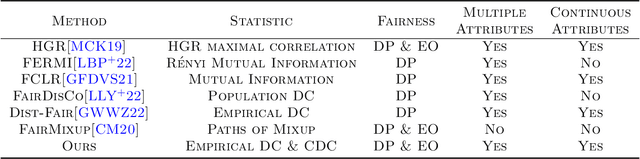
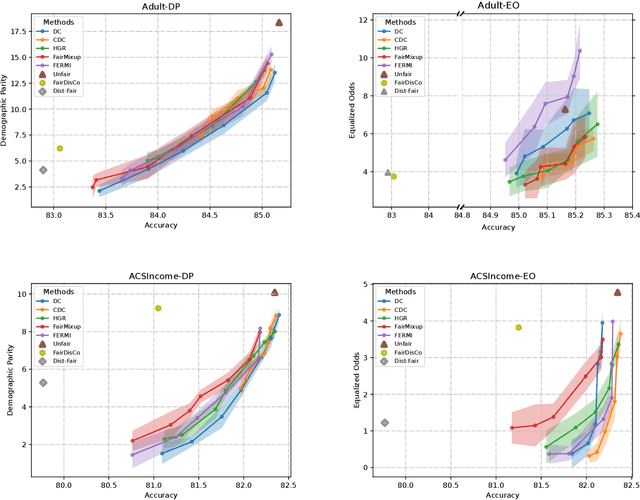
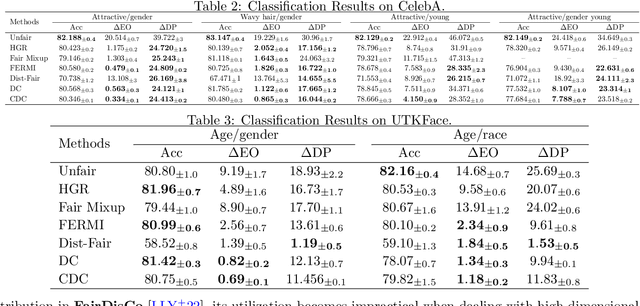
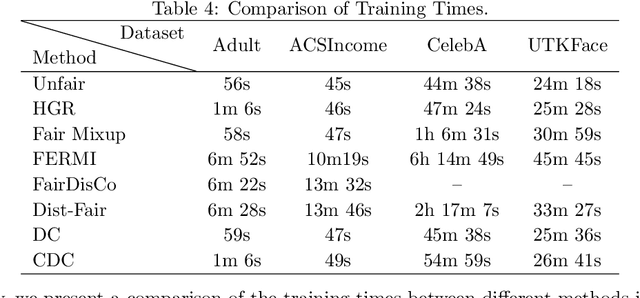
We bridge fairness gaps from a statistical perspective by selectively utilizing either conditional distance covariance or distance covariance statistics as measures to assess the independence between predictions and sensitive attributes. We enhance fairness by incorporating sample (conditional) distance covariance as a manageable penalty term into the machine learning process. Additionally, we present the matrix form of empirical (conditional) distance covariance for parallel calculations to enhance computational efficiency. Theoretically, we provide a proof for the convergence between empirical and population (conditional) distance covariance, establishing necessary guarantees for batch computations. Through experiments conducted on a range of real-world datasets, we have demonstrated that our method effectively bridges the fairness gap in machine learning.