 Add to Chrome
 Add to Firefox
 Add to Edge
DA-RAC: Distance-Aware Calibration of LLM Judges for Trustworthy AI Auditing
Aug 15, 2026
Generative AI systems are increasingly producing real-world artifacts, however their efficacy and validity are often evaluated via context-free LLM-scoring. These judges can be miscalibrated by irrelevant in-context reference examples, creating false confidence and allowing low-quality or harmful outputs to pass evaluation. We study this failure mode as context-induced miscalibration and introduce DA-RAC, a distance-aware reference-anchored calibration method for LLM judges. DA-RAC retrieves semantically and structurally similar labeled anchors for each judgement scenario, weights them by distance, and exposes neighborhood difficulty as a calibration and triage signal. On multi-run LLM-judge evaluation benchmarks, it improves calibration and reduces false-pass risk relative to zero-shot, chain-of-thought evaluation, and static-anchor baselines. Mechanistic analysis shows that judge scores vary systematically with anchor distance, while static references can induce misleading decision boundaries. Thus LLM-judgement requires not only better models, but also calibrated, auditable reference selection, especially when automated evaluation is used to support high-impact AI generated artifacts. Judgments should be grounded in relevant, inspectable, and contestable interpretive artifacts.

ACE: Adaptive Constraint-aware Early Stopping in Hyperparameter Optimization
Aug 04, 2022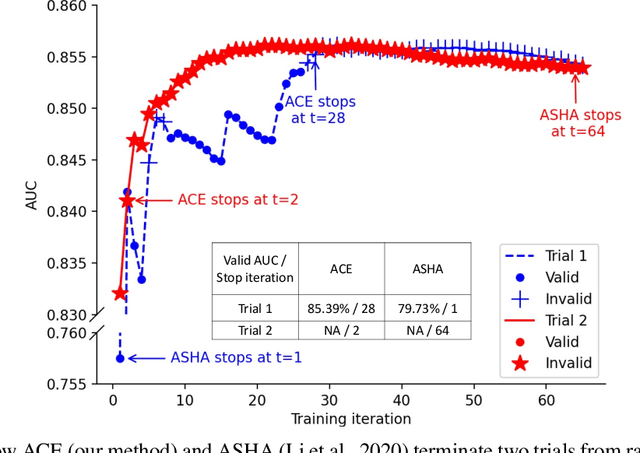
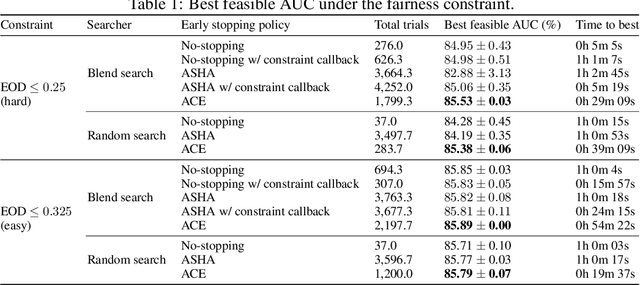
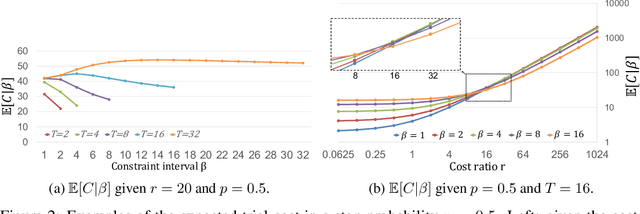
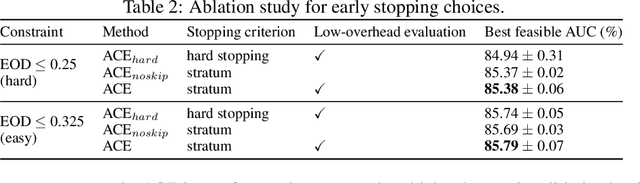
Deploying machine learning models requires high model quality and needs to comply with application constraints. That motivates hyperparameter optimization (HPO) to tune model configurations under deployment constraints. The constraints often require additional computation cost to evaluate, and training ineligible configurations can waste a large amount of tuning cost. In this work, we propose an Adaptive Constraint-aware Early stopping (ACE) method to incorporate constraint evaluation into trial pruning during HPO. To minimize the overall optimization cost, ACE estimates the cost-effective constraint evaluation interval based on a theoretical analysis of the expected evaluation cost. Meanwhile, we propose a stratum early stopping criterion in ACE, which considers both optimization and constraint metrics in pruning and does not require regularization hyperparameters. Our experiments demonstrate superior performance of ACE in hyperparameter tuning of classification tasks under fairness or robustness constraints.
Maximum Regularized Likelihood Estimators: A General Prediction Theory and Applications
Oct 17, 2018Maximum regularized likelihood estimators (MRLEs) are arguably the most established class of estimators in high-dimensional statistics. In this paper, we derive guarantees for MRLEs in Kullback-Leibler divergence, a general measure of prediction accuracy. We assume only that the densities have a convex parametrization and that the regularization is definite and positive homogenous. The results thus apply to a very large variety of models and estimators, such as tensor regression and graphical models with convex and non-convex regularized methods. A main conclusion is that MRLEs are broadly consistent in prediction - regardless of whether restricted eigenvalues or similar conditions hold.