 Add to Chrome
 Add to Firefox
 Add to Edge
Natural data structure extracted from neighborhood-similarity graphs
Feb 15, 2018
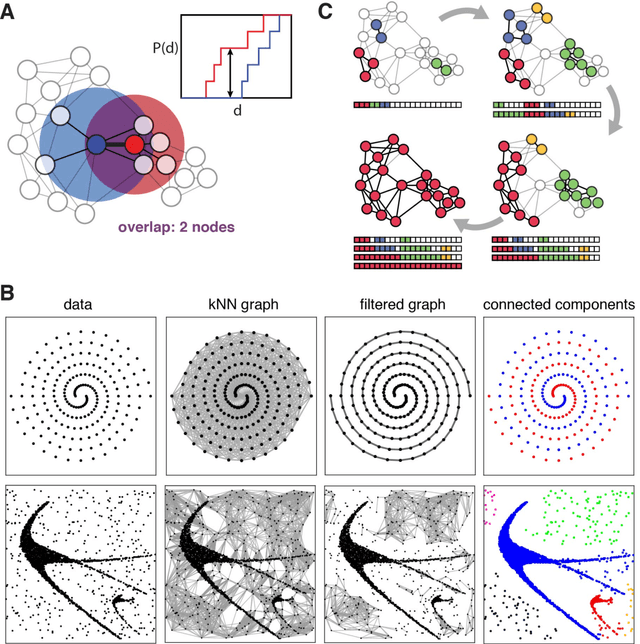
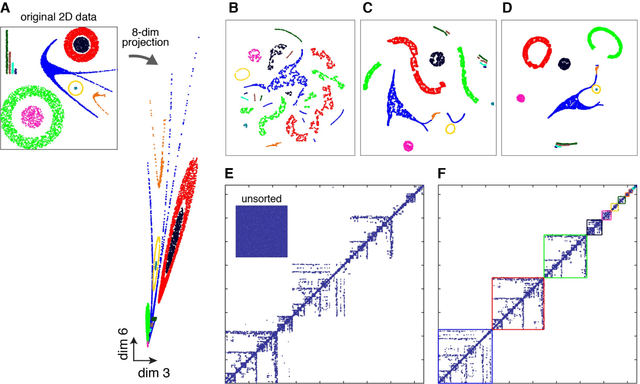
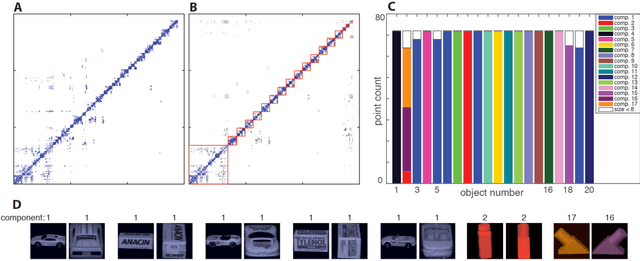
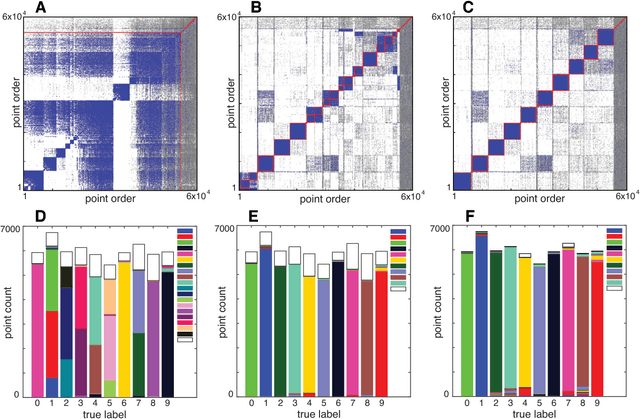
'Big' high-dimensional data are commonly analyzed in low-dimensions, after performing a dimensionality-reduction step that inherently distorts the data structure. For the same purpose, clustering methods are also often used. These methods also introduce a bias, either by starting from the assumption of a particular geometric form of the clusters, or by using iterative schemes to enhance cluster contours, with uncontrollable consequences. The goal of data analysis should, however, be to encode and detect structural data features at all scales and densities simultaneously, without assuming a parametric form of data point distances, or modifying them. We propose a novel approach that directly encodes data point neighborhood similarities as a sparse graph. Our non-iterative framework permits a transparent interpretation of data, without altering the original data dimension and metric. Several natural and synthetic data applications demonstrate the efficacy of our novel approach.

Fly out-smarts man
Feb 27, 2012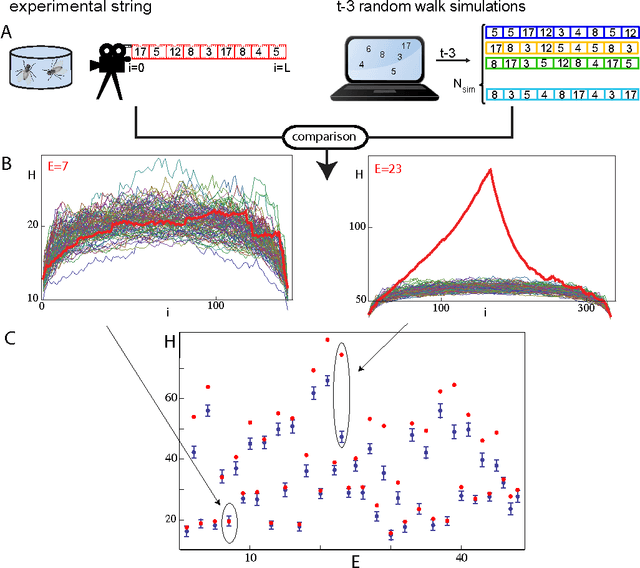
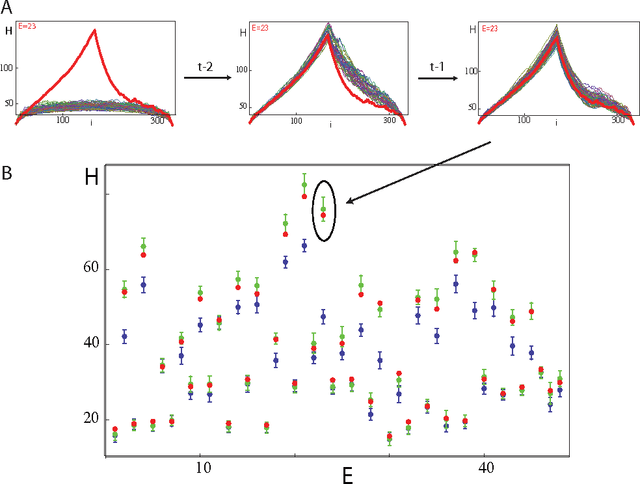
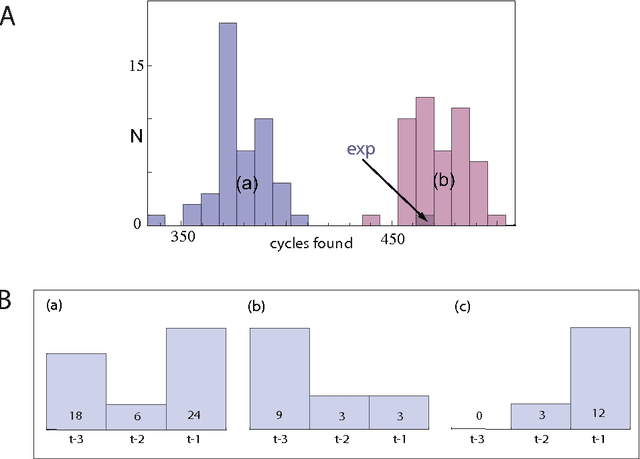
Precopulatory courtship is a high-cost, non-well understood animal world mystery. Drosophila's (=D.'s) precopulatory courtship not only shows marked structural similarities with mammalian courtship, but also with human spoken language. This suggests the study of purpose, modalities and in particular of the power of this language and to compare it to human language. Following a mathematical symbolic dynamics approach, we translate courtship videos of D.'s body language into a formal language. This approach made it possible to show that D. may use its body language to express individual information - information that may be important for evolutionary optimization, on top of the sexual group membership. Here, we use Chomsky's hierarchical language classification to characterize the power of D.'s body language, and then compare it with the power of languages spoken by humans. We find that from a formal language point of view, D.'s body language is at least as powerful as the languages spoken by humans. From this we conclude that human intellect cannot be the direct consequence of the formal grammar complexity of human language.