 Add to Chrome
 Add to Firefox
 Add to Edge
Deep Learning-based Assessment of the Relation Between the Third Molar and Mandibular Canal on Panoramic Radiographs using Local, Centralized, and Federated Learning
Mar 12, 2026
Impaction of the mandibular third molar in proximity to the mandibular canal increases the risk of inferior alveolar nerve injury. Panoramic radiography is routinely used to assess this relationship. Automated classification of molar-canal overlap could support clinical triage and reduce unnecessary CBCT referrals, while federated learning (FL) enables multi-center collaboration without sharing patient data. We compared Local Learning (LL), FL, and Centralized Learning (CL) for binary overlap/no-overlap classification on cropped panoramic radiographs partitioned across eight independent labelers. A pretrained ResNet-34 was trained under each paradigm and evaluated using per-client metrics with locally optimized thresholds and pooled test performance with a global threshold. Performance was assessed using area under the receiver operating characteristic curve (AUC) and threshold-based metrics, alongside training dynamics, Grad-CAM visualizations, and server-side aggregate monitoring signals. On the test set, CL achieved the highest performance (AUC 0.831; accuracy = 0.782), FL showed intermediate performance (AUC 0.757; accuracy = 0.703), and LL generalized poorly across clients (AUC range = 0.619-0.734; mean = 0.672). Training curves suggested overfitting, particularly in LL models, and Grad-CAM indicated more anatomically focused attention in CL and FL. Overall, centralized training provided the strongest performance, while FL offers a privacy-preserving alternative that outperforms LL.

HARU-Net: Hybrid Attention Residual U-Net for Edge-Preserving Denoising in Cone-Beam Computed Tomography
Feb 26, 2026Cone-beam computed tomography (CBCT) is widely used in dental and maxillofacial imaging, but low-dose acquisition introduces strong, spatially varying noise that degrades soft-tissue visibility and obscures fine anatomical structures. Classical denoising methods struggle to suppress noise in CBCT while preserving edges. Although deep learning-based approaches offer high-fidelity restoration, their use in CBCT denoising is limited by the scarcity of high-resolution CBCT data for supervised training. To address this research gap, we propose a novel Hybrid Attention Residual U-Net (HARU-Net) for high-quality denoising of CBCT data, trained on a cadaver dataset of human hemimandibles acquired using a high-resolution protocol of the 3D Accuitomo 170 (J. Morita, Kyoto, Japan) CBCT system. The novel contribution of this approach is the integration of three complementary architectural components: (i) a hybrid attention transformer block (HAB) embedded within each skip connection to selectively emphasize salient anatomical features, (ii) a residual hybrid attention transformer group (RHAG) at the bottleneck to strengthen global contextual modeling and long-range feature interactions, and (iii) residual learning convolutional blocks to facilitate deeper, more stable feature extraction throughout the network. HARU-Net consistently outperforms state-of-the-art (SOTA) methods including SwinIR and Uformer, achieving the highest PSNR (37.52 dB), highest SSIM (0.9557), and lowest GMSD (0.1084). This effective and clinically reliable CBCT denoising is achieved at a computational cost significantly lower than that of the SOTA methods, offering a practical advancement toward improving diagnostic quality in low-dose CBCT imaging.
NAADA: A Noise-Aware Attention Denoising Autoencoder for Dental Panoramic Radiographs
Jun 24, 2025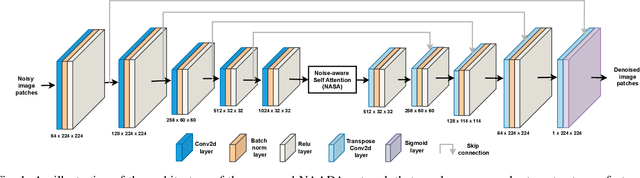
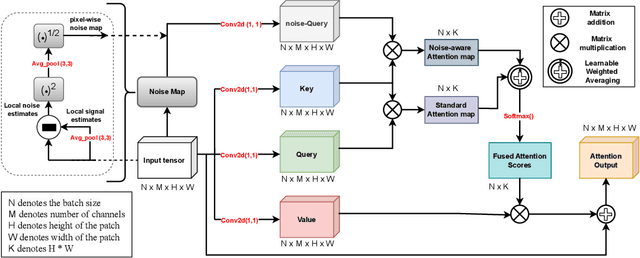
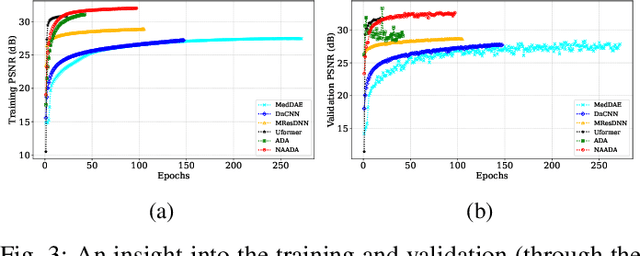
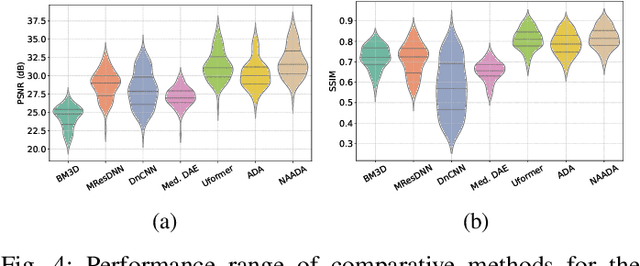
Convolutional denoising autoencoders (DAEs) are powerful tools for image restoration. However, they inherit a key limitation of convolutional neural networks (CNNs): they tend to recover low-frequency features, such as smooth regions, more effectively than high-frequency details. This leads to the loss of fine details, which is particularly problematic in dental radiographs where preserving subtle anatomical structures is crucial. While self-attention mechanisms can help mitigate this issue by emphasizing important features, conventional attention methods often prioritize features corresponding to cleaner regions and may overlook those obscured by noise. To address this limitation, we propose a noise-aware self-attention method, which allows the model to effectively focus on and recover key features even within noisy regions. Building on this approach, we introduce the noise-aware attention-enhanced denoising autoencoder (NAADA) network for enhancing noisy panoramic dental radiographs. Compared with the recent state of the art (and much heavier) methods like Uformer, MResDNN etc., our method improves the reconstruction of fine details, ensuring better image quality and diagnostic accuracy.
Federated learning, ethics, and the double black box problem in medical AI
Apr 29, 2025Federated learning (FL) is a machine learning approach that allows multiple devices or institutions to collaboratively train a model without sharing their local data with a third-party. FL is considered a promising way to address patient privacy concerns in medical artificial intelligence. The ethical risks of medical FL systems themselves, however, have thus far been underexamined. This paper aims to address this gap. We argue that medical FL presents a new variety of opacity -- federation opacity -- that, in turn, generates a distinctive double black box problem in healthcare AI. We highlight several instances in which the anticipated benefits of medical FL may be exaggerated, and conclude by highlighting key challenges that must be overcome to make FL ethically feasible in medicine.
An Explainable and Conformal AI Model to Detect Temporomandibular Joint Involvement in Children Suffering from Juvenile Idiopathic Arthritis
May 02, 2024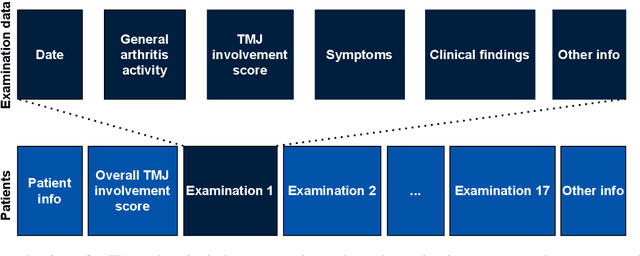
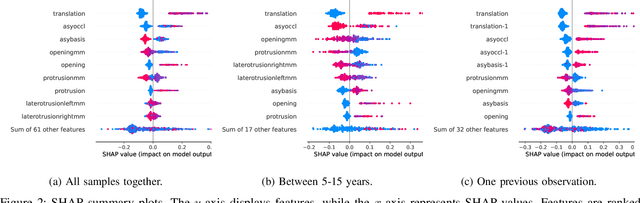
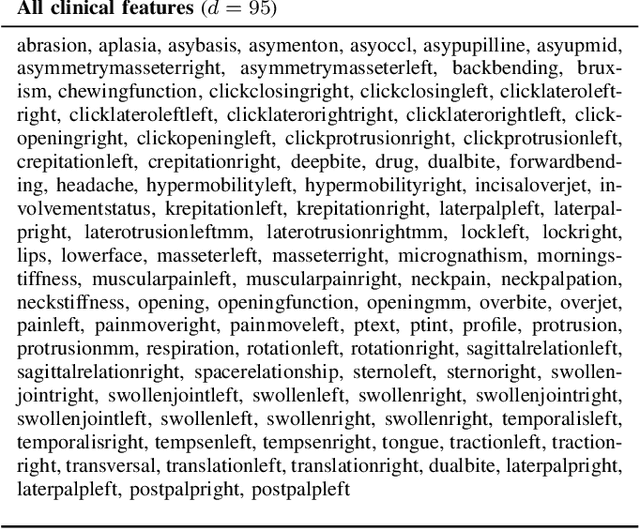
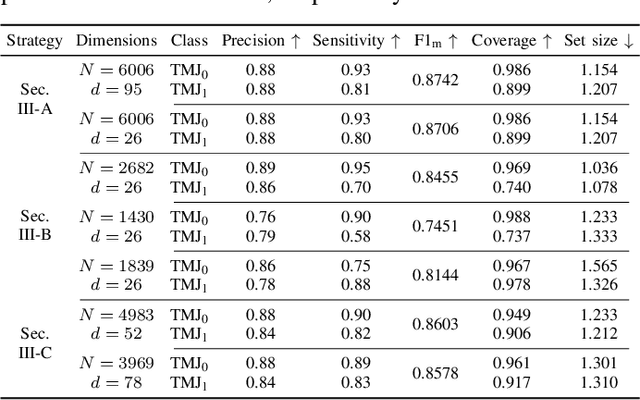
Juvenile idiopathic arthritis (JIA) is the most common rheumatic disease during childhood and adolescence. The temporomandibular joints (TMJ) are among the most frequently affected joints in patients with JIA, and mandibular growth is especially vulnerable to arthritic changes of the TMJ in children. A clinical examination is the most cost-effective method to diagnose TMJ involvement, but clinicians find it difficult to interpret and inaccurate when used only on clinical examinations. This study implemented an explainable artificial intelligence (AI) model that can help clinicians assess TMJ involvement. The classification model was trained using Random Forest on 6154 clinical examinations of 1035 pediatric patients (67% female, 33% male) and evaluated on its ability to correctly classify TMJ involvement or not on a separate test set. Most notably, the results show that the model can classify patients within two years of their first examination as having TMJ involvement with a precision of 0.86 and a sensitivity of 0.7. The results show promise for an AI model in the assessment of TMJ involvement in children and as a decision support tool.