 Add to Chrome
 Add to Firefox
 Add to Edge
Cross-Instance Gaussian Splatting Registration via Geometry-Aware Feature-Guided Alignment
Mar 23, 2026
We present Gaussian Splatting Alignment (GSA), a novel method for aligning two independent 3D Gaussian Splatting (3DGS) models via a similarity transformation (rotation, translation, and scale), even when they are of different objects in the same category (e.g., different cars). In contrast, existing methods can only align 3DGS models of the same object (e.g., the same car) and often must be given true scale as input, while we estimate it successfully. GSA leverages viewpoint-guided spherical map features to obtain robust correspondences and introduces a two-step optimization framework that aligns 3DGS models while keeping them fixed. First, we apply an iterative feature-guided absolute orientation solver as our coarse registration, which is robust to poor initialization (e.g., 180 degrees misalignment or a 10x scale gap). Next, we use a fine registration step that enforces multi-view feature consistency, inspired by inverse radiance-field formulations. The first step already achieves state-of-the-art performance, and the second further improves results. In the same-object case, GSA outperforms prior works, often by a large margin, even when the other methods are given the true scale. In the harder case of different objects in the same category, GSA vastly surpasses them, providing the first effective solution for category-level 3DGS registration and unlocking new applications. Project webpage: https://bgu-cs-vil.github.io/GSA-project/

Gaussian Splashing: Direct Volumetric Rendering Underwater
Nov 29, 2024
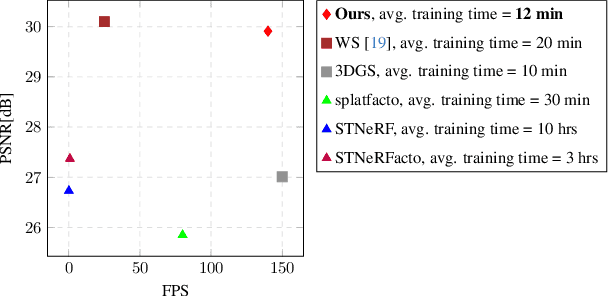

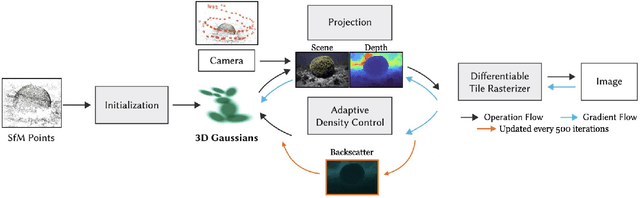
In underwater images, most useful features are occluded by water. The extent of the occlusion depends on imaging geometry and can vary even across a sequence of burst images. As a result, 3D reconstruction methods robust on in-air scenes, like Neural Radiance Field methods (NeRFs) or 3D Gaussian Splatting (3DGS), fail on underwater scenes. While a recent underwater adaptation of NeRFs achieved state-of-the-art results, it is impractically slow: reconstruction takes hours and its rendering rate, in frames per second (FPS), is less than 1. Here, we present a new method that takes only a few minutes for reconstruction and renders novel underwater scenes at 140 FPS. Named Gaussian Splashing, our method unifies the strengths and speed of 3DGS with an image formation model for capturing scattering, introducing innovations in the rendering and depth estimation procedures and in the 3DGS loss function. Despite the complexities of underwater adaptation, our method produces images at unparalleled speeds with superior details. Moreover, it reveals distant scene details with far greater clarity than other methods, dramatically improving reconstructed and rendered images. We demonstrate results on existing datasets and a new dataset we have collected. Additional visual results are available at: https://bgu-cs-vil.github.io/gaussiansplashingUW.github.io/ .
Wavelet Convolutions for Large Receptive Fields
Jul 08, 2024In recent years, there have been attempts to increase the kernel size of Convolutional Neural Nets (CNNs) to mimic the global receptive field of Vision Transformers' (ViTs) self-attention blocks. That approach, however, quickly hit an upper bound and saturated way before achieving a global receptive field. In this work, we demonstrate that by leveraging the Wavelet Transform (WT), it is, in fact, possible to obtain very large receptive fields without suffering from over-parameterization, e.g., for a $k \times k$ receptive field, the number of trainable parameters in the proposed method grows only logarithmically with $k$. The proposed layer, named WTConv, can be used as a drop-in replacement in existing architectures, results in an effective multi-frequency response, and scales gracefully with the size of the receptive field. We demonstrate the effectiveness of the WTConv layer within ConvNeXt and MobileNetV2 architectures for image classification, as well as backbones for downstream tasks, and show it yields additional properties such as robustness to image corruption and an increased response to shapes over textures. Our code is available at https://github.com/BGU-CS-VIL/WTConv.