 Add to Chrome
 Add to Firefox
 Add to Edge
Algorithmic statistics of retinal images
Aug 12, 2026
There has been a tremendous amount of image processing and machine learning research to measure and classify disease progression from live optical coherence tomography (OCT) imaging of the retina. The images considered here are large, complex, three-dimensional (3-D) and difficult to visualize effectively. Many current supervised machine learning approaches, \emph{e.g.} neural networks, are non-metric meaning that any features or measurements generated can introduce systematic distortion that may be correlated with underlying non-meaningful physiological differences. Here we present a metric learning approach using the normalized compression distance (NCD) combined with anisotropic structure-enhancing filters to quantify and visualize the principal differences among a collection of 3-D retinal images. We validate the NCD-measured structural differences between pairs of images against the physician-measured change in visual field function, achieving a prediction error of $\sim$ 0.5 dB, more accurate than non-metric deep learning approaches. The normalized compression vectors (NCV) are proposed as a feature set measuring visual differences among a collection of 3-D microscopy images. The utility of the NCV for visualizing and measuring patterns of change is demonstrated for a human with moderate non-progressing glaucoma and for a non-human primate model using intraocular pressure setting manipulation. We conclude with a brief simulation of non-metric embedding features, \emph{e.g.} from neural networks, introducing class-correlated statistical distortion.

Self-supervised OCT Image Denoising with Slice-to-Slice Registration and Reconstruction
Dec 08, 2023

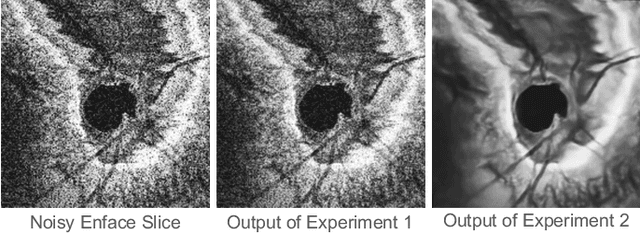
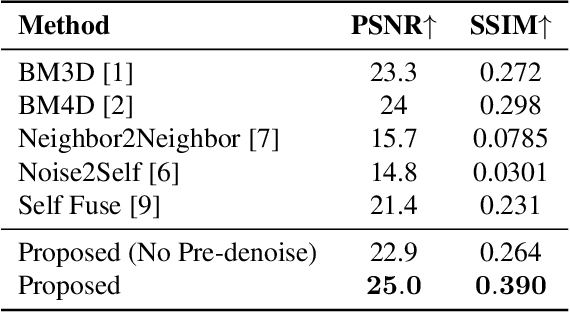
Strong speckle noise is inherent to optical coherence tomography (OCT) imaging and represents a significant obstacle for accurate quantitative analysis of retinal structures which is key for advances in clinical diagnosis and monitoring of disease. Learning-based self-supervised methods for structure-preserving noise reduction have demonstrated superior performance over traditional methods but face unique challenges in OCT imaging. The high correlation of voxels generated by coherent A-scan beams undermines the efficacy of self-supervised learning methods as it violates the assumption of independent pixel noise. We conduct experiments demonstrating limitations of existing models due to this independence assumption. We then introduce a new end-to-end self-supervised learning framework specifically tailored for OCT image denoising, integrating slice-by-slice training and registration modules into one network. An extensive ablation study is conducted for the proposed approach. Comparison to previously published self-supervised denoising models demonstrates improved performance of the proposed framework, potentially serving as a preprocessing step towards superior segmentation performance and quantitative analysis.