 Add to Chrome
 Add to Firefox
 Add to Edge
Uniform Laws of Large Numbers in Product Spaces
Mar 25, 2026
Uniform laws of large numbers form a cornerstone of Vapnik--Chervonenkis theory, where they are characterized by the finiteness of the VC dimension. In this work, we study uniform convergence phenomena in cartesian product spaces, under assumptions on the underlying distribution that are compatible with the product structure. Specifically, we assume that the distribution is absolutely continuous with respect to the product of its marginals, a condition that captures many natural settings, including product distributions, sparse mixtures of product distributions, distributions with low mutual information, and more. We show that, under this assumption, a uniform law of large numbers holds for a family of events if and only if the linear VC dimension of the family is finite. The linear VC dimension is defined as the maximum size of a shattered set that lies on an axis-parallel line, namely, a set of vectors that agree on all but at most one coordinate. This dimension is always at most the classical VC dimension, yet it can be arbitrarily smaller. For instance, the family of convex sets in $\mathbb{R}^d$ has linear VC dimension $2$, while its VC dimension is infinite already for $d\ge 2$. Our proofs rely on estimator that departs substantially from the standard empirical mean estimator and exhibits more intricate structure. We show that such deviations from the standard empirical mean estimator are unavoidable in this setting. Throughout the paper, we propose several open questions, with a particular focus on quantitative sample complexity bounds.

A Theory of PAC Learnability of Partial Concept Classes
Jul 20, 2021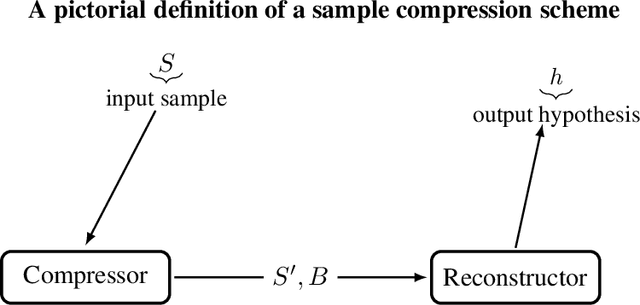
We extend the theory of PAC learning in a way which allows to model a rich variety of learning tasks where the data satisfy special properties that ease the learning process. For example, tasks where the distance of the data from the decision boundary is bounded away from zero. The basic and simple idea is to consider partial concepts: these are functions that can be undefined on certain parts of the space. When learning a partial concept, we assume that the source distribution is supported only on points where the partial concept is defined. This way, one can naturally express assumptions on the data such as lying on a lower dimensional surface or margin conditions. In contrast, it is not at all clear that such assumptions can be expressed by the traditional PAC theory. In fact we exhibit easy-to-learn partial concept classes which provably cannot be captured by the traditional PAC theory. This also resolves a question posed by Attias, Kontorovich, and Mansour 2019. We characterize PAC learnability of partial concept classes and reveal an algorithmic landscape which is fundamentally different than the classical one. For example, in the classical PAC model, learning boils down to Empirical Risk Minimization (ERM). In stark contrast, we show that the ERM principle fails in explaining learnability of partial concept classes. In fact, we demonstrate classes that are incredibly easy to learn, but such that any algorithm that learns them must use an hypothesis space with unbounded VC dimension. We also find that the sample compression conjecture fails in this setting. Thus, this theory features problems that cannot be represented nor solved in the traditional way. We view this as evidence that it might provide insights on the nature of learnability in realistic scenarios which the classical theory fails to explain.