 Add to Chrome
 Add to Firefox
 Add to Edge
Efficient Clustering with Provable Guardrails for LLM Inference at Scale
Jul 22, 2026
Scaling LLM-based applications to millions of users is bottlenecked by the inference cost and latency of modern foundation models. A natural fix is to cluster the inputs and call the LLM only on cluster representatives, letting other members inherit the output -- but this is only safe if each member is measurably close to its representative. Existing clustering methods do not offer such per-sample quality control at scale: none jointly guarantee a minimal within-cluster similarity, exact matching of categorical attributes, and scalability to tens of millions of samples. We propose a two-stage algorithm that generates initial clusters with Mini-batch K-Means, then greedily selects representatives within each initial cluster -- a step equivalent to the Johnson-Chvatal heuristic for Set Cover over alpha-balls in embedding space. The algorithm enforces the similarity and attribute guardrails exactly by construction, and runs in $O(nd + n^2 d/K)$ time and $O(nd + n^2/K^2)$ memory for $n$ samples, feature dimension $d$, and $K$ initial clusters -- linear in $n$ when $K$ grows proportionally with $n$. We provide benchmarks against common clustering methods on internal and public datasets: our method not only delivers per-sample guardrails but also runs 10-1000x faster and scales to data sizes where most standard methods become intractable. Deployed on 38 million customers for a persona-based recommender, the clustering method cut downstream cost and latency by 50-fold while preserving personalization and unblocked the production launch.

A Neural Network Solves and Generates Mathematics Problems by Program Synthesis: Calculus, Differential Equations, Linear Algebra, and More
Jan 04, 2022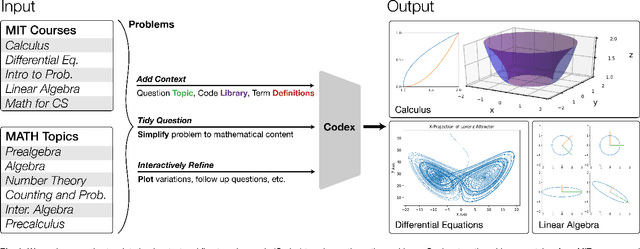
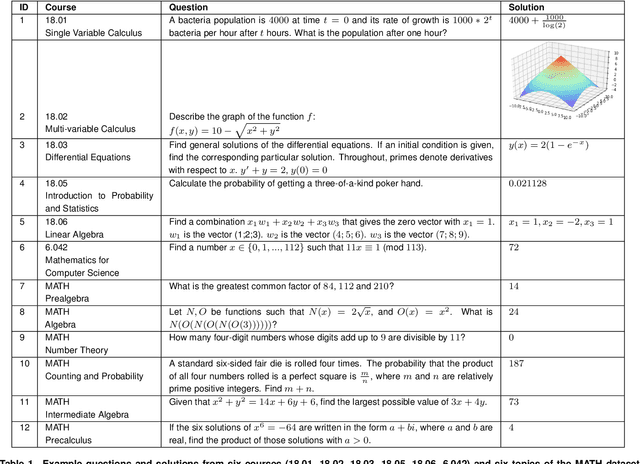
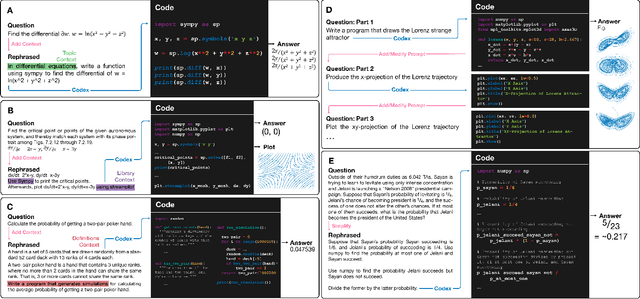
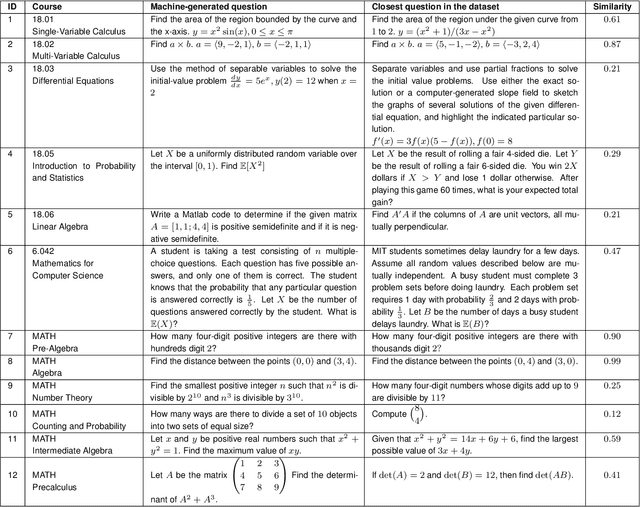
We demonstrate that a neural network pre-trained on text and fine-tuned on code solves Mathematics problems by program synthesis. We turn questions into programming tasks, automatically generate programs, and then execute them, perfectly solving university-level problems from MIT's large Mathematics courses (Single Variable Calculus 18.01, Multivariable Calculus 18.02, Differential Equations 18.03, Introduction to Probability and Statistics 18.05, Linear Algebra 18.06, and Mathematics for Computer Science 6.042), Columbia University's COMS3251 Computational Linear Algebra course, as well as questions from a MATH dataset (on Prealgebra, Algebra, Counting and Probability, Number Theory, and Precalculus), the latest benchmark of advanced mathematics problems specifically designed to assess mathematical reasoning. We explore prompt generation methods that enable Transformers to generate question solving programs for these subjects, including solutions with plots. We generate correct answers for a random sample of questions in each topic. We quantify the gap between the original and transformed questions and perform a survey to evaluate the quality and difficulty of generated questions. This is the first work to automatically solve, grade, and generate university-level Mathematics course questions at scale. This represents a milestone for higher education.
Top 3 in FG 2021 Families In the Wild Kinship Verification Challenge
Oct 27, 2021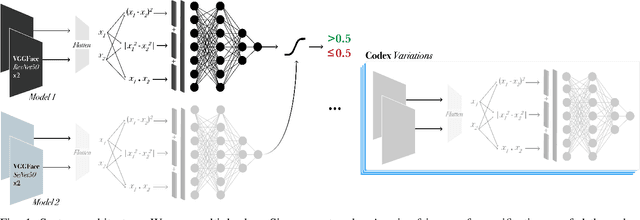
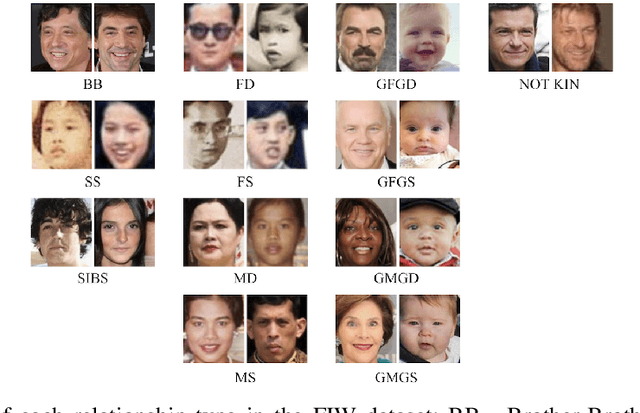
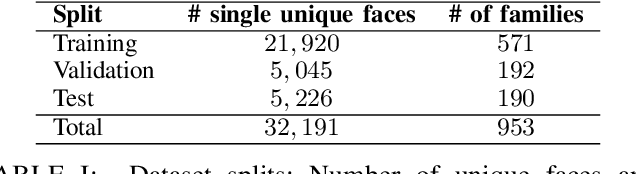
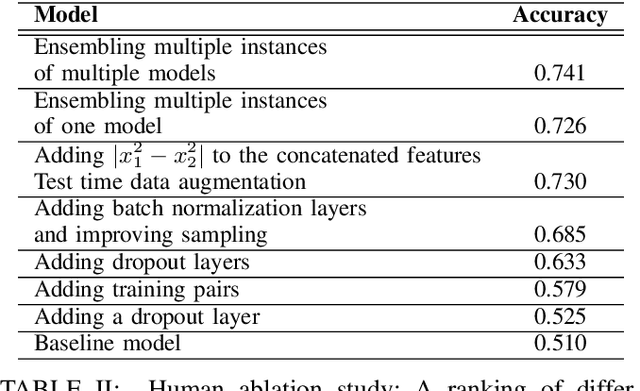
Kinship verification is the task of determining whether a parent-child, sibling, or grandparent-grandchild relationship exists between two people and is important in social media applications, forensic investigations, finding missing children, and reuniting families. We demonstrate high quality kinship verification by participating in the 2021 Recognizing Families in the Wild challenge which provides the largest publicly available dataset in the field. Our approach is among the top 3 winning entries in the competition. We ensemble models written by both human experts and OpenAI Codex. We make our models and code publicly available.