 Add to Chrome
 Add to Firefox
 Add to Edge
Attention to Detail: Evaluating Energy, Performance, and Accuracy Trade-offs Across vLLM Configurations
Jul 10, 2026
Large Language Models are reshaping how software is developed and maintained. They are typically deployed in production using inference engines such as vLLM, which can efficiently serve pre-trained, highly configurable models. While prior work has focused on model architectures and hardware acceleration, the impact of inference engine configuration on energy consumption, performance, and output quality remains poorly understood. In this paper, we present a large-scale controlled study of three selected vLLM configuration options: attention kernel type, prefix caching, and chunked prefill. We evaluate all combinations of these configurations across 5 open-weight LLMs and 5 diverse inference tasks, totaling $9,000$ runs and $93,600$ measures. We analyze energy consumption, latency, and accuracy, and examine both main effects and interaction effects between configuration options and tasks. Our results show that the studied configuration options significantly impact energy and performance, mainly driven by attention type and prefix caching, while chunked prefill has a limited effect under the default vLLM serving configuration and evaluated workloads. These effects are highly model- and workload-dependent, and no configuration is universally optimal. We further show that model choice dominates global trade-offs, while configuration tuning provides local improvements along the Pareto frontier. Unexpectedly, inference options can also affect model accuracy.

DOT: Dynamic Knob Selection and Online Sampling for Automated Database Tuning
Mar 16, 2026Database Management Systems (DBMS) are crucial for efficient data management and access control, but their administration remains challenging for Database Administrators (DBAs). Tuning, in particular, is known to be difficult. Modern systems have many tuning parameters, but only a subset significantly impacts performance. Focusing on these influential parameters reduces the search space and optimizes performance. Current methods rely on costly warm-up phases and human expertise to identify important tuning parameters. In this paper, we present DOT, a dynamic knob selection and online sampling DBMS tuning algorithm. DOT uses Recursive Feature Elimination with Cross-Validation (RFECV) to prune low-importance tuning parameters and a Likelihood Ratio Test (LRT) strategy to balance exploration and exploitation. For parameter search, DOT uses a Bayesian Optimization (BO) algorithm to optimize configurations on-the-fly, eliminating the need for warm-up phases or prior knowledge (although existing knowledge can be incorporated). Experiments show that DOT achieves matching or outperforming performance compared to state-of-the-art tuners while substantially reducing tuning overhead.
Green My LLM: Studying the key factors affecting the energy consumption of code assistants
Nov 07, 2024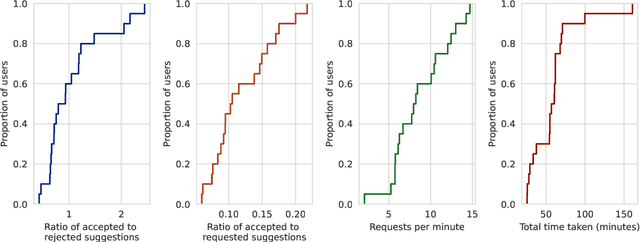

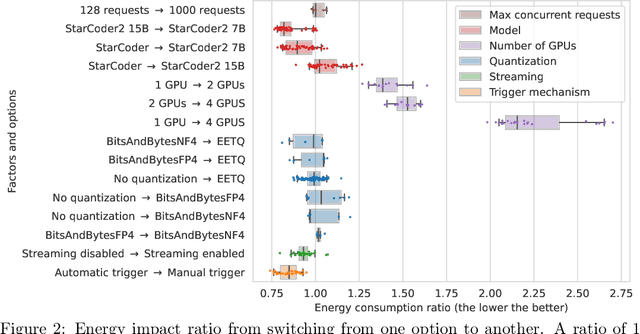
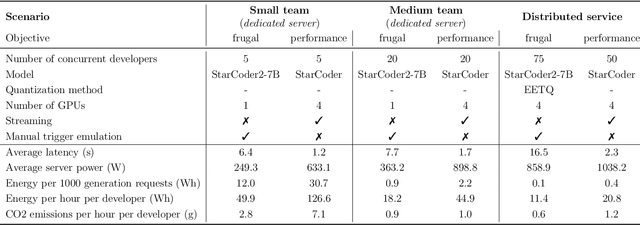
In recent years,Large Language Models (LLMs) have significantly improved in generating high-quality code, enabling their integration into developers' Integrated Development Environments (IDEs) as code assistants. These assistants, such as GitHub Copilot, deliver real-time code suggestions and can greatly enhance developers' productivity. However, the environmental impact of these tools, in particular their energy consumption, remains a key concern. This paper investigates the energy consumption of LLM-based code assistants by simulating developer interactions with GitHub Copilot and analyzing various configuration factors. We collected a dataset of development traces from 20 developers and conducted extensive software project development simulations to measure energy usage under different scenarios. Our findings reveal that the energy consumption and performance of code assistants are influenced by various factors, such as the number of concurrent developers, model size, quantization methods, and the use of streaming. Notably, a substantial portion of generation requests made by GitHub Copilot is either canceled or rejected by developers, indicating a potential area for reducing wasted computations. Based on these findings, we share actionable insights into optimizing configurations for different use cases, demonstrating that careful adjustments can lead to significant energy savings.
A Performance Study of LLM-Generated Code on Leetcode
Jul 31, 2024
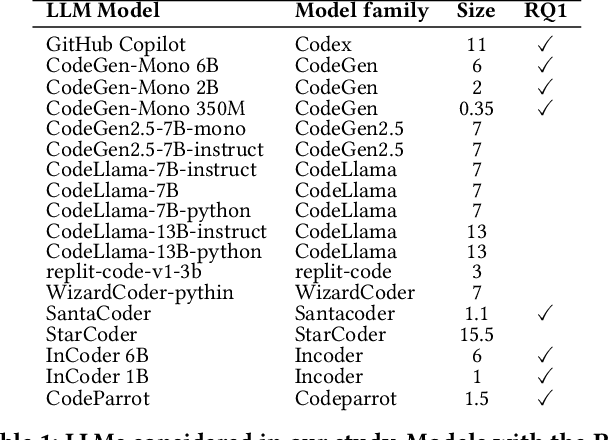
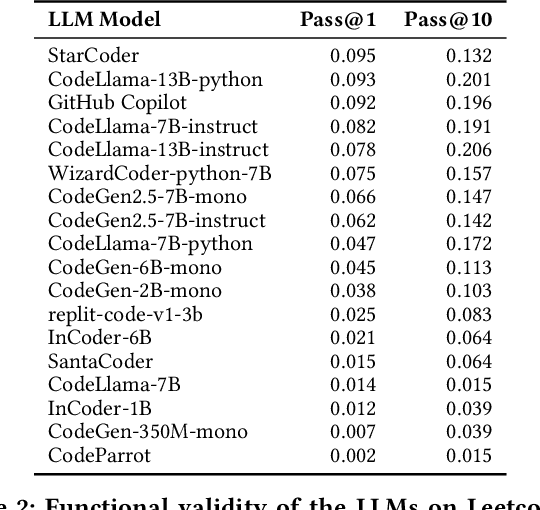

This study evaluates the efficiency of code generation by Large Language Models (LLMs) and measures their performance against human-crafted solutions using a dataset from Leetcode. We compare 18 LLMs, considering factors such as model temperature and success rate, and their impact on code performance. This research introduces a novel method for measuring and comparing the speed of LLM-generated code, revealing that LLMs produce code with comparable performance, irrespective of the adopted LLM. We also find that LLMs are capable of generating code that is, on average, more efficient than the code written by humans. The paper further discusses the use of Leetcode as a benchmarking dataset, the limitations imposed by potential data contamination, and the platform's measurement reliability. We believe that our findings contribute to a better understanding of LLM capabilities in code generation and set the stage for future optimizations in the field.