 Add to Chrome
 Add to Firefox
 Add to Edge
FASE : A Fairness-Aware Spatiotemporal Event Graph Framework for Predictive Policing
Apr 22, 2026
Predictive policing systems that allocate patrol resources based solely on predicted crime risk can unintentionally amplify racial disparities through feedback driven data bias. We present FASE, a Fairness Aware Spatiotemporal Event Graph framework, which integrates spatiotemporal crime prediction with fairness constrained patrol allocation and a closed loop deployment feedback simulator. We model Baltimore as a graph of 25 ZIP Code Tabulation Areas and use 139,982 Part 1 crime incidents from 2017 to 2019 at hourly resolution, producing a sparse feature tensor. The prediction module combines a spatiotemporal graph neural network with a multivariate Hawkes process to capture spatial dependencies and self exciting temporal dynamics. Outputs are modeled using a Zero Inflated Negative Binomial distribution, suitable for overdispersed and zero heavy crime counts. The model achieves a validation loss of 0.4800 and a test loss of 0.4857. Patrol allocation is formulated as a fairness constrained linear optimization problem that maximizes risk weighted coverage while enforcing a Demographic Impact Ratio constraint with deviation bounded by 0.05. Across six simulated deployment cycles, fairness remains within 0.9928 to 1.0262, and coverage ranges from 0.876 to 0.936. However, a persistent detection rate gap of approximately 3.5 percentage points remains between minority and non minority areas. This result shows that allocation level fairness constraints alone do not eliminate feedback induced bias in retraining data, highlighting the need for fairness interventions across the full pipeline.

Deep Spatiotemporal Clustering: A Temporal Clustering Approach for Multi-dimensional Climate Data
Apr 27, 2023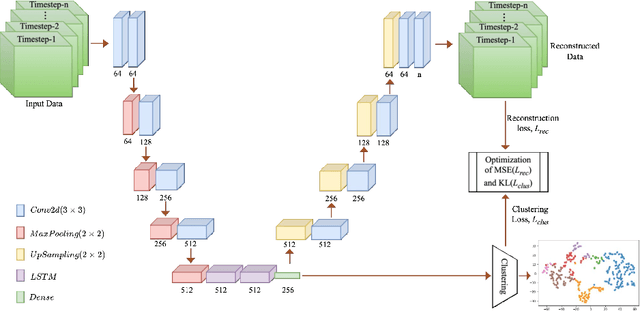
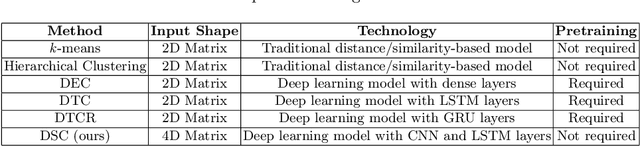
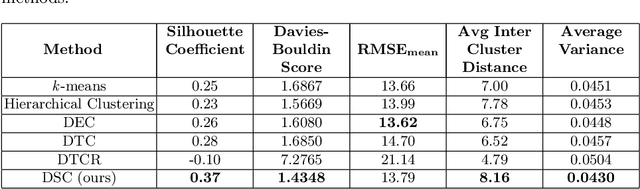
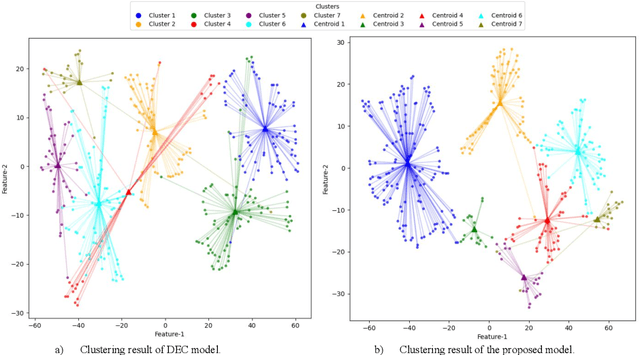
Clustering high-dimensional spatiotemporal data using an unsupervised approach is a challenging problem for many data-driven applications. Existing state-of-the-art methods for unsupervised clustering use different similarity and distance functions but focus on either spatial or temporal features of the data. Concentrating on joint deep representation learning of spatial and temporal features, we propose Deep Spatiotemporal Clustering (DSC), a novel algorithm for the temporal clustering of high-dimensional spatiotemporal data using an unsupervised deep learning method. Inspired by the U-net architecture, DSC utilizes an autoencoder integrating CNN-RNN layers to learn latent representations of the spatiotemporal data. DSC also includes a unique layer for cluster assignment on latent representations that uses the Student's t-distribution. By optimizing the clustering loss and data reconstruction loss simultaneously, the algorithm gradually improves clustering assignments and the nonlinear mapping between low-dimensional latent feature space and high-dimensional original data space. A multivariate spatiotemporal climate dataset is used to evaluate the efficacy of the proposed method. Our extensive experiments show our approach outperforms both conventional and deep learning-based unsupervised clustering algorithms. Additionally, we compared the proposed model with its various variants (CNN encoder, CNN autoencoder, CNN-RNN encoder, CNN-RNN autoencoder, etc.) to get insight into using both the CNN and RNN layers in the autoencoder, and our proposed technique outperforms these variants in terms of clustering results.