 Add to Chrome
 Add to Firefox
 Add to Edge
Model-agnostic Retrieval-Augmented Extended Forecasting for time series
Aug 14, 2026
Time series forecasting with pretrained foundation models has demonstrated strong zero-shot capabilities. However, achieving optimal performance on time series with short or negligible historical data in domain-specific applications typically requires adaptation via either fine-tuning or RAG. While fine-tuning is effective, it incurs substantial computational costs. This work explores RAG within univariate time series (Retrieval Augmented Generation) as a more efficient alternative, in particular RAF (Retrieval Augmented Forecasting), and introduces RAEF (Retrieval-Augmented Extended Forecasting), a model-agnostic method built upon RAF. RAEF incorporates key refinements to the retrieval and aggregation mechanisms: (1) direct retrieval in input-space rather than embedding-space, reducing inference overhead, and (2) concatenation-based aggregation that preserves temporal structure instead of averaging. Empirical evaluation across multiple benchmark datasets demonstrates that RAEF outperforms RAF in both accuracy and inference overhead. Furthermore, comprehensive comparisons with zero-shot and fine-tuned foundation models show that RAEF achieves competitive or superior performance to fine-tuning while avoiding its computational burden, establishing it as a practical and scalable approach for domain adaptation in time series forecasting.

Detecting and Mitigating Memorization in Diffusion Models through Anisotropy of the Log-Probability
Jan 28, 2026Diffusion-based image generative models produce high-fidelity images through iterative denoising but remain vulnerable to memorization, where they unintentionally reproduce exact copies or parts of training images. Recent memorization detection methods are primarily based on the norm of score difference as indicators of memorization. We prove that such norm-based metrics are mainly effective under the assumption of isotropic log-probability distributions, which generally holds at high or medium noise levels. In contrast, analyzing the anisotropic regime reveals that memorized samples exhibit strong angular alignment between the guidance vector and unconditional scores in the low-noise setting. Through these insights, we develop a memorization detection metric by integrating isotropic norm and anisotropic alignment. Our detection metric can be computed directly on pure noise inputs via two conditional and unconditional forward passes, eliminating the need for costly denoising steps. Detection experiments on Stable Diffusion v1.4 and v2 show that our metric outperforms existing denoising-free detection methods while being at least approximately 5x faster than the previous best approach. Finally, we demonstrate the effectiveness of our approach by utilizing a mitigation strategy that adapts memorized prompts based on our developed metric.
Multi-conditioned Graph Diffusion for Neural Architecture Search
Mar 09, 2024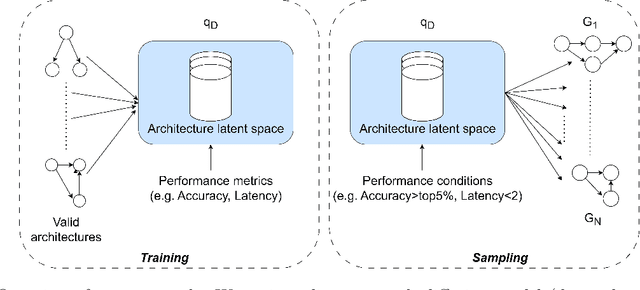
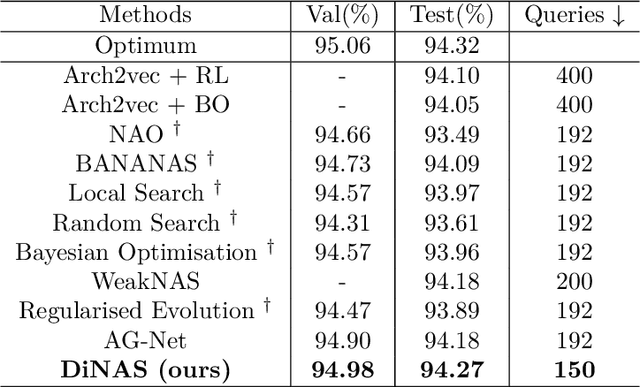
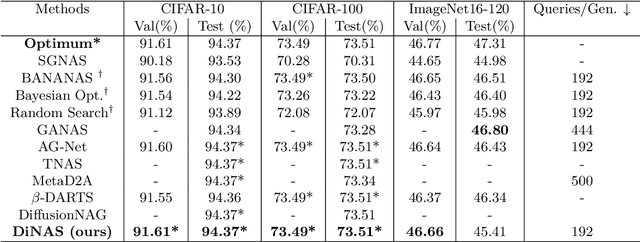
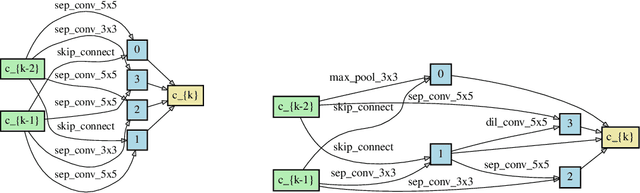
Neural architecture search automates the design of neural network architectures usually by exploring a large and thus complex architecture search space. To advance the architecture search, we present a graph diffusion-based NAS approach that uses discrete conditional graph diffusion processes to generate high-performing neural network architectures. We then propose a multi-conditioned classifier-free guidance approach applied to graph diffusion networks to jointly impose constraints such as high accuracy and low hardware latency. Unlike the related work, our method is completely differentiable and requires only a single model training. In our evaluations, we show promising results on six standard benchmarks, yielding novel and unique architectures at a fast speed, i.e. less than 0.2 seconds per architecture. Furthermore, we demonstrate the generalisability and efficiency of our method through experiments on ImageNet dataset.