 Add to Chrome
 Add to Firefox
 Add to Edge
NARRAS: Edge-Triggered Distributed Inference for CSI-Based Localization in Vehicular IoT Networks
Jun 10, 2026
CSI-based localization with spatially distributed antenna arrays exposes a basic resource trade-off. Each array can provide a rich view of the channel, but forwarding observations from all arrays to a fusion center is wasteful when only a few carry useful information, and the shared uplink supports only a limited number of simultaneous transmissions. We let each array decide locally whether its current observation is worth reporting, subject to a budget on the average number of active transmitters. We refer to this abstraction as Edge-Triggered Distributed Inference (ETDI). It captures a broader class of task-oriented communication problems where resource-constrained devices share an access channel for a common inference task. We instantiate ETDI for CSI-based localization, a common scenario in vehicular IoT networks. Spatially distributed remote antenna arrays (RAAs) encode local channel state information (CSI) from user equipment (UE) transmissions into latent features, and the fusion center estimates the UE position from the subset of reported features. We propose NARRAS, a decentralized reporting policy in which each RAA combines a recurrent summary of its recent observations with a memory of the last latent it transmitted. Training controls an explicit activity budget through differentiable activity penalties and validation-calibrated deterministic thresholds, and uses channel-chart regularization to shape the latent geometry. Experiments show that, at comparable uplink activity, NARRAS improves localization accuracy over learned and heuristic sparse-reporting strategies, while dense full-report models remain useful budget-free references. In low-activity regimes, chart regularization further reduces high-percentile localization errors, suggesting that geometry-aware latent representations are more robust under sparse reporting.

A Foundation Model for Patient Behavior Monitoring and Suicide Detection
Mar 19, 2025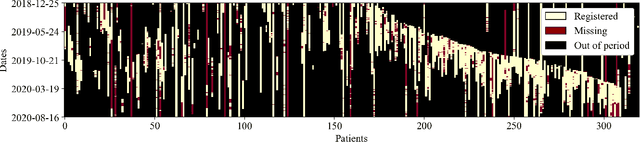
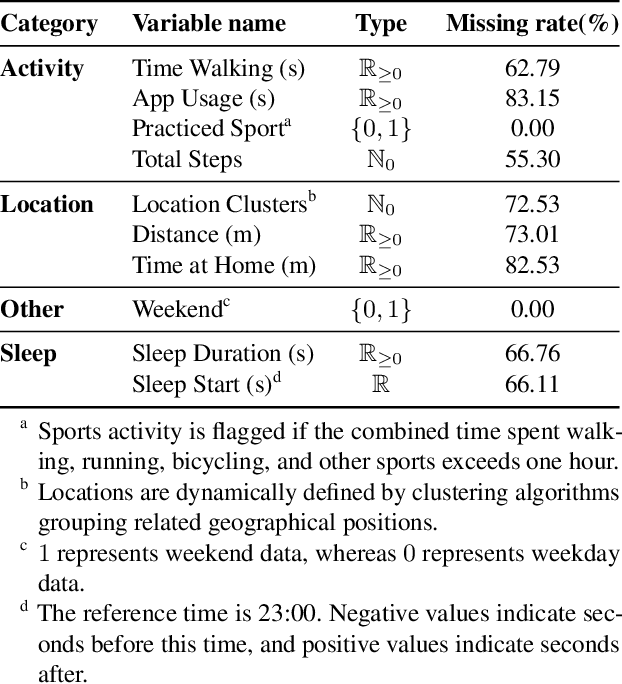

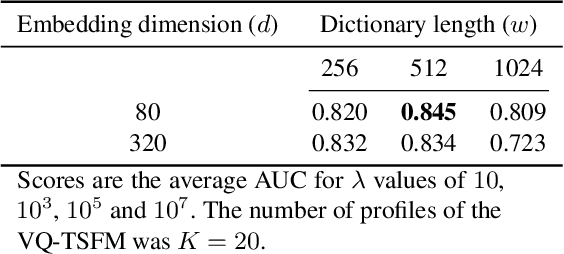
Foundation models (FMs) have achieved remarkable success across various domains, yet their adoption in healthcare remains limited. While significant advances have been made in medical imaging, genetic biomarkers, and time series from electronic health records, the potential of FMs for patient behavior monitoring through wearable devices remains underexplored. These datasets are inherently heterogeneous, multisource, and often exhibit high rates of missing data, posing unique challenges. This paper introduces a novel FM based on a modified vector quantized variational autoencoder (VQ-VAE), specifically designed to process real-world data from wearable devices. We demonstrate that our pretrained FM, trained on a broad cohort of psychiatric patients, performs downstream tasks via its latent representation without fine-tuning on a held-out cohort of suicidal patients. To illustrate this, we develop a probabilistic change-point detection algorithm for suicide detection and demonstrate the FM's effectiveness in predicting emotional states. Our results show that the discrete latent structure of the VQ-VAE outperforms a state-of-the-art Informer architecture in unsupervised suicide detection, while matching its performance in supervised emotion prediction when the latent dimensionality is increased, though at the cost of reduced unsupervised accuracy. This trade-off highlights the need for future FMs to integrate hybrid discrete-continuous structures for balanced performance across tasks.