 Add to Chrome
 Add to Firefox
 Add to Edge
A Deep Learning Iterative Framework for Sentinel-1 Stripmap Enhancement Based on Azimuth Doppler Decomposition
May 27, 2026
Synthetic Aperture Radar (SAR) imagery enables all-weather, day-and-night Earth observation; however, it remains difficult to interpret due to speckle noise and other intrinsic imaging artifacts. Sentinel-1 (S1) constitutes one of the most widely used spaceborne SAR missions, offering systematic global coverage, high temporal resolution, dual-polarization imaging, and free data availability. Among S1 modes, Stripmap (SM) provides the highest resolution, yet speckle noise and spatial constraints often hinder applications requiring finer spatial detail. This motivates the need for effective image enhancement strategies. In this work, we propose a self-supervised enhancement framework for S1 SM imagery based on azimuth subaperture decomposition. The method exploits the physical consistency between subaperture reconstructions and the corresponding full-aperture image to generate paired training data without external sensors, simulated ground truth, or multi-temporal stacks. The proposed framework integrates single- and multi-frame learning and incorporates an iterative inference scheme that progressively refines image quality. Experiments on real S1 SM data show that the proposed approach consistently outperforms the widely adopted self-supervised deep learning baseline MERLIN, in terms of PSNR and SSIM, while MERLIN attains higher ENL, highlighting a trade-off between structural fidelity and speckle smoothing. Overall, the results demonstrate that subaperture-based supervision provides a physically grounded, reproducible, and operationally viable approach for SAR image enhancement using S1 data. It is worth noting that the proposed approach can be extended to other SAR platforms, polarizations, and acquisition modes.

Learning to Focus Synthetic Aperture Radar On-line with State-Space Models
May 11, 2026Conventional focusing methods for Synthetic Aperture Radar (SAR) employ block processing efficiently but remain latency-heavy processes that prevent the realisation of a closed-loop cognitive SAR vision system. We present the first Online SAR Processor (OSP), an online image-formation framework that treats SAR sensing as a stream and produces focused SAR image output line by line during acquisition. OSP uses a tiny state-space surrogate model trained with teacher-student distillation and multi-stage losses. We evaluate the method on 300GB of SAR data from Maya4, a Sentinel-1-derived dataset containing raw, range-compressed, range-cell-migration-corrected, and azimuth-compressed products. Relative to a linewise digital-signal-processing baseline, OSP delivers approximately 70$\times$ lower latency and 130$\times$ lower memory use; on a single AMD CPU core it processes one row in 16 ms with a memory footprint of 6 MB whilst maintaining a focusing quality high enough to support downstream decisions, which we illustrate with vessel detection and flood-mapping tasks.
Deployment-Aligned Low-Precision Neural Architecture Search for Spaceborne Edge AI
Apr 27, 2026Designing deep networks that meet strict latency and accuracy constraints on edge accelerators increasingly relies on hardware-aware optimization, including neural architecture search (NAS) guided by device-level metrics. Yet most hardware-aware NAS pipelines still optimize architectures under full-precision assumptions and apply low-precision adaptation only after the search, leading to a mismatch between optimization-time behavior and deployment-time execution on low-precision hardware that can substantially degrade accuracy. We address this limitation by integrating deployment-aligned low-precision training directly into hardware-aware NAS. Candidate architectures are exposed to FP16 numerical constraints during fine-tuning and evaluation, enabling joint optimization of architectural efficiency and numerical robustness without modifying the search space or evolutionary strategy. We evaluate the proposed framework on vessel segmentation for spaceborne maritime monitoring, targeting the Intel Movidius Myriad X Visual Processing Unit (VPU). While post-training precision conversion reduces on-device performance from 0.85 to 0.78 mIoU, deployment-aligned low-precision training achieves 0.826 mIoU on-device for the same architecture (95,791 parameters), recovering approximately two-thirds of deployment-induced accuracy gap without increasing model complexity. These results demonstrate that incorporating deployment-consistent numerical constraints into hardware-aware NAS substantially improves robustness and alignment between optimization and deployment for resource-constrained edge Artificial Intelligence (AI).
Supervised and self-supervised land-cover segmentation & classification of the Biesbosch wetlands
May 27, 2025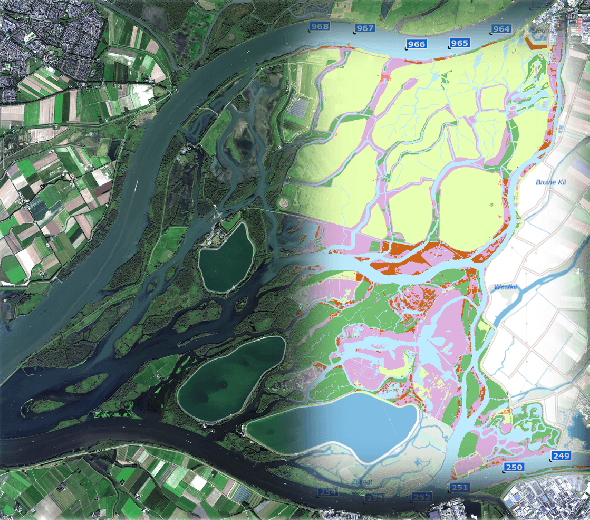

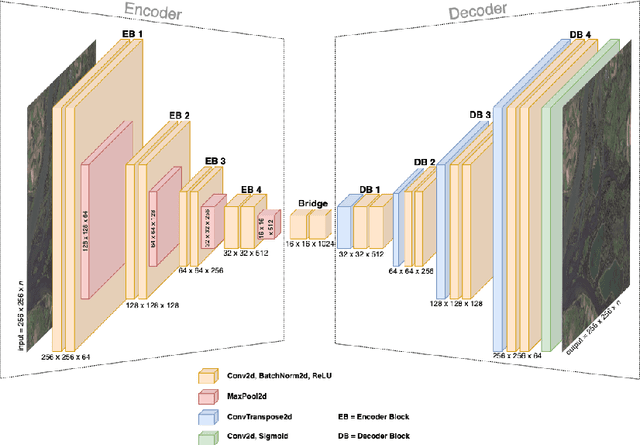

Accurate wetland land-cover classification is essential for environmental monitoring, biodiversity assessment, and sustainable ecosystem management. However, the scarcity of annotated data, especially for high-resolution satellite imagery, poses a significant challenge for supervised learning approaches. To tackle this issue, this study presents a methodology for wetland land-cover segmentation and classification that adopts both supervised and self-supervised learning (SSL). We train a U-Net model from scratch on Sentinel-2 imagery across six wetland regions in the Netherlands, achieving a baseline model accuracy of 85.26%. Addressing the limited availability of labeled data, the results show that SSL pretraining with an autoencoder can improve accuracy, especially for the high-resolution imagery where it is more difficult to obtain labeled data, reaching an accuracy of 88.23%. Furthermore, we introduce a framework to scale manually annotated high-resolution labels to medium-resolution inputs. While the quantitative performance between resolutions is comparable, high-resolution imagery provides significantly sharper segmentation boundaries and finer spatial detail. As part of this work, we also contribute a curated Sentinel-2 dataset with Dynamic World labels, tailored for wetland classification tasks and made publicly available.
Enhancing Maritime Situational Awareness through End-to-End Onboard Raw Data Analysis
Nov 05, 2024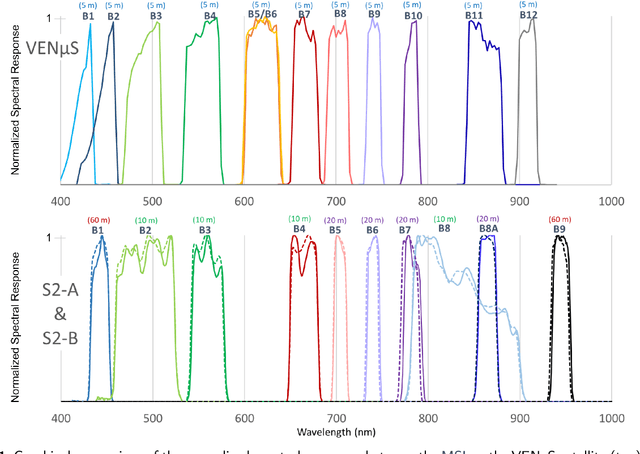
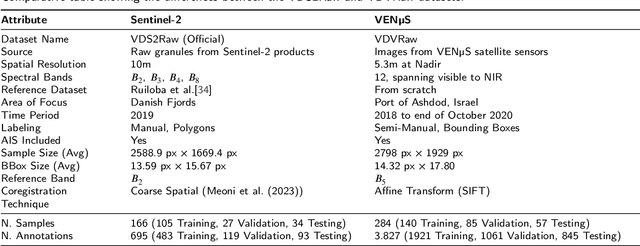
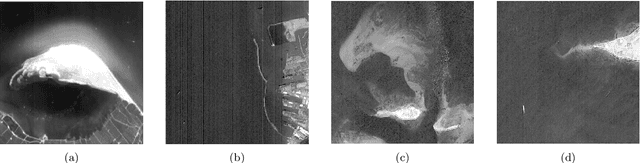

Satellite-based onboard data processing is crucial for time-sensitive applications requiring timely and efficient rapid response. Advances in edge artificial intelligence are shifting computational power from ground-based centers to on-orbit platforms, transforming the "sensing-communication-decision-feedback" cycle and reducing latency from acquisition to delivery. The current research presents a framework addressing the strict bandwidth, energy, and latency constraints of small satellites, focusing on maritime monitoring. The study contributes three main innovations. Firstly, it investigates the application of deep learning techniques for direct ship detection and classification from raw satellite imagery. By simplifying the onboard processing chain, our approach facilitates direct analyses without requiring computationally intensive steps such as calibration and ortho-rectification. Secondly, to address the scarcity of raw satellite data, we introduce two novel datasets, VDS2Raw and VDV2Raw, which are derived from raw data from Sentinel-2 and Vegetation and Environment Monitoring New Micro Satellite (VENuS) missions, respectively, and enriched with Automatic Identification System (AIS) records. Thirdly, we characterize the tasks' optimal single and multiple spectral band combinations through statistical and feature-based analyses validated on both datasets. In sum, we demonstrate the feasibility of the proposed method through a proof-of-concept on CubeSat-like hardware, confirming the models' potential for operational satellite-based maritime monitoring.
THRawS: A Novel Dataset for Thermal Hotspots Detection in Raw Sentinel-2 Data
May 12, 2023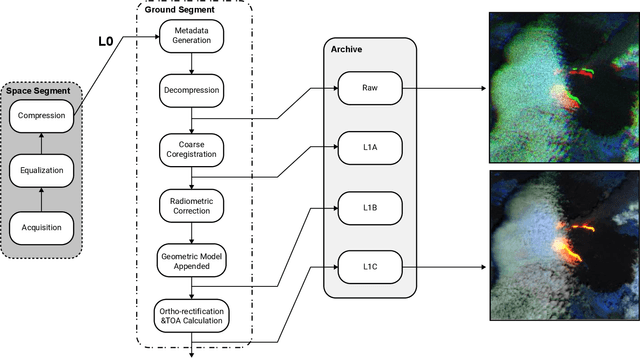
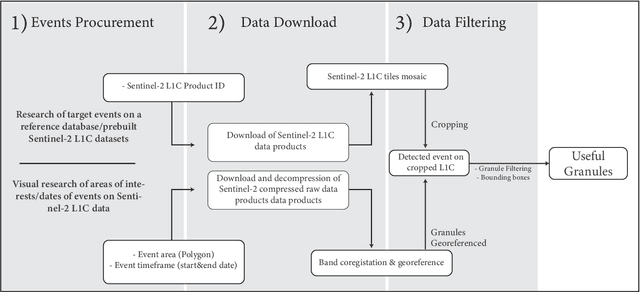
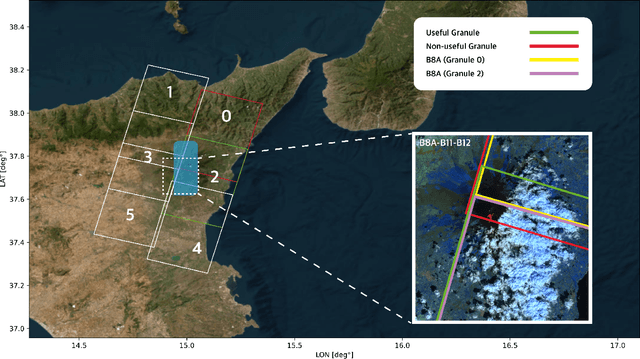
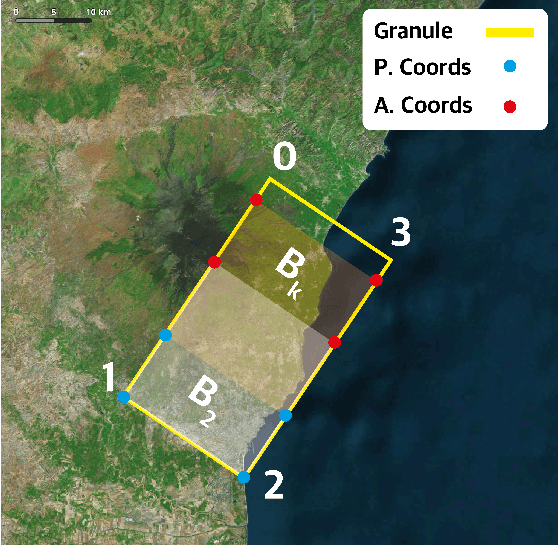
Nowadays, most of the datasets leveraging space-borne Earth Observation (EO) data are based on high-end levels products, which are ortho-rectified, coregistered, calibrated, and further processed to mitigate the impact of noise and distortions. Nevertheless, given the growing interest to apply Artificial Intelligence (AI) onboard satellites for time-critical applications, such as natural disaster response, providing raw satellite images could be useful to foster the research on energy-efficient pre-processing algorithms and AI models for onboard-satellite applications. In this framework, we present THRawS, the first dataset composed of Sentinel-2 (S-2) raw data containing warm temperature hotspots (wildfires and volcanic eruptions). To foster the realisation of robust AI architectures, the dataset gathers data from all over the globe. Furthermore, we designed a custom methodology to identify events in raw data starting from the corresponding Level-1C (L1C) products. Indeed, given the availability of state-of-the-art algorithms for thermal anomalies detection on the L1C tiles, we detect such events on these latter and we then re-project them on the corresponding raw images. Additionally, to deal with unprocessed data, we devise a lightweight coarse coregisteration and georeferencing strategy. The developed dataset is comprehensive of more than 100 samples containing wildfires, volcanic eruptions, and event-free volcanic areas to enable both warm-events detection and general classification applications. Finally, we compare performances between the proposed coarse spatial coregistration technique and the SuperGlue Deep Neural Network method to highlight the different constraints in terms of timing and quality of spatial registration to minimise the spatial displacement error for a specific scene.