 Add to Chrome
 Add to Firefox
 Add to Edge
COP-GEN: Latent Diffusion Transformer for Copernicus Earth Observation Data -- Generation Stochastic by Design
Mar 03, 2026
Earth observation applications increasingly rely on data from multiple sensors, including optical, radar, elevation, and land-cover products. Relationships between these modalities are fundamental for data integration but are inherently non-injective: identical conditioning information can correspond to multiple physically plausible observations. Thus, such conditional mappings should be parametrised as data distributions. As a result, deterministic models tend to collapse toward conditional means and fail to represent the uncertainty and variability required for tasks such as data completion and cross-sensor translation. We introduce COP-GEN, a multimodal latent diffusion transformer that models the joint distribution of heterogeneous Earth Observation modalities at their native spatial resolutions. By parameterising cross-modal mappings as conditional distributions, COP-GEN enables flexible any-to-any conditional generation, including zero-shot modality translation, spectral band infilling, and generation under partial or missing inputs, without task-specific retraining. Experiments on a large-scale global multimodal dataset show that COP-GEN generates diverse yet physically consistent realisations while maintaining strong peak fidelity across optical, radar, and elevation modalities. Qualitative and quantitative analyses demonstrate that the model captures meaningful cross-modal structure and systematically adapts its output uncertainty as conditioning information increases. These results highlight the practical importance of stochastic generative modeling for Earth observation and motivate evaluation protocols that move beyond single-reference, pointwise metrics. Website: https:// miquel-espinosa.github.io/cop-gen

Supervised and self-supervised land-cover segmentation & classification of the Biesbosch wetlands
May 27, 2025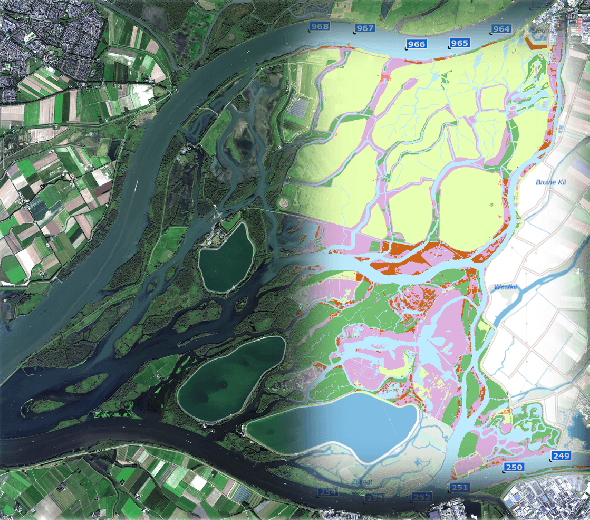

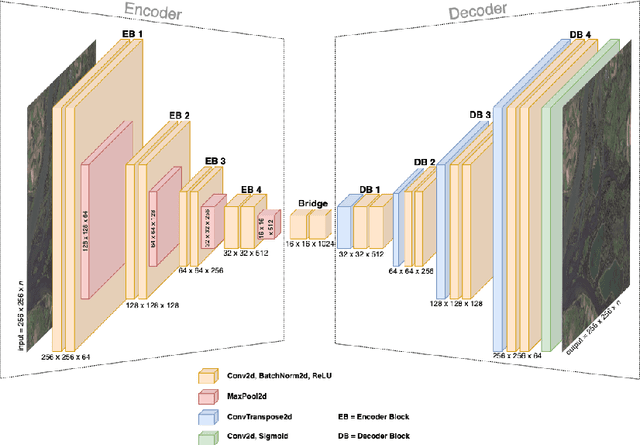

Accurate wetland land-cover classification is essential for environmental monitoring, biodiversity assessment, and sustainable ecosystem management. However, the scarcity of annotated data, especially for high-resolution satellite imagery, poses a significant challenge for supervised learning approaches. To tackle this issue, this study presents a methodology for wetland land-cover segmentation and classification that adopts both supervised and self-supervised learning (SSL). We train a U-Net model from scratch on Sentinel-2 imagery across six wetland regions in the Netherlands, achieving a baseline model accuracy of 85.26%. Addressing the limited availability of labeled data, the results show that SSL pretraining with an autoencoder can improve accuracy, especially for the high-resolution imagery where it is more difficult to obtain labeled data, reaching an accuracy of 88.23%. Furthermore, we introduce a framework to scale manually annotated high-resolution labels to medium-resolution inputs. While the quantitative performance between resolutions is comparable, high-resolution imagery provides significantly sharper segmentation boundaries and finer spatial detail. As part of this work, we also contribute a curated Sentinel-2 dataset with Dynamic World labels, tailored for wetland classification tasks and made publicly available.