 Add to Chrome
 Add to Firefox
 Add to Edge
QSTRBench: a New Benchmark to Evaluate the Ability of Language Models to Reason with Qualitative Spatial and Temporal Calculi
May 18, 2026
We introduce an extensive qualitative spatial and temporal reasoning (QSTR) benchmark for evaluating large language models (LLMs). We pose questions concerning compositional reasoning (using composition tables, CT), converse relations, and conceptual neighbourhoods (CN) for QSTR calculi, Point Algebra (PA), Allen's Interval Algebra, Interval and Duration (INDU), Region Connection Calculus (RCC-5, RCC-8, and RCC-22), the nine intersection model, cardinal direction calculus, and STAR. The RCC-22 CN is published here for the first time. An extended benchmark systematically varies question presentation including prefix/infix, words/symbols/nonce terms and schematic descriptions for selected calculi. We report results for contemporary frontier models. All models tested perform better than guessing but none can consistently answer all questions correctly. Performance varies sharply by calculus, with PA being the most straightforward, and RCC-22 the most difficult. We release the benchmark, and our results under an open licence to facilitate further assessment of qualitative spatio/temporal reasoning in LLMs.

Towards Reproducible LLM Evaluation: Quantifying Uncertainty in LLM Benchmark Scores
Oct 04, 2024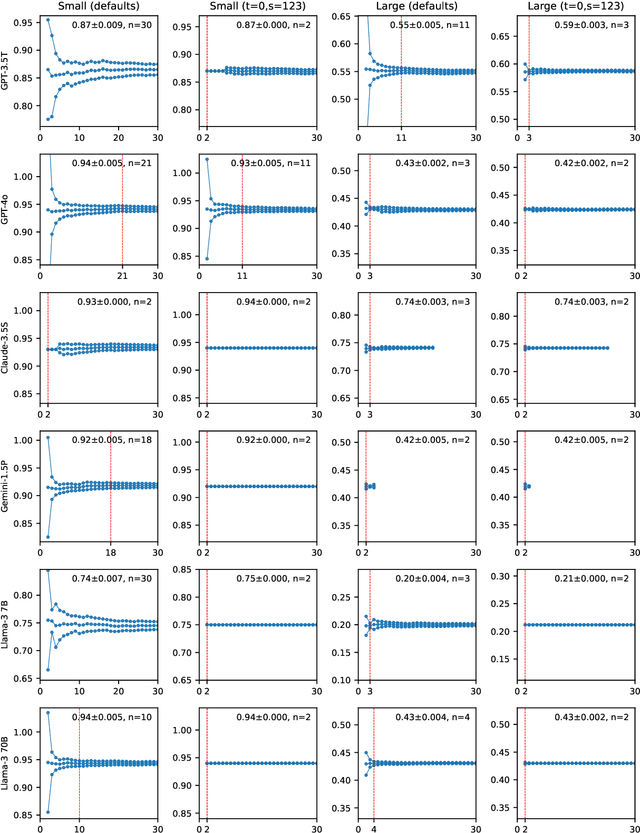
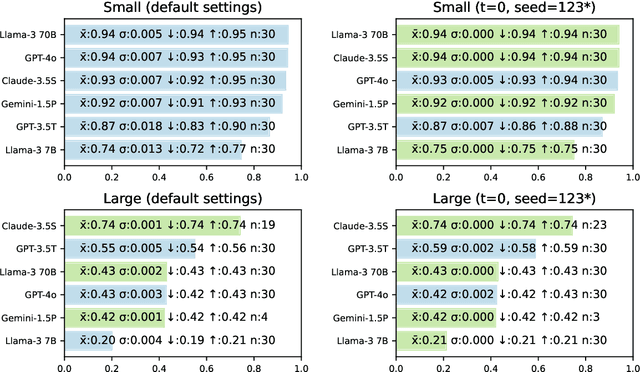
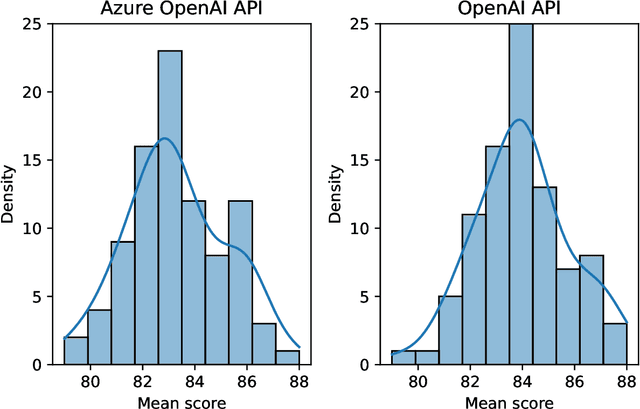
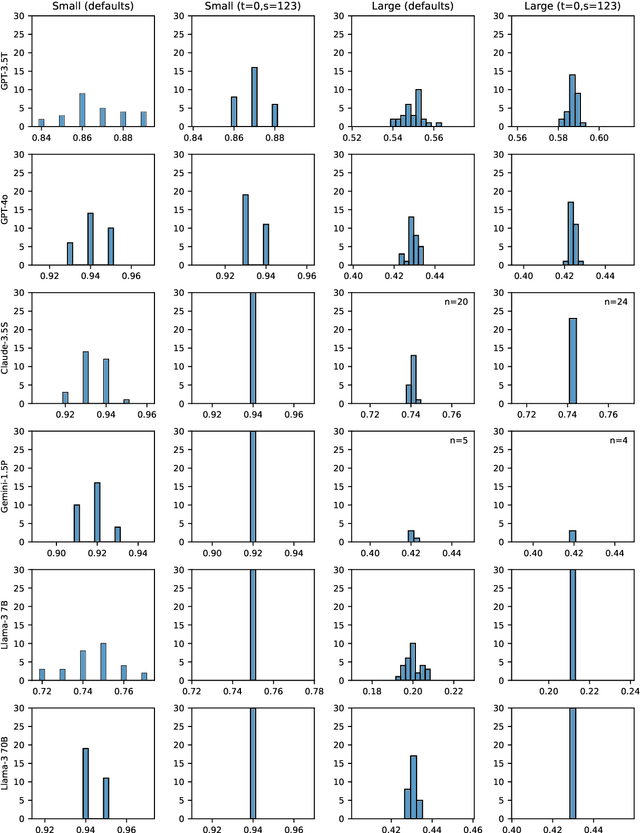
Large language models (LLMs) are stochastic, and not all models give deterministic answers, even when setting temperature to zero with a fixed random seed. However, few benchmark studies attempt to quantify uncertainty, partly due to the time and cost of repeated experiments. We use benchmarks designed for testing LLMs' capacity to reason about cardinal directions to explore the impact of experimental repeats on mean score and prediction interval. We suggest a simple method for cost-effectively quantifying the uncertainty of a benchmark score and make recommendations concerning reproducible LLM evaluation.