 Add to Chrome
 Add to Firefox
 Add to Edge
ForecastOcc: Vision-based Semantic Occupancy Forecasting
Feb 08, 2026
Autonomous driving requires forecasting both geometry and semantics over time to effectively reason about future environment states. Existing vision-based occupancy forecasting methods focus on motion-related categories such as static and dynamic objects, while semantic information remains largely absent. Recent semantic occupancy forecasting approaches address this gap but rely on past occupancy predictions obtained from separate networks. This makes current methods sensitive to error accumulation and prevents learning spatio-temporal features directly from images. In this work, we present ForecastOcc, the first framework for vision-based semantic occupancy forecasting that jointly predicts future occupancy states and semantic categories. Our framework yields semantic occupancy forecasts for multiple horizons directly from past camera images, without relying on externally estimated maps. We evaluate ForecastOcc in two complementary settings: multi-view forecasting on the Occ3D-nuScenes dataset and monocular forecasting on SemanticKITTI, where we establish the first benchmark for this task. We introduce the first baselines by adapting two 2D forecasting modules within our framework. Importantly, we propose a novel architecture that incorporates a temporal cross-attention forecasting module, a 2D-to-3D view transformer, a 3D encoder for occupancy prediction, and a semantic occupancy head for voxel-level forecasts across multiple horizons. Extensive experiments on both datasets show that ForecastOcc consistently outperforms baselines, yielding semantically rich, future-aware predictions that capture scene dynamics and semantics critical for autonomous driving.

Panoptic-Depth Forecasting
Sep 18, 2024
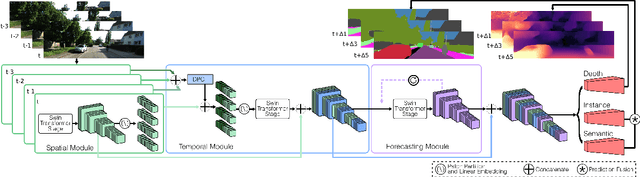

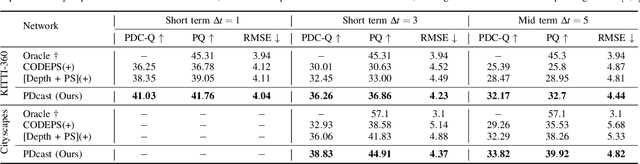
Forecasting the semantics and 3D structure of scenes is essential for robots to navigate and plan actions safely. Recent methods have explored semantic and panoptic scene forecasting; however, they do not consider the geometry of the scene. In this work, we propose the panoptic-depth forecasting task for jointly predicting the panoptic segmentation and depth maps of unobserved future frames, from monocular camera images. To facilitate this work, we extend the popular KITTI-360 and Cityscapes benchmarks by computing depth maps from LiDAR point clouds and leveraging sequential labeled data. We also introduce a suitable evaluation metric that quantifies both the panoptic quality and depth estimation accuracy of forecasts in a coherent manner. Furthermore, we present two baselines and propose the novel PDcast architecture that learns rich spatio-temporal representations by incorporating a transformer-based encoder, a forecasting module, and task-specific decoders to predict future panoptic-depth outputs. Extensive evaluations demonstrate the effectiveness of PDcast across two datasets and three forecasting tasks, consistently addressing the primary challenges. We make the code publicly available at https://pdcast.cs.uni-freiburg.de.