 Add to Chrome
 Add to Firefox
 Add to Edge
Optimizing Chlorination in Water Distribution Systems via Surrogate-assisted Neuroevolution
Feb 07, 2026
Ensuring the microbiological safety of large, heterogeneous water distribution systems (WDS) typically requires managing appropriate levels of disinfectant residuals including chlorine. WDS include complex fluid interactions that are nonlinear and noisy, making such maintenance a challenging problem for traditional control algorithms. This paper proposes an evolutionary framework to this problem based on neuroevolution, multi-objective optimization, and surrogate modeling. Neural networks were evolved with NEAT to inject chlorine at strategic locations in the distribution network at select times. NSGA-II was employed to optimize four objectives: minimizing the total amount of chlorine injected, keeping chlorine concentrations homogeneous across the network, ensuring that maximum concentrations did not exceed safe bounds, and distributing the injections regularly over time. Each network was evaluated against a surrogate model, i.e. a neural network trained to emulate EPANET, an industry-level hydraulic WDS simulator that is accurate but infeasible in terms of computational cost to support machine learning. The evolved controllers produced a diverse range of Pareto-optimal policies that could be implemented in practice, outperforming standard reinforcement learning methods such as PPO. The results thus suggest a pathway toward improving urban water systems, and highlight the potential of using evolution with surrogate modeling to optimize complex real-world systems.

Leveraging Evolutionary Surrogate-Assisted Prescription in Multi-Objective Chlorination Control Systems
Aug 26, 2025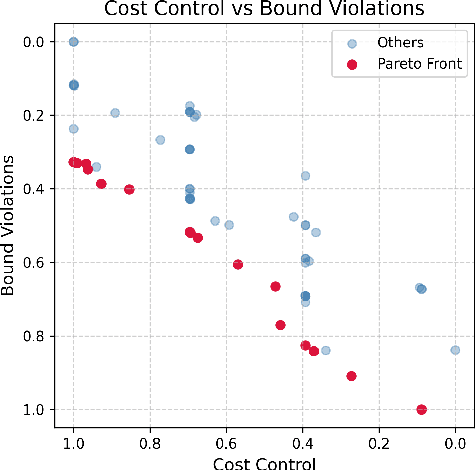
This short, written report introduces the idea of Evolutionary Surrogate-Assisted Prescription (ESP) and presents preliminary results on its potential use in training real-world agents as a part of the 1st AI for Drinking Water Chlorination Challenge at IJCAI-2025. This work was done by a team from Project Resilience, an organization interested in bridging AI to real-world problems.