 Add to Chrome
 Add to Firefox
 Add to Edge
Optimizing Chlorination in Water Distribution Systems via Surrogate-assisted Neuroevolution
Feb 07, 2026
Ensuring the microbiological safety of large, heterogeneous water distribution systems (WDS) typically requires managing appropriate levels of disinfectant residuals including chlorine. WDS include complex fluid interactions that are nonlinear and noisy, making such maintenance a challenging problem for traditional control algorithms. This paper proposes an evolutionary framework to this problem based on neuroevolution, multi-objective optimization, and surrogate modeling. Neural networks were evolved with NEAT to inject chlorine at strategic locations in the distribution network at select times. NSGA-II was employed to optimize four objectives: minimizing the total amount of chlorine injected, keeping chlorine concentrations homogeneous across the network, ensuring that maximum concentrations did not exceed safe bounds, and distributing the injections regularly over time. Each network was evaluated against a surrogate model, i.e. a neural network trained to emulate EPANET, an industry-level hydraulic WDS simulator that is accurate but infeasible in terms of computational cost to support machine learning. The evolved controllers produced a diverse range of Pareto-optimal policies that could be implemented in practice, outperforming standard reinforcement learning methods such as PPO. The results thus suggest a pathway toward improving urban water systems, and highlight the potential of using evolution with surrogate modeling to optimize complex real-world systems.

Leveraging Evolutionary Surrogate-Assisted Prescription in Multi-Objective Chlorination Control Systems
Aug 26, 2025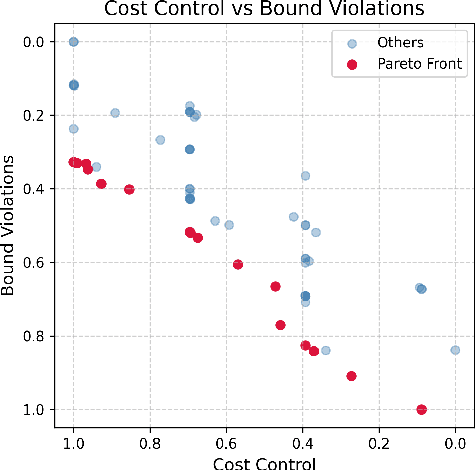
This short, written report introduces the idea of Evolutionary Surrogate-Assisted Prescription (ESP) and presents preliminary results on its potential use in training real-world agents as a part of the 1st AI for Drinking Water Chlorination Challenge at IJCAI-2025. This work was done by a team from Project Resilience, an organization interested in bridging AI to real-world problems.
Discovering Effective Policies for Land-Use Planning
Nov 21, 2023How areas of land are allocated for different uses, such as forests, urban, and agriculture, has a large effect on carbon balance, and therefore climate change. Based on available historical data on changes in land use and a simulation of carbon emissions/absorption, a surrogate model can be learned that makes it possible to evaluate the different options available to decision-makers efficiently. An evolutionary search process can then be used to discover effective land-use policies for specific locations. Such a system was built on the Project Resilience platform and evaluated with the Land-Use Harmonization dataset and the BLUE simulator. It generates Pareto fronts that trade off carbon impact and amount of change customized to different locations, thus providing a potentially useful tool for land-use planning.
Self-supervised motion descriptor for cardiac phase detection in 4D CMR based on discrete vector field estimations
Sep 18, 2022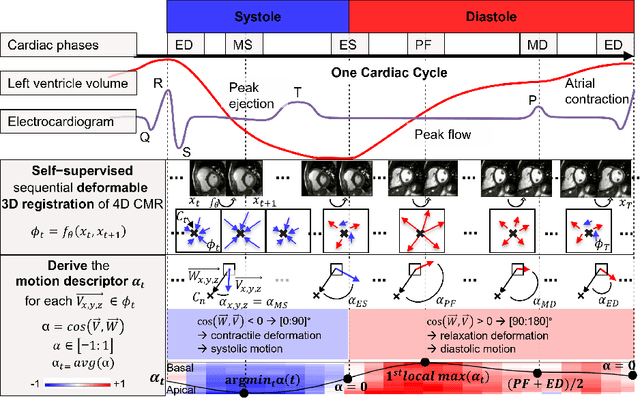
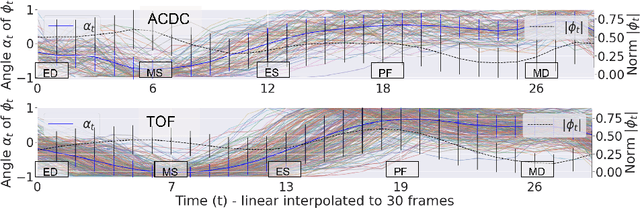

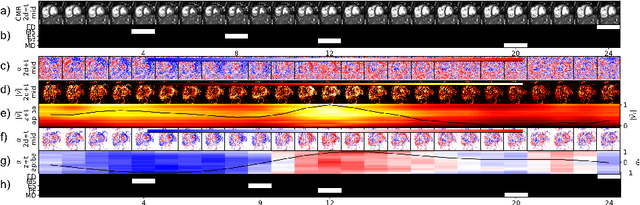
Cardiac magnetic resonance (CMR) sequences visualise the cardiac function voxel-wise over time. Simultaneously, deep learning-based deformable image registration is able to estimate discrete vector fields which warp one time step of a CMR sequence to the following in a self-supervised manner. However, despite the rich source of information included in these 3D+t vector fields, a standardised interpretation is challenging and the clinical applications remain limited so far. In this work, we show how to efficiently use a deformable vector field to describe the underlying dynamic process of a cardiac cycle in form of a derived 1D motion descriptor. Additionally, based on the expected cardiovascular physiological properties of a contracting or relaxing ventricle, we define a set of rules that enables the identification of five cardiovascular phases including the end-systole (ES) and end-diastole (ED) without the usage of labels. We evaluate the plausibility of the motion descriptor on two challenging multi-disease, -center, -scanner short-axis CMR datasets. First, by reporting quantitative measures such as the periodic frame difference for the extracted phases. Second, by comparing qualitatively the general pattern when we temporally resample and align the motion descriptors of all instances across both datasets. The average periodic frame difference for the ED, ES key phases of our approach is $0.80\pm{0.85}$, $0.69\pm{0.79}$ which is slightly better than the inter-observer variability ($1.07\pm{0.86}$, $0.91\pm{1.6}$) and the supervised baseline method ($1.18\pm{1.91}$, $1.21\pm{1.78}$). Code and labels will be made available on our GitHub repository. https://github.com/Cardio-AI/cmr-phase-detection