 Add to Chrome
 Add to Firefox
 Add to Edge
On the Expressive Power of Transformers
Aug 13, 2026
Multi-layer transformers form the critical component of essentially all large language models (LLMs) in use today. Because of their ubiquity and computational capability, there is a rapidly growing body of work that aims to precisely calibrate the expressive power of transformers as language recognizers by comparing them against standard models of computation studied for decades by the theoretical computer science community. In this endeavor, circuit complexity has by and large emerged as the "correct" branch of computational complexity to analyze the expressive power of transformers; the reason is that parameterizing transformers by the various resources they use, such as attention and precision, leads to direct comparisons with different classes of circuits parameterized by resources such as type of gates, size, and depth. Here, we present an overview of selected results that delineate the expressive power of transformers using concepts and methods from circuit complexity.

Separating quantum circuits from classical LLMs
Aug 04, 2026Modern large language models - transformers and diffusion language models - are built around two canonical algorithmic tasks: prediction and generation. We prove unconditional separations between low-depth quantum computation and the corresponding bounded-resource classical language-model architectures in both regimes. Concretely, we exhibit the following: 1. Distributional separation. We give a distribution that is sampleable by $\textsf{QNC}^0$ circuits (i.e., a family of constant-depth quantum circuits consisting of bounded fan-in gates) that no constant-round diffusion language model ($\textsf{DLM}$) with shallow scheduling and denoising can sample within constant distance, even when allowed sublinear chain-of-thought and output-token revision/remasking events, the very features modern $\textsf{DLM}$s rely on. 2. Functional separation. We exhibit a function computable in $\land \circ \textsf{QNC}^0[\log\log n]$ (i.e., a family of O$(\log\log n)$-depth $\textsf{QNC}^0$ circuits, where $n$ is the input length, followed by a single classical $\mathsf{AND}$ gate) such that any constant-depth decoder-only transformer computing the function must be large: it would have to have width $n^{Ω(1)}$. Together, our work initiates the study of quantum advantage in the era of large language models.
Time Fairness in Online Knapsack Problems
May 22, 2023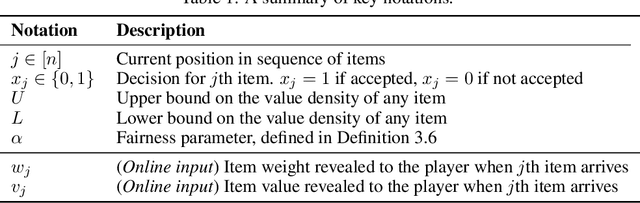
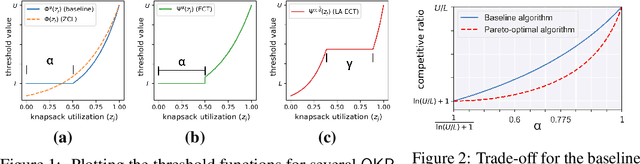

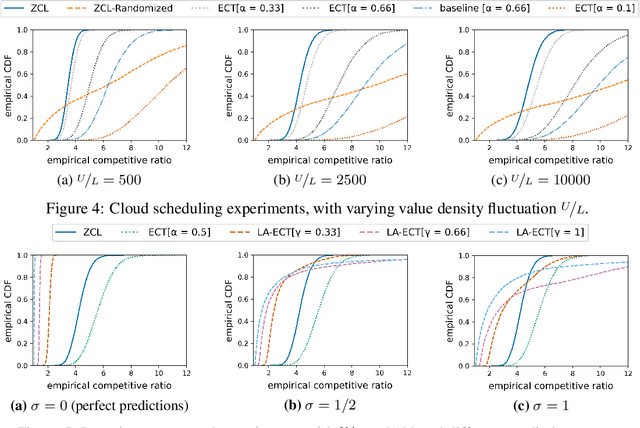
The online knapsack problem is a classic problem in the field of online algorithms. Its canonical version asks how to pack items of different values and weights arriving online into a capacity-limited knapsack so as to maximize the total value of the admitted items. Although optimal competitive algorithms are known for this problem, they may be fundamentally unfair, i.e., individual items may be treated inequitably in different ways. Inspired by recent attention to fairness in online settings, we develop a natural and practically-relevant notion of time fairness for the online knapsack problem, and show that the existing optimal algorithms perform poorly under this metric. We propose a parameterized deterministic algorithm where the parameter precisely captures the Pareto-optimal trade-off between fairness and competitiveness. We show that randomization is theoretically powerful enough to be simultaneously competitive and fair; however, it does not work well in practice, using trace-driven experiments. To further improve the trade-off between fairness and competitiveness, we develop a fair, robust (competitive), and consistent learning-augmented algorithm with substantial performance improvement in trace-driven experiments.
Graphical House Allocation
Jan 03, 2023
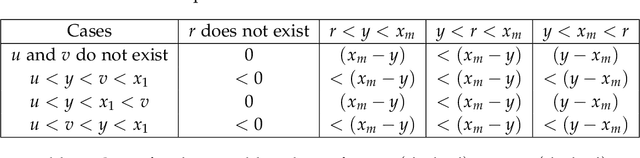


The classical house allocation problem involves assigning $n$ houses (or items) to $n$ agents according to their preferences. A key criterion in such problems is satisfying some fairness constraints such as envy-freeness. We consider a generalization of this problem wherein the agents are placed along the vertices of a graph (corresponding to a social network), and each agent can only experience envy towards its neighbors. Our goal is to minimize the aggregate envy among the agents as a natural fairness objective, i.e., the sum of all pairwise envy values over all edges in a social graph. When agents have identical and evenly-spaced valuations, our problem reduces to the well-studied problem of linear arrangements. For identical valuations with possibly uneven spacing, we show a number of deep and surprising ways in which our setting is a departure from this classical problem. More broadly, we contribute several structural and computational results for various classes of graphs, including NP-hardness results for disjoint unions of paths, cycles, stars, or cliques, and fixed-parameter tractable (and, in some cases, polynomial-time) algorithms for paths, cycles, stars, cliques, and their disjoint unions. Additionally, a conceptual contribution of our work is the formulation of a structural property for disconnected graphs that we call separability which results in efficient parameterized algorithms for finding optimal allocations.