 Add to Chrome
 Add to Firefox
 Add to Edge
Source-Free Controlled Adaptation of Teachers for Continual Test-Time Adaptation
Jul 26, 2026
In many real-world scenarios, encountering continual shifts in domain during inference is very common. Consequently, continual test-time adaptation (CTTA) techniques leveraging a teacher-student framework have gained prominence, allowing models to adapt continuously even after deployment. In such a framework, a weight-averaged mean teacher is used to produce pseudo-labels from test data for self-training. The mean teacher gets updated as an exponential moving average of the student parameters using a high value of momentum that is kept fixed even if different distributions of test data are encountered. To combat the resulting drift of the model, we propose a novel controlled teacher adaptation methodology that dynamically sets a proper momentum value depending on the quality of the incoming data. Additionally, we estimate class prototypes from the source pretrained model to help align the target data as they come in. Importantly, our method does not require access to source data or its statistics at any stage of the pipeline, making it truly source-free. We perform extensive experiments on benchmark datasets to demonstrate that our approach outperforms different state-of-the-art adaptation frameworks, many of which require access to source data.

Convolutional Prompting meets Language Models for Continual Learning
Mar 29, 2024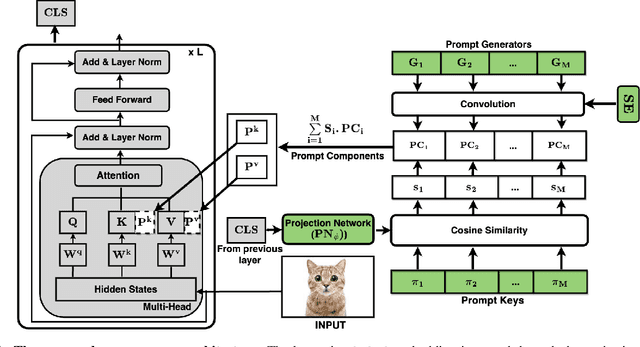

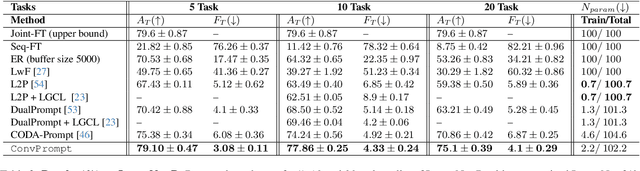

Continual Learning (CL) enables machine learning models to learn from continuously shifting new training data in absence of data from old tasks. Recently, pretrained vision transformers combined with prompt tuning have shown promise for overcoming catastrophic forgetting in CL. These approaches rely on a pool of learnable prompts which can be inefficient in sharing knowledge across tasks leading to inferior performance. In addition, the lack of fine-grained layer specific prompts does not allow these to fully express the strength of the prompts for CL. We address these limitations by proposing ConvPrompt, a novel convolutional prompt creation mechanism that maintains layer-wise shared embeddings, enabling both layer-specific learning and better concept transfer across tasks. The intelligent use of convolution enables us to maintain a low parameter overhead without compromising performance. We further leverage Large Language Models to generate fine-grained text descriptions of each category which are used to get task similarity and dynamically decide the number of prompts to be learned. Extensive experiments demonstrate the superiority of ConvPrompt and improves SOTA by ~3% with significantly less parameter overhead. We also perform strong ablation over various modules to disentangle the importance of different components.