 Add to Chrome
 Add to Firefox
 Add to Edge
Decoding Pedestrian Crossing Intention from Egocentric Vision via Vision Language Models
Jun 08, 2026
Egocentric vision offers a first-person view of human perception and decision making, yet its potential for traffic-safety prediction remains underexplored. In this work, we study the decoding of pedestrian crossing intentions from short egocentric video clips. We approach this by formulating the task as a closed-ended visual question answering (VQA) problem and leveraging vision language models (VLMs) to predict the pedestrians' intent. We first benchmark three families of state-of-the-art VLMs in a zero-shot setting, finding that they achieve moderate gains over random guessing but exhibit limited higher-level traffic reasoning. Motivated by these findings, we further adapt VLMs to the target task using parameter-efficient fine-tuning. Our results show that the fine-tuned models substantially outperform their zero-shot counterparts and achieve a 9\% accuracy improvement over a specialized transformer-based baseline. Finally, we demonstrate that incorporating additional contextual cues, including ego motion, vehicle motion, and eye gaze, further improves predictive performance. In particular, the fine-tuned Qwen3-VL-2B model guided by eye gaze and ego motion achieves a 14.5% accuracy improvement over the transformer baseline, establishing a new state of the art for egocentric pedestrian intent decoding.

Eye Gaze-Informed and Context-Aware Pedestrian Trajectory Prediction in Shared Spaces with Automated Shuttles: A Virtual Reality Study
Mar 20, 2026The integration of Automated Shuttles into shared urban spaces presents unique challenges due to the absence of traffic rules and the complex pedestrian interactions. Accurately anticipating pedestrian behavior in such unstructured environments is therefore critical for ensuring both safety and efficiency. This paper presents a Virtual Reality (VR) study that captures how pedestrians interact with automated shuttles across diverse scenarios, including varying approach angles and navigating in continuous traffic. We identify critical behavior patterns present in pedestrians' decision-making in shared spaces, including hesitation, evasive maneuvers, gaze allocation, and proxemic adjustments. To model pedestrian behavior, we propose GazeX-LSTM, a multimodal eye gaze-informed and context-aware prediction model that integrates pedestrians' trajectories, fine-grained eye gaze dynamics, and contextual factors. We shift prediction from a vehicle- to a human-centered perspective by leveraging eye-tracking data to capture pedestrian attention. We systematically validate the unique and irreplaceable predictive power of eye gaze over head orientation alone, further enhancing performance by integrating contextual variables. Notably, the combination of eye gaze data and contextual information produces super-additive improvements on pedestrian behavior prediction accuracy, revealing the complementary relationship between visual attention and situational contexts. Together, our findings provide the first evidence that eye gaze-informed modeling fundamentally advances pedestrian behavior prediction and highlight the critical role of situational contexts in shared-space interactions. This paves the way for safer and more adaptive automated vehicle technologies that account for how people perceive and act in complex shared spaces.
Fast Bayesian Estimation of Spatial Count Data Models
Jul 07, 2020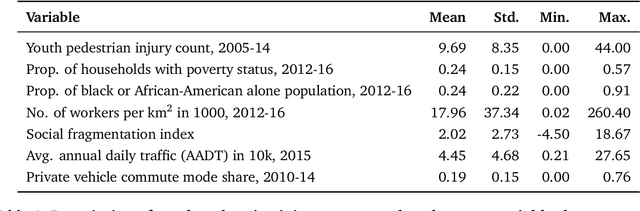
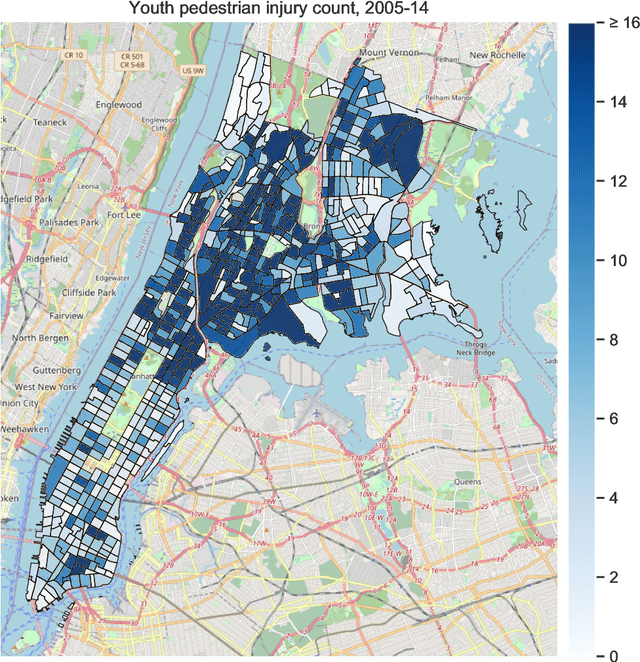
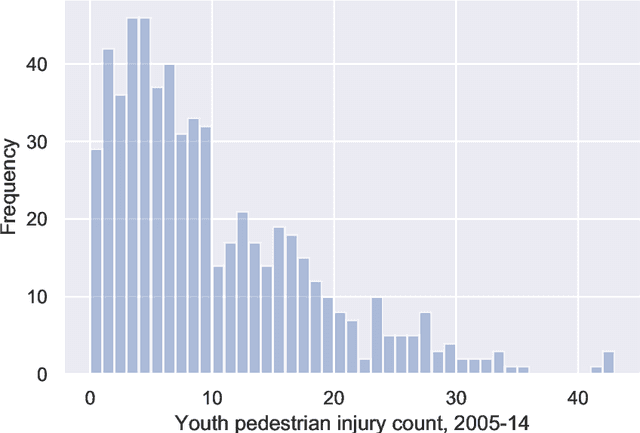

Spatial count data models are used to explain and predict the frequency of phenomena such as traffic accidents in geographically distinct entities such as census tracts or road segments. These models are typically estimated using Bayesian Markov chain Monte Carlo (MCMC) simulation methods, which, however, are computationally expensive and do not scale well to large datasets. Variational Bayes (VB), a method from machine learning, addresses the shortcomings of MCMC by casting Bayesian estimation as an optimisation problem instead of a simulation problem. In this paper, we derive a VB method for posterior inference in negative binomial models with unobserved parameter heterogeneity and spatial dependence. The proposed method uses Polya-Gamma augmentation to deal with the non-conjugacy of the negative binomial likelihood and an integrated non-factorised specification of the variational distribution to capture posterior dependencies. We demonstrate the benefits of the approach using simulated data and real data on youth pedestrian injury counts in the census tracts of New York City boroughs Bronx and Manhattan. The empirical analysis suggests that the VB approach is between 7 and 13 times faster than MCMC on a regular eight-core processor, while offering similar estimation and predictive accuracy. Conditional on the availability of computational resources, the embarrassingly parallel architecture of the proposed VB method can be exploited to further accelerate the estimation by up to 100 times.
Pólygamma Data Augmentation to address Non-conjugacy in the Bayesian Estimation of Mixed Multinomial Logit Models
Apr 13, 2019The standard Gibbs sampler of Mixed Multinomial Logit (MMNL) models involves sampling from conditional densities of utility parameters using Metropolis-Hastings (MH) algorithm due to unavailability of conjugate prior for logit kernel. To address this non-conjugacy concern, we propose the application of P\'olygamma data augmentation (PG-DA) technique for the MMNL estimation. The posterior estimates of the augmented and the default Gibbs sampler are similar for two-alternative scenario (binary choice), but we encounter empirical identification issues in the case of more alternatives ($J \geq 3$).
Bayesian Estimation of Mixed Multinomial Logit Models: Advances and Simulation-Based Evaluations
Apr 12, 2019


Variational Bayes (VB) methods have emerged as a fast and computationally-efficient alternative to Markov chain Monte Carlo (MCMC) methods for Bayesian estimation of mixed multinomial logit (MMNL) models. It has been established that VB is substantially faster than MCMC at practically no compromises in predictive accuracy. In this paper, we address two critical gaps concerning the usage and understanding of VB for MMNL. First, extant VB methods are limited to utility specifications involving only individual-specific taste parameters. Second, the finite-sample properties of VB estimators and the relative performance of VB, MCMC and maximum simulated likelihood estimation (MSLE) are not known. To address the former, this study extends several VB methods for MMNL to admit utility specifications including both fixed and random utility parameters. To address the latter, we conduct an extensive simulation-based evaluation to benchmark the extended VB methods against MCMC and MSLE in terms of estimation times, parameter recovery and predictive accuracy. The results suggest that all VB variants perform as well as MCMC and MSLE at prediction and recovery of all model parameters with the exception of the covariance matrix of the multivariate normal mixing distribution. In particular, VB with nonconjugate variational message passing and the delta-method (VB-NCVMP-Delta) is relatively accurate and up to 15 times faster than MCMC and MSLE. On the whole, VB-NCVMP-Delta is most suitable for applications in which fast predictions are paramount, while MCMC should be preferred in applications in which accurate inferences are most important.
A Dirichlet Process Mixture Model of Discrete Choice
Jan 19, 2018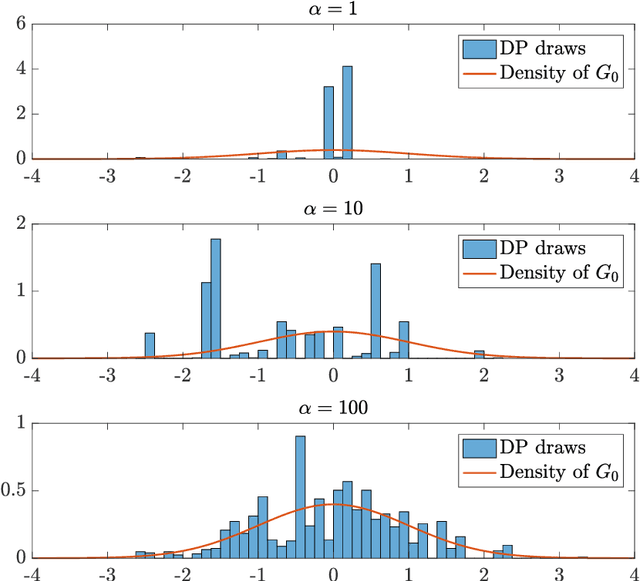
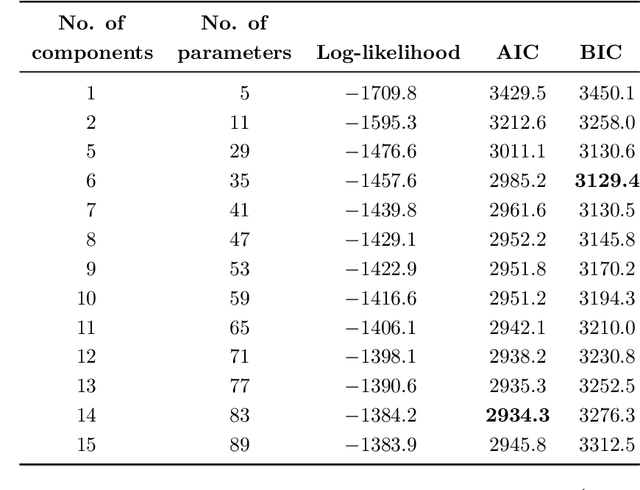

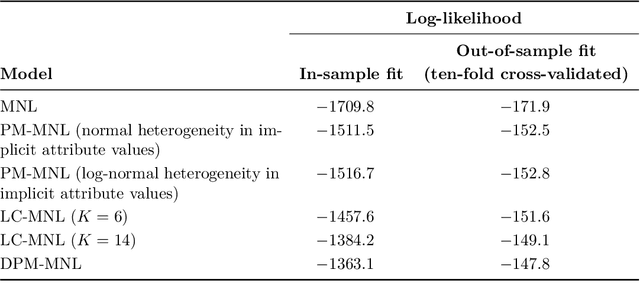
We present a mixed multinomial logit (MNL) model, which leverages the truncated stick-breaking process representation of the Dirichlet process as a flexible nonparametric mixing distribution. The proposed model is a Dirichlet process mixture model and accommodates discrete representations of heterogeneity, like a latent class MNL model. Yet, unlike a latent class MNL model, the proposed discrete choice model does not require the analyst to fix the number of mixture components prior to estimation, as the complexity of the discrete mixing distribution is inferred from the evidence. For posterior inference in the proposed Dirichlet process mixture model of discrete choice, we derive an expectation maximisation algorithm. In a simulation study, we demonstrate that the proposed model framework can flexibly capture differently-shaped taste parameter distributions. Furthermore, we empirically validate the model framework in a case study on motorists' route choice preferences and find that the proposed Dirichlet process mixture model of discrete choice outperforms a latent class MNL model and mixed MNL models with common parametric mixing distributions in terms of both in-sample fit and out-of-sample predictive ability. Compared to extant modelling approaches, the proposed discrete choice model substantially abbreviates specification searches, as it relies on less restrictive parametric assumptions and does not require the analyst to specify the complexity of the discrete mixing distribution prior to estimation.