 Add to Chrome
 Add to Firefox
 Add to Edge
Feedback Attribution and Representation Geometry: Metrics for Comparing Individual and Shared Rewards in MARL
Jul 17, 2026
Cooperative multi-agent RL systems routinely use team-averaged rewards, a feedback-attribution choice that gives each agent the team outcome regardless of its individual contribution. We ask whether this leaves a measurable signature, geometric or behavioral, on learned representations. We propose EffRank/$n$ (effective rank normalized by agent count) and $D_\text{act}$ (mean pairwise KL divergence between agents' action distributions) as low-overhead diagnostics for reward-attribution effects, then test them on competent MAPPO agents in SMACv2 \texttt{protoss\_5\_vs\_5}, where unit type is encoded in the observation. In an observation $\times$ reward-attribution comparison (unit type observed vs.\ masked; individual damage-contribution reward vs.\ shared team reward), geometry follows observation rather than reward. With unit type observed, shared and individual rewards have similar EffRank/$n$ ($0.31{\pm}0.03$ vs.\ $0.29{\pm}0.02$) and probe accuracy ($0.75{\pm}0.05$ vs.\ $0.73{\pm}0.05$, both $\gg 1/3$ chance), while $D_\text{act}$ leans higher under individual rewards ($1.23{\pm}0.06$ vs.\ $1.07{\pm}0.20$). Masking unit type cuts the above-chance probe signal by more than half, to $0.49$ in both reward arms. In short: individually rewarded agents are competent and separable by role, but on SMACv2 the observation explains the geometry and reward attribution shows up mainly in behavior. Thus geometric diagnostics must control for observed role information and test persistent roles that are not directly observed. EffRank/$n$ and $D_\text{act}$ add $<$5\% overhead.

EPIC-KITCHENS VISOR Benchmark: VIdeo Segmentations and Object Relations
Sep 26, 2022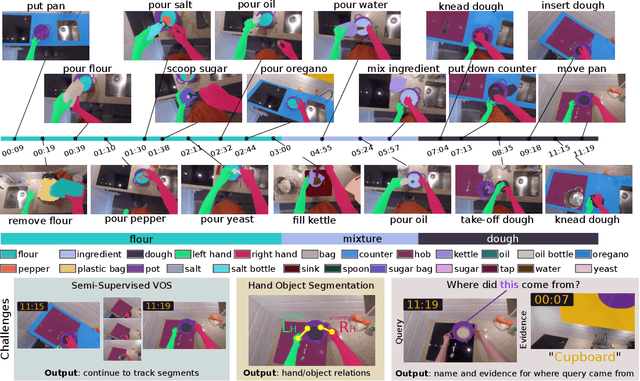
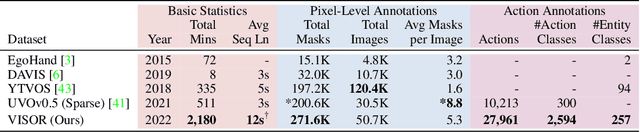
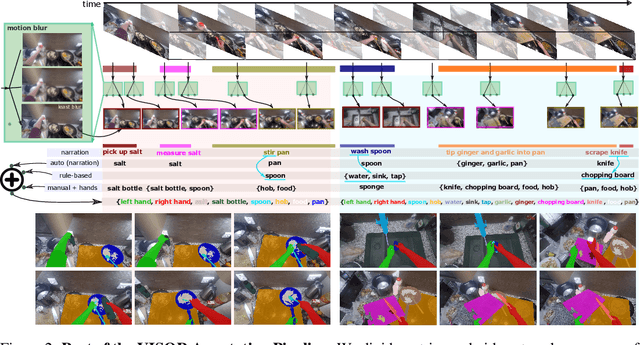
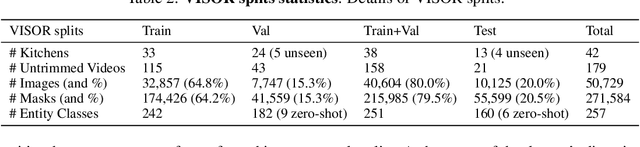
We introduce VISOR, a new dataset of pixel annotations and a benchmark suite for segmenting hands and active objects in egocentric video. VISOR annotates videos from EPIC-KITCHENS, which comes with a new set of challenges not encountered in current video segmentation datasets. Specifically, we need to ensure both short- and long-term consistency of pixel-level annotations as objects undergo transformative interactions, e.g. an onion is peeled, diced and cooked - where we aim to obtain accurate pixel-level annotations of the peel, onion pieces, chopping board, knife, pan, as well as the acting hands. VISOR introduces an annotation pipeline, AI-powered in parts, for scalability and quality. In total, we publicly release 272K manual semantic masks of 257 object classes, 9.9M interpolated dense masks, 67K hand-object relations, covering 36 hours of 179 untrimmed videos. Along with the annotations, we introduce three challenges in video object segmentation, interaction understanding and long-term reasoning. For data, code and leaderboards: http://epic-kitchens.github.io/VISOR