 Add to Chrome
 Add to Firefox
 Add to Edge
Toward Ethical AI Through Bayesian Uncertainty in Neural Question Answering
Dec 19, 2025
We explore Bayesian reasoning as a means to quantify uncertainty in neural networks for question answering. Starting with a multilayer perceptron on the Iris dataset, we show how posterior inference conveys confidence in predictions. We then extend this to language models, applying Bayesian inference first to a frozen head and finally to LoRA-adapted transformers, evaluated on the CommonsenseQA benchmark. Rather than aiming for state-of-the-art accuracy, we compare Laplace approximations against maximum a posteriori (MAP) estimates to highlight uncertainty calibration and selective prediction. This allows models to abstain when confidence is low. An ``I don't know'' response not only improves interpretability but also illustrates how Bayesian methods can contribute to more responsible and ethical deployment of neural question-answering systems.
* 14 pages, 8 figures,

The Dawn of Quantum Natural Language Processing
Oct 13, 2021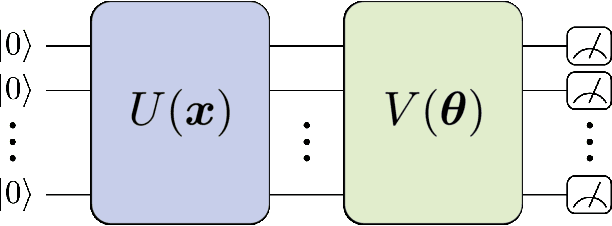
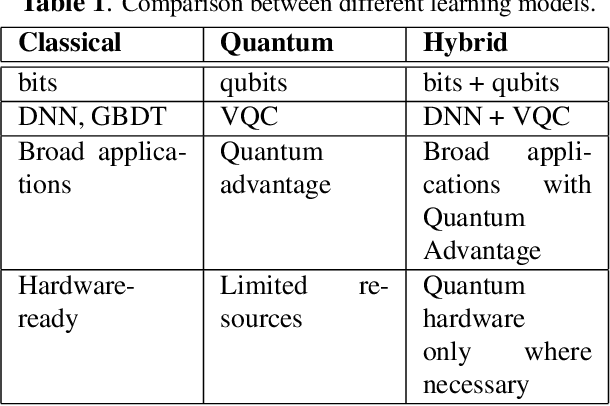
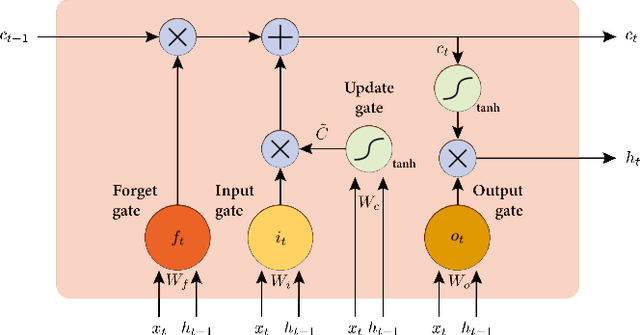
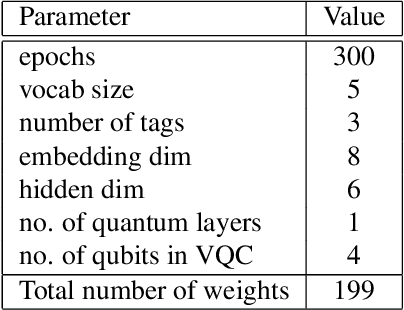
In this paper, we discuss the initial attempts at boosting understanding human language based on deep-learning models with quantum computing. We successfully train a quantum-enhanced Long Short-Term Memory network to perform the parts-of-speech tagging task via numerical simulations. Moreover, a quantum-enhanced Transformer is proposed to perform the sentiment analysis based on the existing dataset.