 Add to Chrome
 Add to Firefox
 Add to Edge
Cognition spaces: natural, artificial, and hybrid
Jan 19, 2026
Cognitive processes are realized across an extraordinary range of natural, artificial, and hybrid systems, yet there is no unified framework for comparing their forms, limits, and unrealized possibilities. Here, we propose a cognition space approach that replaces narrow, substrate-dependent definitions with a comparative representation based on organizational and informational dimensions. Within this framework, cognition is treated as a graded capacity to sense, process, and act upon information, allowing systems as diverse as cells, brains, artificial agents, and human-AI collectives to be analyzed within a common conceptual landscape. We introduce and examine three cognition spaces -- basal aneural, neural, and human-AI hybrid -- and show that their occupation is highly uneven, with clusters of realized systems separated by large unoccupied regions. We argue that these voids are not accidental but reflect evolutionary contingencies, physical constraints, and design limitations. By focusing on the structure of cognition spaces rather than on categorical definitions, this approach clarifies the diversity of existing cognitive systems and highlights hybrid cognition as a promising frontier for exploring novel forms of complexity beyond those produced by biological evolution.

Cooperative control of environmental extremes by artificial intelligent agents
Dec 05, 2022Humans have been able to tackle biosphere complexities by acting as ecosystem engineers, profoundly changing the flows of matter, energy and information. This includes major innovations that allowed to reduce and control the impact of extreme events. Modelling the evolution of such adaptive dynamics can be challenging given the potentially large number of individual and environmental variables involved. This paper shows how to address this problem by using fire as the source of external, bursting and wide fluctuations. Fire propagates on a spatial landscape where a group of agents harvest and exploit trees while avoiding the damaging effects of fire spreading. The agents need to solve a conflict to reach a group-level optimal state: while tree harvesting reduces the propagation of fires, it also reduces the availability of resources provided by trees. It is shown that the system displays two major evolutionary innovations that end up in an ecological engineering strategy that favours high biomass along with the suppression of large fires. The implications for potential A.I. management of complex ecosystems are discussed.
Individual specialization in multi-task environments with multiagent reinforcement learners
Dec 29, 2019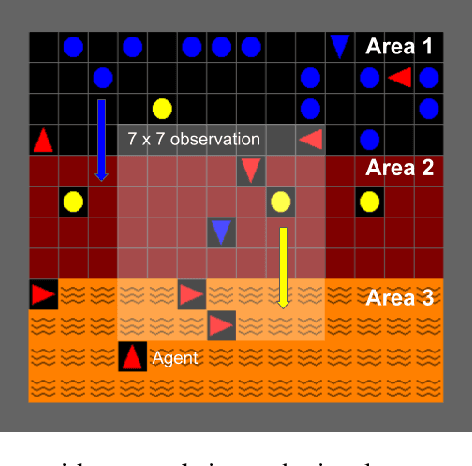
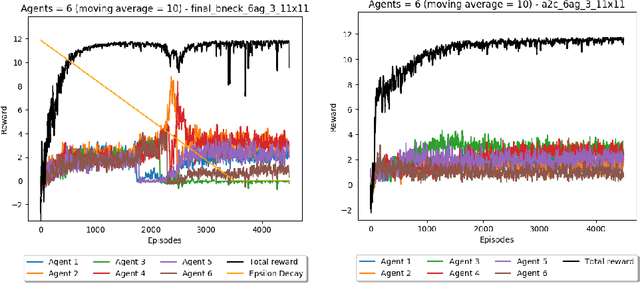
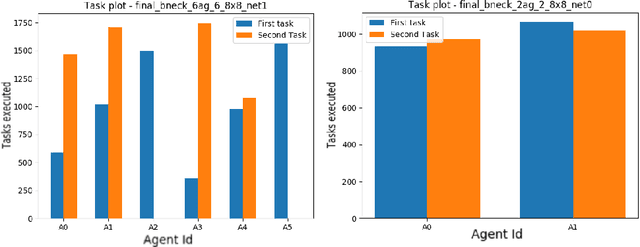
There is a growing interest in Multi-Agent Reinforcement Learning (MARL) as the first steps towards building general intelligent agents that learn to make low and high-level decisions in non-stationary complex environments in the presence of other agents. Previous results point us towards increased conditions for coordination, efficiency/fairness, and common-pool resource sharing. We further study coordination in multi-task environments where several rewarding tasks can be performed and thus agents don't necessarily need to perform well in all tasks, but under certain conditions may specialize. An observation derived from the study is that epsilon greedy exploration of value-based reinforcement learning methods is not adequate for multi-agent independent learners because the epsilon parameter that controls the probability of selecting a random action synchronizes the agents artificially and forces them to have deterministic policies at the same time. By using policy-based methods with independent entropy regularised exploration updates, we achieved a better and smoother convergence. Another result that needs to be further investigated is that with an increased number of agents specialization tends to be more probable.
The morphospace of language networks
Mar 05, 2018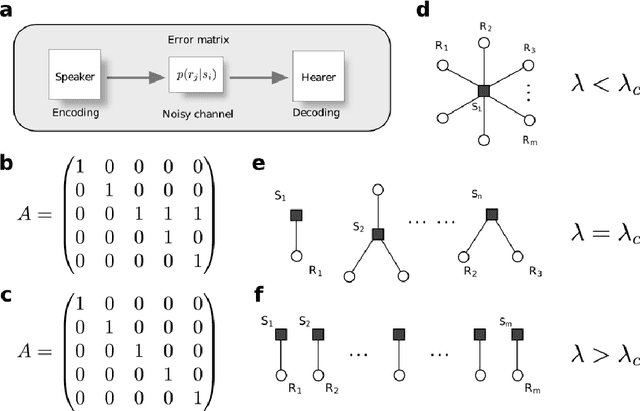
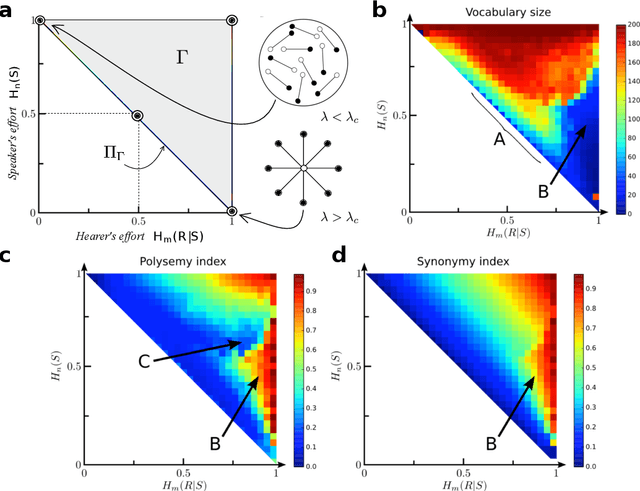
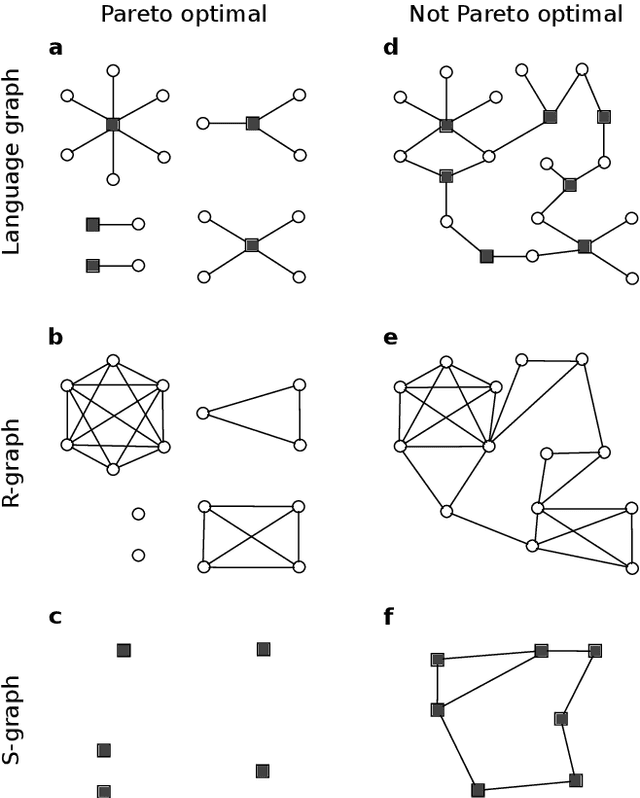
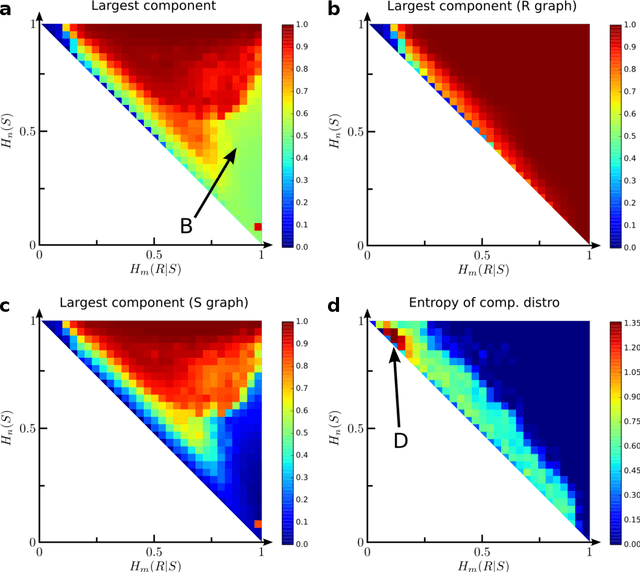
Language can be described as a network of interacting objects with different qualitative properties and complexity. These networks include semantic, syntactic, or phonological levels and have been found to provide a new picture of language complexity and its evolution. A general approach considers language from an information theory perspective that incorporates a speaker, a hearer, and a noisy channel. The later is often encoded in a matrix connecting the signals used for communication with meanings to be found in the real world. Most studies of language evolution deal in a way or another with such theoretical contraption and explore the outcome of diverse forms of selection on the communication matrix that somewhat optimizes communication. This framework naturally introduces networks mediating the communicating agents, but no systematic analysis of the underlying landscape of possible language graphs has been developed. Here we present a detailed analysis of network properties on a generic model of a communication code, which reveals a rather complex and heterogeneous morphospace of language networks. Additionally, we use curated data of English words to locate and evaluate real languages within this language morphospace. Our findings indicate a surprisingly simple structure in human language unless particles are introduced in the vocabulary, with the ability of naming any other concept. These results refine and for the first time complement with empirical data a lasting theoretical tradition around the framework of \emph{least effort language}.