 Add to Chrome
 Add to Firefox
 Add to Edge
Stigma and Support in Online Sexual Violence Narratives on Reddit
Aug 11, 2026
Online communities increasingly provide spaces where survivors of sexual violence can share their experiences and seek support. Although prior research has examined stigma and social support separately, less is known about how stigma expressed in survivor narratives relates to the support offered in response. We introduce the SCOPE dataset, linking stigma signals in online survivor narratives to support types in corresponding comment threads. We annotate posts using a multi-dimensional stigma taxonomy, including Experienced, Internalized, Anticipated, and Structural Stigma, and comments using a support taxonomy encompassing Information Support, Emotional Support, Esteem Support, Tangible Assistance, and Group Interaction. Using contextual, linguistic, and emotion analyses, we compare Stigma and No Stigma content and find that Stigma narratives place greater emphasis on internalized distress, whereas No Stigma narratives focus more on interpreting situations and experiences. Internalized Stigma is the most prevalent category, and community responses remain broadly stable across stigma types, with Information and Esteem Support appearing most often. These findings show how stigma shapes survivor narratives and peer responses and have implications for computational modeling, content moderation, and safer online systems.

Beyond Binary Detection: A Multi-Dimensional Taxonomy of Cancer Misinformation on Reddit
Jul 14, 2026Cancer-related discussions on social media provide an important space for information exchange and peer support, but also facilitate the spread of misinformation that may influence prevention, screening, and treatment decisions. Existing research on cancer misinformation often relies on narrow definitions, small-scale datasets, or binary labeling frameworks. We introduce a multi-dimensional taxonomy for characterizing cancer misinformation in Reddit discussions of breast, lung, colon, and prostate cancer. The taxonomy captures seven dimensions, including misinformation presence, information type, risk level, stance, and topical focus. Using expert-annotated data, we evaluate multiple large language models (LLMs) for scalable misinformation annotation and analyze cancer misinformation across Reddit communities. Our results show that cancer-related misinformation constitutes approximately 6\% of Reddit cancer discussions, with substantial variation across communities and misinformation topics. Few-shot prompting substantially improves classification performance, particularly for nuanced taxonomy dimensions. We additionally identify recurring misinformation narratives centered on unsupported treatments, distrust of conventional medicine, and misleading claims about diagnosis and screening. Our taxonomy, dataset, and findings provide a foundation for multi-dimensional modeling of online cancer misinformation.
The cognitive, affective, and behavioral expression of self-stigma among people who use drugs in online substance use communities
Jun 23, 2026Objectives: To develop a codebook for self-stigma across cognitive, affective, and behavioral domains, and to estimate the prevalence, co-occurrence, and temporal patterns of these indicators in Reddit posts by people who use drugs. Methods: We developed a ten-indicator codebook through consensus-based abductive coding spanning cognitive (self-labeling, pessimism/self-defeatism, deservingness/worthlessness), affective (shame, guilt/self-blame, despair/hopelessness), and behavioral (concealment, anticipated rejection, desire to quit, ambivalence) domains; two coders reached substantial agreement (Cohen's k = 0.72). We then scaled classification with a large language model validated against expert coding (k = 0.73, F1 = 0.80), analyzing 72,115 thread-initiating posts from 1,660 English-language users (2006-2025). Results: 3,838 posts (5.3%) from 1,228 users (74.0%) contained self-stigma; all ten indicators discriminated self-stigma posts (RR 3.6 to 86.2), led by self-labeling (56.0%) and despair/hopelessness (48.5%). Self-stigma was integrated: core and behavioral indicators were strongly associated at the user level (OR = 4.65, 95% CI 3.12-6.94, p < 0.001), and 87.0% of posts with behavioral indicators also contained a core indicator. Contrary to progressive models, behavioral indicators emerged earlier than core ones (desire to quit at median position 0.08 vs. shame at 0.38). Nine of ten indicators were stable across posting trajectories; only pessimism increased (OR = 1.62, 95% CI 1.25-2.10). Conclusion: Among people who use drugs online, self-stigma is an integrated phenomenon in which behavioral indicators rarely appear without internalized ones and often precede them. Most expressions remain stable over time, but pessimism about change deepens, marking a target for early digital intervention and showing that progressive stage models do not map directly onto textual disclosure.
Self-Stigma Is Not a Monolith, but Generic Empathy Is: Persona-Conditioned LLM Support for People Who Use Drugs
Jun 22, 2026Self-stigma predicts treatment avoidance and disengagement among people who use drugs (PWUD), yet conversational systems aiming to provide support typically treat self-stigma expression as a uniform signal. We present a three-phase, proof-of-concept study of a persona-aware approach to LLM support. Latent Profile Analysis (LPA) on indicator-level features from 1,174 self-stigma expressors on Reddit yields a four-persona typology validated against held-out behavioral and linguistic features. Sequential Bayesian and recurrent neural classifiers recover these personas from limited posting histories, substantially outperforming batch and few-shot LLM baselines (macro-F1 = 0.74 at 30 posts). Evaluation by eight clinical experts across three contemporary LLMs revealed a misalignment: persona-matched responses successfully achieved targeted behavioral shifts, yet raters holistically preferred the generic empathy of the persona-neutral baseline. Our findings suggest that holistic empathy judgments and clinically-aligned response design can pull in opposite directions, and that evaluating LLM-based stigma support requires rubrics capable of decomposing the two.
Reddit After Roe: A Computational Analysis of Abortion Narratives and Barriers in the Wake of Dobbs
Mar 23, 2026The 2022 U.S. Supreme Court decision in Dobbs v. Jackson Women's Health Organization reshaped the reproductive rights landscape, introducing new uncertainty and barriers to abortion access. We present a large-scale computational analysis of abortion discourse on Reddit, examining how barriers to access are articulated across information-seeking and information-sharing behaviors, different stages of abortion (before, during, after), and three phases of the Dobbs decision in 2022. Drawing on more than 17,000 posts from four abortion-related subreddits, we employed a multi-step pipeline to classify posts by information type, abortion stage, barrier category, and expressed emotions. Using a codebook of eight barrier types, including legal, financial, emotional, and social obstacles, we analyzed their associations with emotions and information behaviors. Topic modeling of model-generated barrier rationales further revealed how discourse evolved in response to shifting legal and cultural contexts. Our findings show that emotional and psychological barriers consistently dominate abortion narratives online, with emotions such as nervousness, confusion, fear, and sadness prevalent across discourse. By linking information behaviors, barriers, emotions, and temporal dynamics, this study provides a multi-dimensional account of how abortion is navigated in online communities.
Like a Therapist, But Not: Reddit Narratives of AI in Mental Health Contexts
Jan 28, 2026Large language models (LLMs) are increasingly used for emotional support and mental health-related interactions outside clinical settings, yet little is known about how people evaluate and relate to these systems in everyday use. We analyze 5,126 Reddit posts from 47 mental health communities describing experiential or exploratory use of AI for emotional support or therapy. Grounded in the Technology Acceptance Model and therapeutic alliance theory, we develop a theory-informed annotation framework and apply a hybrid LLM-human pipeline to analyze evaluative language, adoption-related attitudes, and relational alignment at scale. Our results show that engagement is shaped primarily by narrated outcomes, trust, and response quality, rather than emotional bond alone. Positive sentiment is most strongly associated with task and goal alignment, while companionship-oriented use more often involves misaligned alliances and reported risks such as dependence and symptom escalation. Overall, this work demonstrates how theory-grounded constructs can be operationalized in large-scale discourse analysis and highlights the importance of studying how users interpret language technologies in sensitive, real-world contexts.
A Transformer and Prototype-based Interpretable Model for Contextual Sarcasm Detection
Mar 14, 2025Sarcasm detection, with its figurative nature, poses unique challenges for affective systems designed to perform sentiment analysis. While these systems typically perform well at identifying direct expressions of emotion, they struggle with sarcasm's inherent contradiction between literal and intended sentiment. Since transformer-based language models (LMs) are known for their efficient ability to capture contextual meanings, we propose a method that leverages LMs and prototype-based networks, enhanced by sentiment embeddings to conduct interpretable sarcasm detection. Our approach is intrinsically interpretable without extra post-hoc interpretability techniques. We test our model on three public benchmark datasets and show that our model outperforms the current state-of-the-art. At the same time, the prototypical layer enhances the model's inherent interpretability by generating explanations through similar examples in the reference time. Furthermore, we demonstrate the effectiveness of incongruity loss in the ablation study, which we construct using sentiment prototypes.
From #Dr00gtiktok to #harmreduction: Exploring Substance Use Hashtags on TikTok
Jan 27, 2025


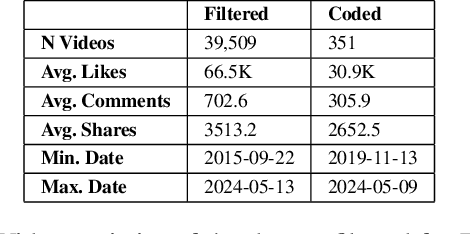
The rise of TikTok as a primary source of information for youth, combined with its unique short-form video format, creates urgent questions about how substance use content manifests and spreads on the platform. This paper provides the first in-depth exploration of substance use-related content on TikTok, covering all major substance categories as classified by the Drug Enforcement Agency. Through social network analysis and qualitative coding, we examined more than 2,333 hashtags across 39,509 videos, identified 16 distinct hashtag communities and analyzed their interconnections and thematic content. Our analysis revealed a highly interconnected small-world network where recovery-focused hashtags like #addiction, #recovery, and #sober serve as central bridges between communities. Through manual coding of 351 representative videos, we found that Recovery Advocacy content (33.9%) and Satirical content (28.2%) dominate, while direct substance depiction appears in only 26% of videos, with active use shown in just 6.5% of them. This suggests TikTok functions primarily as a recovery support platform rather than a space promoting substance use. We found strong alignment between hashtag communities and video content, indicating organic community formation rather than attempts to evade content moderation. Our findings inform how platforms can balance content moderation with preserving valuable recovery support communities, while also providing insights for the design of social media-based recovery interventions.
From Conversation to Automation: Leveraging Large Language Models to Analyze Strategies in Problem Solving Therapy
Jan 10, 2025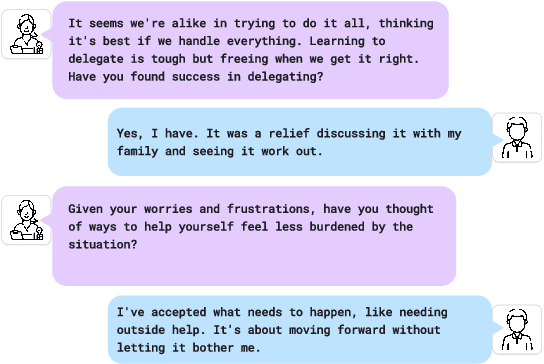


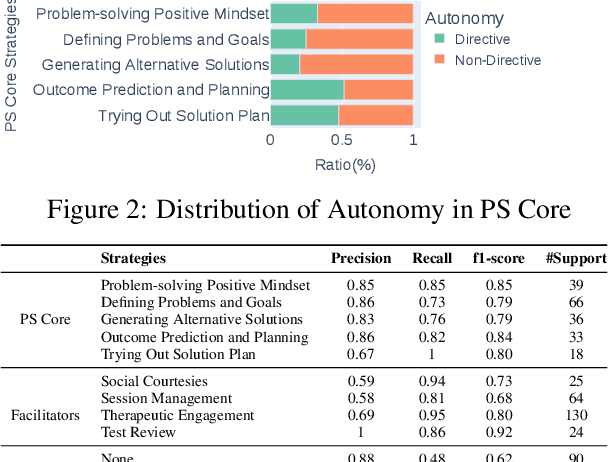
Problem-solving therapy (PST) is a structured psychological approach that helps individuals manage stress and resolve personal issues by guiding them through problem identification, solution brainstorming, decision-making, and outcome evaluation. As mental health care increasingly integrates technologies like chatbots and large language models (LLMs), understanding how PST can be effectively automated is important. This study leverages anonymized therapy transcripts to analyze and classify therapeutic interventions using various LLMs and transformer-based models. Our results show that GPT-4o achieved the highest accuracy (0.76) in identifying PST strategies, outperforming other models. Additionally, we introduced a new dimension of communication strategies that enhances the current PST framework, offering deeper insights into therapist-client interactions. This research demonstrates the potential of LLMs to automate complex therapeutic dialogue analysis, providing a scalable, efficient tool for mental health interventions. Our annotation framework can enhance the accessibility, effectiveness, and personalization of PST, supporting therapists in real-time with more precise, targeted interventions.
Words Matter: Reducing Stigma in Online Conversations about Substance Use with Large Language Models
Aug 15, 2024Stigma is a barrier to treatment for individuals struggling with substance use disorders (SUD), which leads to significantly lower treatment engagement rates. With only 7% of those affected receiving any form of help, societal stigma not only discourages individuals with SUD from seeking help but isolates them, hindering their recovery journey and perpetuating a cycle of shame and self-doubt. This study investigates how stigma manifests on social media, particularly Reddit, where anonymity can exacerbate discriminatory behaviors. We analyzed over 1.2 million posts, identifying 3,207 that exhibited stigmatizing language towards people who use substances (PWUS). Using Informed and Stylized LLMs, we develop a model for de-stigmatization of these expressions into empathetic language, resulting in 1,649 reformed phrase pairs. Our paper contributes to the field by proposing a computational framework for analyzing stigma and destigmatizing online content, and delving into the linguistic features that propagate stigma towards PWUS. Our work not only enhances understanding of stigma's manifestations online but also provides practical tools for fostering a more supportive digital environment for those affected by SUD. Code and data will be made publicly available upon acceptance.