 Add to Chrome
 Add to Firefox
 Add to Edge
When Reasoning Narrows the Move: Diversity Collapse in LLM Game Play
Jul 21, 2026
Supervised fine-tuning (SFT) is widely used to adapt large language models to downstream tasks, but its effect on behavioral diversity in sequential decision-making remains under-explored. We study this question in a controlled suite of deterministic board games based on tic-tac-toe variants, where optimal actions are exactly computable and diversity can be measured directly. Across state-level evaluation, arena gameplay, and training trajectories, we find that reasoning-mode generation frequently suppresses action diversity without uniformly improving action accuracy. Furthermore, standard SFT improves accuracy but often induces premature diversity collapse, which exceeds what is minimally required by the accuracy-diversity tradeoff. We then show that action augmentation, which trains on all optimal actions per state rather than a single demonstrated action, would partially mitigates this effect. Our results identify narrow-support imitation as a source of policy collapse in LLM decision-making and suggest that preserving action support during SFT is important for maintaining exploratory behavior.

Multi-agent Adaptive Mechanism Design
Dec 25, 2025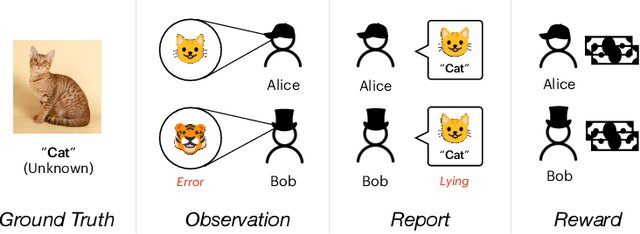
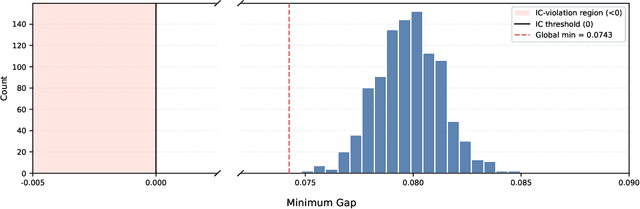
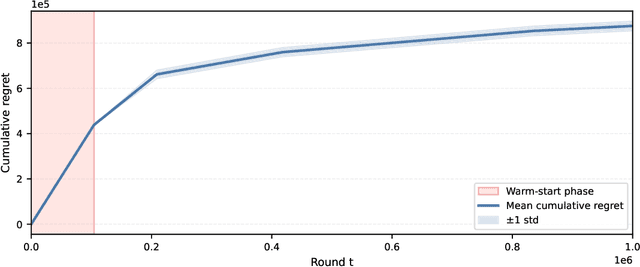
We study a sequential mechanism design problem in which a principal seeks to elicit truthful reports from multiple rational agents while starting with no prior knowledge of agents' beliefs. We introduce Distributionally Robust Adaptive Mechanism (DRAM), a general framework combining insights from both mechanism design and online learning to jointly address truthfulness and cost-optimality. Throughout the sequential game, the mechanism estimates agents' beliefs and iteratively updates a distributionally robust linear program with shrinking ambiguity sets to reduce payments while preserving truthfulness. Our mechanism guarantees truthful reporting with high probability while achieving $\tilde{O}(\sqrt{T})$ cumulative regret, and we establish a matching lower bound showing that no truthful adaptive mechanism can asymptotically do better. The framework generalizes to plug-in estimators, supporting structured priors and delayed feedback. To our knowledge, this is the first adaptive mechanism under general settings that maintains truthfulness and achieves optimal regret when incentive constraints are unknown and must be learned.