 Add to Chrome
 Add to Firefox
 Add to Edge
BioResearcher: Scenario-Guided Multi-Agent for Translational Medicine
May 07, 2026
Translational medicine turns underspecified development goals into evidence synthesis that must combine literature, trials, patents, and quantitative multi-omics analysis while preserving identifiers, uncertainty, and retrievable provenance. General-purpose foundation models and off-the-shelf tool-augmented or multi-agent systems are not built for this: they tend to produce single-shot answers or run open-endedly, and fall short on the auditable, scenario-specific workflows that heterogeneous biomedical sources demand. This paper introduces Ingenix BioResearcher, a scenario-guided multi-agent system that maps queries to versioned research playbooks, delegates to specialized subagents over 30+ tools and machine-learning endpoints, mixes structured database access with sandboxed code for genome-scale analyses, and applies claim-level multi-model reconciliation before editorial assembly. We evaluate BioResearcher across unit-level capabilities, open-ended biomedical reasoning, and end-to-end clinical discovery. It leads evaluated baselines on 109 single-step tests (83.49% pass rate; 0.892 average score), achieves strong biomedical benchmark performance (89.33% on BixBench-Verified-50 and the top 0.758 mean score on BaisBench Scientific Discovery), and leads on a 30-query clinical end-to-end benchmark with the highest positive hit rate (74.7% $\pm$ 3.3%) and negative clear rate (96.8% $\pm$ 0.2%). These results show broad, competitive performance across unit-level, open-ended, and end-to-end clinical evaluations.

Advancing Polish Language Modeling through Tokenizer Optimization in the Bielik v3 7B and 11B Series
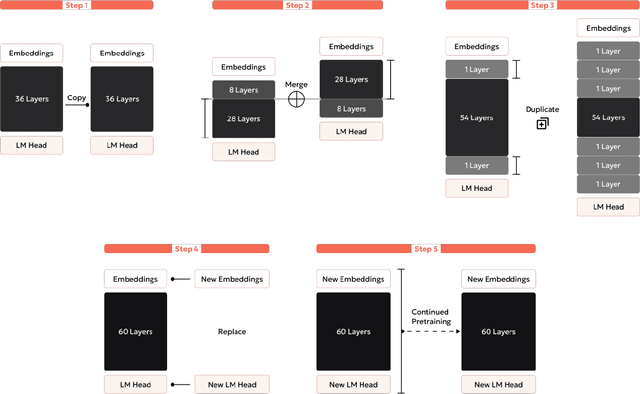
Apr 12, 2026The development of the Bielik v3 PL series, encompassing both the 7B and 11B parameter variants, represents a significant milestone in the field of language-specific large language model (LLM) optimization. While general-purpose models often demonstrate impressive multilingual capabilities, they frequently suffer from a fundamental architectural inefficiency: the use of universal tokenizers. These tokenizers, typically designed to cover a broad spectrum of languages, often fail to capture the morphological nuances of specific languages like Polish, leading to higher fertility ratios, increased inference costs, and restricted effective context windows. This report details the transition from the universal Mistral-based tokenization to a dedicated Polish-optimized vocabulary for the Bielik v3 models, exploring the FOCUS-based embedding initialization, the multi-stage pretraining curriculum, and the subsequent post-training alignment involving Supervised Fine-Tuning, Direct Preference Optimization, and Reinforcement Learning through Group Relative Policy Optimization with verifiable rewards.
Bielik-Minitron-7B: Compressing Large Language Models via Structured Pruning and Knowledge Distillation for the Polish Language
Mar 12, 2026This report details the creation of Bielik-Minitron-7B, a compressed 7.35B parameter version of the Bielik-11B-v3.0 model, specifically optimized for European languages. By leveraging a two-stage compression methodology inspired by the NVIDIA Minitron approach, we combined structured hybrid pruning and knowledge distillation to reduce the model's parameter count by 33.4%, from 11.04B to 7.35B. We utilized the NVIDIA Model Optimizer for structural pruning and the NVIDIA NeMo Framework for logit-based distillation for quality recovery. Following distillation, the model underwent a rigorous alignment pipeline consisting of Supervised Fine-Tuning (SFT), Direct Preference Optimization (DPO-P), and Reinforcement Learning (GRPO). Our final model successfully recovered approximately 90% of the baseline model's performance while providing up to 50% inference speedup. This approach demonstrates an efficient pathway to create language models for less-represented languages, preserving the original model quality while reducing inference deployment costs.
Making Bielik LLM Reason (Better): A Field Report
Mar 11, 2026This paper presents a research program dedicated to evaluating and advancing the reasoning capabilities of Bielik, a Polish large language model. The study describes a number of stages of work: initial benchmarking and creation of evaluation methodology, analyzing of comparative results with other LLMs and outlining of future prospects that take into account the limitations of the analyses conducted so far and aims to keep Bielik in the race give the ever-changing -- and competitive -- AI landscape.
Bielik 11B v2 Technical Report
May 05, 2025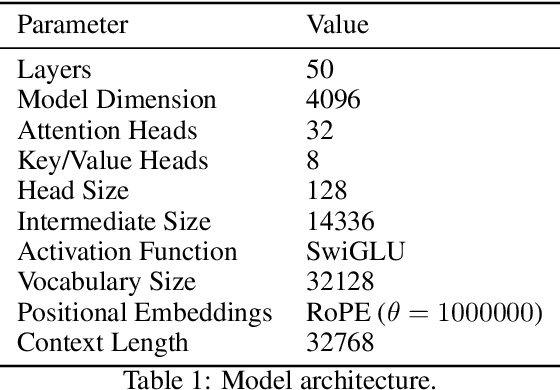

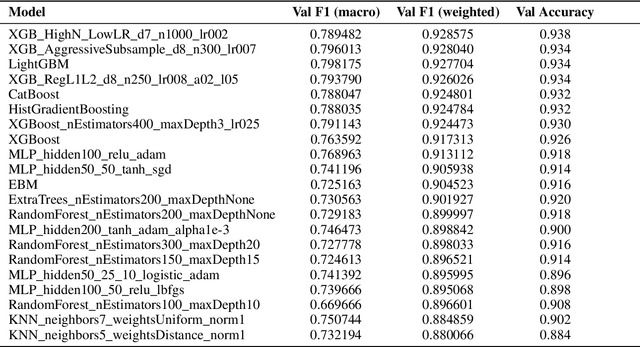
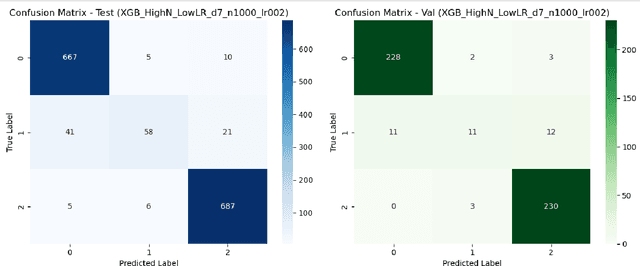
We present Bielik 11B v2, a state-of-the-art language model optimized for Polish text processing. Built on the Mistral 7B v0.2 architecture and scaled to 11B parameters using depth up-scaling, this model demonstrates exceptional performance across Polish language benchmarks while maintaining strong cross-lingual capabilities. We introduce two key technical innovations: Weighted Instruction Cross-Entropy Loss, which optimizes learning across diverse instruction types by assigning quality-based weights to training examples, and Adaptive Learning Rate, which dynamically adjusts based on context length. Comprehensive evaluation across multiple benchmarks demonstrates that Bielik 11B v2 outperforms many larger models, including those with 2-6 times more parameters, and significantly surpasses other specialized Polish language models on tasks ranging from linguistic understanding to complex reasoning. The model's parameter efficiency and extensive quantization options enable deployment across various hardware configurations, advancing Polish language AI capabilities and establishing new benchmarks for resource-efficient language modeling in less-represented languages.
Bielik v3 Small: Technical Report
May 05, 2025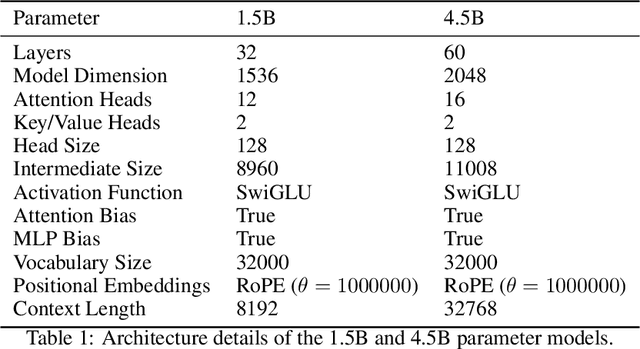
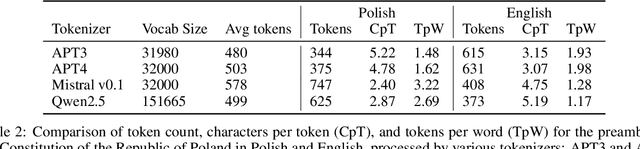
We introduce Bielik v3, a series of parameter-efficient generative text models (1.5B and 4.5B) optimized for Polish language processing. These models demonstrate that smaller, well-optimized architectures can achieve performance comparable to much larger counterparts while requiring substantially fewer computational resources. Our approach incorporates several key innovations: a custom Polish tokenizer (APT4) that significantly improves token efficiency, Weighted Instruction Cross-Entropy Loss to balance learning across instruction types, and Adaptive Learning Rate that dynamically adjusts based on training progress. Trained on a meticulously curated corpus of 292 billion tokens spanning 303 million documents, these models excel across multiple benchmarks, including the Open PL LLM Leaderboard, Complex Polish Text Understanding Benchmark, Polish EQ-Bench, and Polish Medical Leaderboard. The 4.5B parameter model achieves results competitive with models 2-3 times its size, while the 1.5B model delivers strong performance despite its extremely compact profile. These advances establish new benchmarks for parameter-efficient language modeling in less-represented languages, making high-quality Polish language AI more accessible for resource-constrained applications.
Bielik 7B v0.1: A Polish Language Model -- Development, Insights, and Evaluation
Oct 24, 2024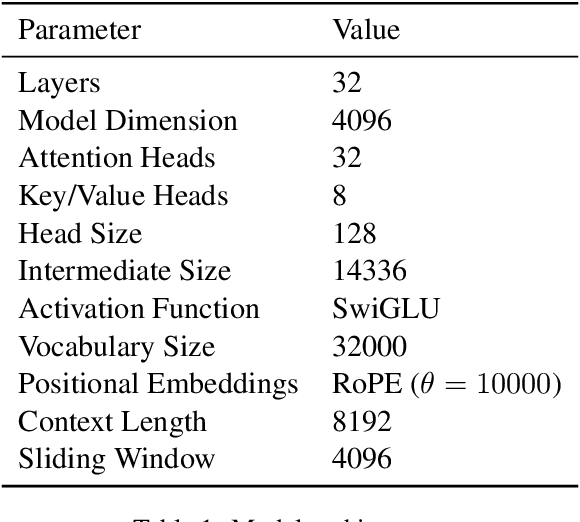
We introduce Bielik 7B v0.1, a 7-billion-parameter generative text model for Polish language processing. Trained on curated Polish corpora, this model addresses key challenges in language model development through innovative techniques. These include Weighted Instruction Cross-Entropy Loss, which balances the learning of different instruction types, and Adaptive Learning Rate, which dynamically adjusts the learning rate based on training progress. To evaluate performance, we created the Open PL LLM Leaderboard and Polish MT-Bench, novel frameworks assessing various NLP tasks and conversational abilities. Bielik 7B v0.1 demonstrates significant improvements, achieving a 9 percentage point increase in average score compared to Mistral-7B-v0.1 on the RAG Reader task. It also excels in the Polish MT-Bench, particularly in Reasoning (6.15/10) and Role-playing (7.83/10) categories. This model represents a substantial advancement in Polish language AI, offering a powerful tool for diverse linguistic applications and setting new benchmarks in the field.