 Add to Chrome
 Add to Firefox
 Add to Edge
First Shape, Then Meaning: Efficient Geometry and Semantics Learning for Indoor Reconstruction
May 05, 2026
Neural Surface Reconstruction has become a standard methodology for indoor 3D reconstruction, with Signed Distance Functions (SDFs) proving particularly effective for representing scene geometry. A variety of applications require a detailed understanding of the scene context, driving the need for object-level semantic signals. While recent methods successfully integrate semantic labels, they often inherit the slow training time and limited scalability of multi-SDF learning. In this paper, we introduce FSTM, a unified approach for learning geometry and semantics through a two-step process: a geometry warm-up using RGB inputs and geometric cues, followed by semantic field estimation. By first optimising geometry without semantic supervision, we observe substantial improvements compared to the standard joint optimisation. Rather than relying on specialised modules or complex multi-SDF designs, FSTM shows that a streamlined formulation is sufficient to achieve strong geometric and semantic reconstructions. Experiments on both synthetic and real-world indoor datasets show that our method outperforms multi-SDF approaches. It trains 2.3x faster on Replica, improves robustness to real-world imperfections on ScanNet++, and achieves higher recall by recovering the surfaces of more objects in the scene. The code will be made available at https://remichierchia.github.io/FSTM.

Multi-View Consistent Wound Segmentation With Neural Fields
Jan 23, 2026Wound care is often challenged by the economic and logistical burdens that consistently afflict patients and hospitals worldwide. In recent decades, healthcare professionals have sought support from computer vision and machine learning algorithms. In particular, wound segmentation has gained interest due to its ability to provide professionals with fast, automatic tissue assessment from standard RGB images. Some approaches have extended segmentation to 3D, enabling more complete and precise healing progress tracking. However, inferring multi-view consistent 3D structures from 2D images remains a challenge. In this paper, we evaluate WoundNeRF, a NeRF SDF-based method for estimating robust wound segmentations from automatically generated annotations. We demonstrate the potential of this paradigm in recovering accurate segmentations by comparing it against state-of-the-art Vision Transformer networks and conventional rasterisation-based algorithms. The code will be released to facilitate further development in this promising paradigm.
Wound3DAssist: A Practical Framework for 3D Wound Assessment
Aug 25, 2025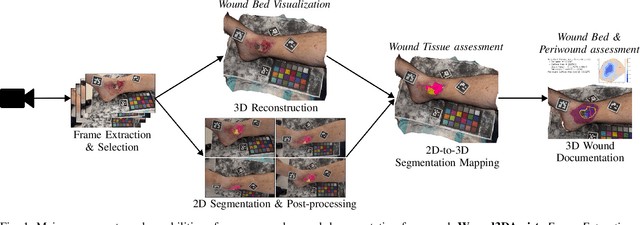
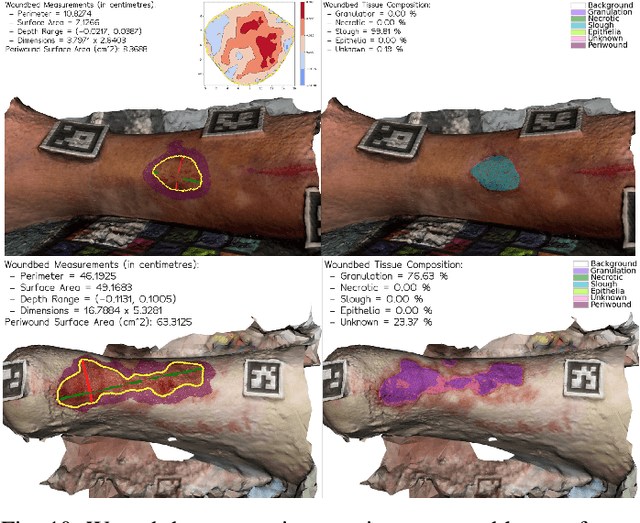
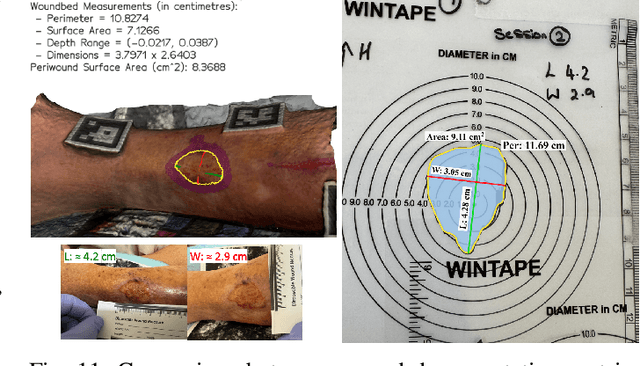
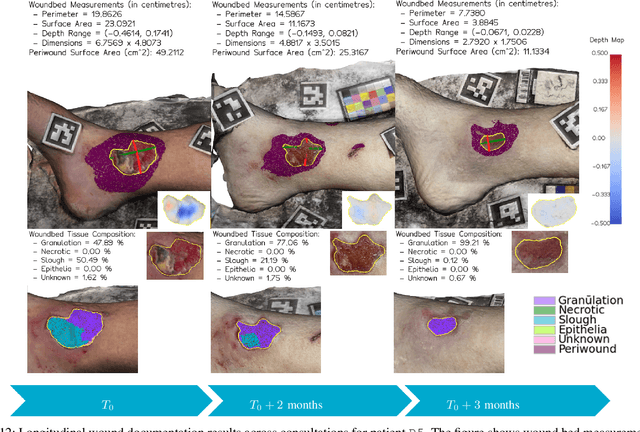
Managing chronic wounds remains a major healthcare challenge, with clinical assessment often relying on subjective and time-consuming manual documentation methods. Although 2D digital videometry frameworks aided the measurement process, these approaches struggle with perspective distortion, a limited field of view, and an inability to capture wound depth, especially in anatomically complex or curved regions. To overcome these limitations, we present Wound3DAssist, a practical framework for 3D wound assessment using monocular consumer-grade videos. Our framework generates accurate 3D models from short handheld smartphone video recordings, enabling non-contact, automatic measurements that are view-independent and robust to camera motion. We integrate 3D reconstruction, wound segmentation, tissue classification, and periwound analysis into a modular workflow. We evaluate Wound3DAssist across digital models with known geometry, silicone phantoms, and real patients. Results show that the framework supports high-quality wound bed visualization, millimeter-level accuracy, and reliable tissue composition analysis. Full assessments are completed in under 20 minutes, demonstrating feasibility for real-world clinical use.
SALVE: A 3D Reconstruction Benchmark of Wounds from Consumer-grade Videos
Jul 29, 2024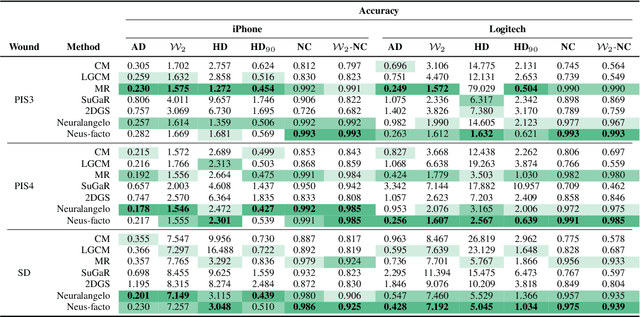
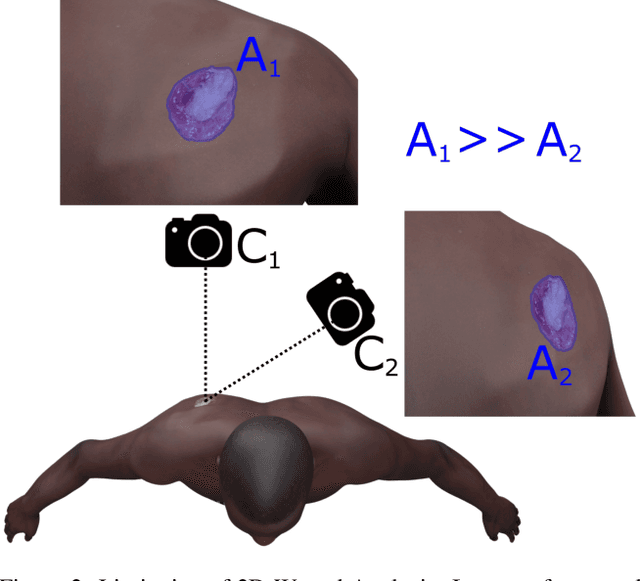
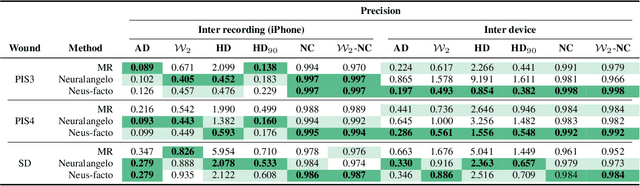
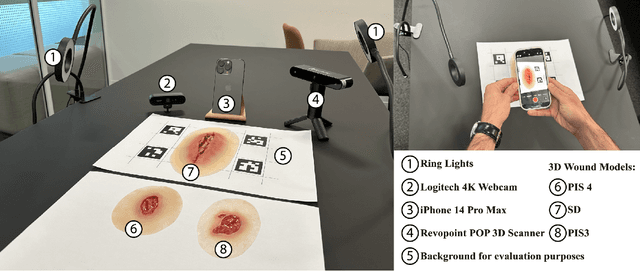
Managing chronic wounds is a global challenge that can be alleviated by the adoption of automatic systems for clinical wound assessment from consumer-grade videos. While 2D image analysis approaches are insufficient for handling the 3D features of wounds, existing approaches utilizing 3D reconstruction methods have not been thoroughly evaluated. To address this gap, this paper presents a comprehensive study on 3D wound reconstruction from consumer-grade videos. Specifically, we introduce the SALVE dataset, comprising video recordings of realistic wound phantoms captured with different cameras. Using this dataset, we assess the accuracy and precision of state-of-the-art methods for 3D reconstruction, ranging from traditional photogrammetry pipelines to advanced neural rendering approaches. In our experiments, we observe that photogrammetry approaches do not provide smooth surfaces suitable for precise clinical measurements of wounds. Neural rendering approaches show promise in addressing this issue, advancing the use of this technology in wound care practices.
Syn3DWound: A Synthetic Dataset for 3D Wound Bed Analysis
Nov 27, 2023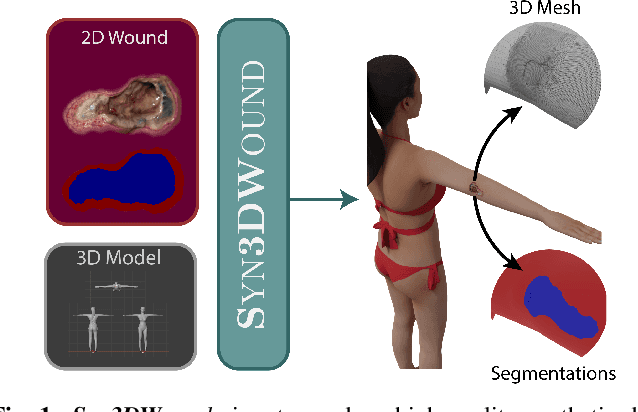


Wound management poses a significant challenge, particularly for bedridden patients and the elderly. Accurate diagnostic and healing monitoring can significantly benefit from modern image analysis, providing accurate and precise measurements of wounds. Despite several existing techniques, the shortage of expansive and diverse training datasets remains a significant obstacle to constructing machine learning-based frameworks. This paper introduces Syn3DWound, an open-source dataset of high-fidelity simulated wounds with 2D and 3D annotations. We propose baseline methods and a benchmarking framework for automated 3D morphometry analysis and 2D/3D wound segmentation.