 Add to Chrome
 Add to Firefox
 Add to Edge
How Neural Reward Models Learn Features for Policy Optimization: A Single-Index Analysis
May 23, 2026
Reward modeling is not only a prediction problem: in KL-regularized policy optimization, the learned reward is exponentiated to define the deployed policy, so downstream value depends on errors in reward-tilted regions. We study this feedback in a Gaussian single-index model with $r^*(x) = σ^*(\langle θ^*, x\rangle)$ and $x \sim N(0, I_d)$. We analyze a two-stage neural reward model that first learns the hidden direction $θ^*$ from reward-weighted samples and then fits the readout layer by weighted ridge regression. Exponential reward weighting changes the Hermite signal available to the first layer; for any feature-learning temperature $β_1$ above a dimension-free $O(1)$ threshold, a constant fraction of neurons recover the hidden direction, with weak-recovery complexity governed by the generative exponent. After feature recovery, we derive tilted-policy value-gap bounds for an idealized label-weighted fit with weights $e^{y/β_2}$ and a more practical surrogate-weighted fit with weights $e^{r_{a_0}(x)/β_2}$. Keeping the $β_2$-dependence explicit yields an admissible set of deployment temperatures, balancing the gain from lowering $β_2$ against the learning cost amplified by exponential weighting; in the surrogate-weighted case, proxy-dependent factors shrink this admissible set.

Inference-Aware Meta-Alignment of LLMs via Non-Linear GRPO
Feb 02, 2026Aligning large language models (LLMs) to diverse human preferences is fundamentally challenging since criteria can often conflict with each other. Inference-time alignment methods have recently gained popularity as they allow LLMs to be aligned to multiple criteria via different alignment algorithms at inference time. However, inference-time alignment is computationally expensive since it often requires multiple forward passes of the base model. In this work, we propose inference-aware meta-alignment (IAMA), a novel approach that enables LLMs to be aligned to multiple criteria with limited computational budget at inference time. IAMA trains a base model such that it can be effectively aligned to multiple tasks via different inference-time alignment algorithms. To solve the non-linear optimization problems involved in IAMA, we propose non-linear GRPO, which provably converges to the optimal solution in the space of probability measures.
A Relative-Budget Theory for Reinforcement Learning with Verifiable Rewards in Large Language Model Reasoning
Feb 02, 2026Reinforcement learning (RL) is a dominant paradigm for improving the reasoning abilities of large language models, yet its effectiveness varies across tasks and compute budgets. We propose a \emph{relative-budget} theory explaining this variation through a single quantity called relative budget $ξ:= H/\mathbb{E}[T]$, where $H$ is the generation horizon (token budget) and $T$ denotes the number of tokens until the first correct solution under a base policy. We show that $ξ$ determines sample efficiency by controlling reward variance and the likelihood of informative trajectories. Our analysis reveals three regimes: in the \emph{deficient} regime ($ξ\to 0$), informative trajectories are rare and the sample complexity explodes; in the \emph{balanced} regime ($ξ=Θ(1)$), informative trajectories occur with non-negligible probability and RL is maximally sample-efficient; and in the \emph{ample} regime ($ξ\to \infty$), learning remains stable but marginal gains per iteration diminish. We further provide finite-sample guarantees for online RL that characterize learning progress across these regimes. Specifically, in a case study under idealized distributional assumptions, we show that the relative budget grows linearly over iterations. Our empirical results confirm these predictions in realistic settings, identifying a budget $ξ\in [1.5, 2.0]$ that maximizes learning efficiency and coincides with peak reasoning performance.
Direct Density Ratio Optimization: A Statistically Consistent Approach to Aligning Large Language Models
May 12, 2025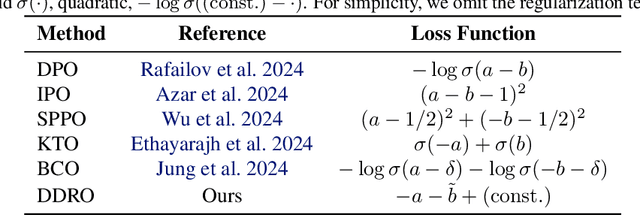
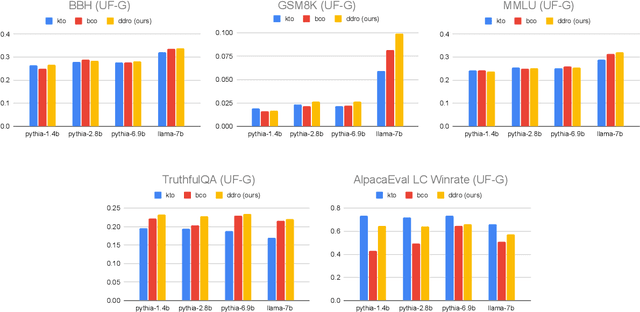
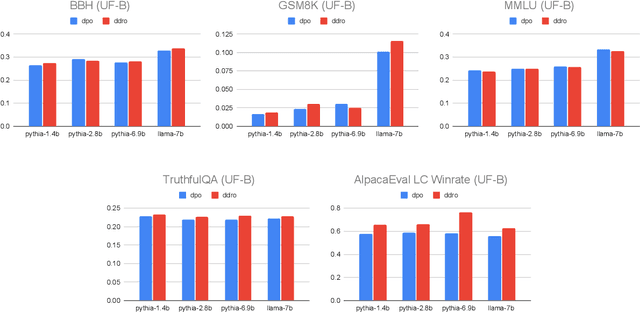
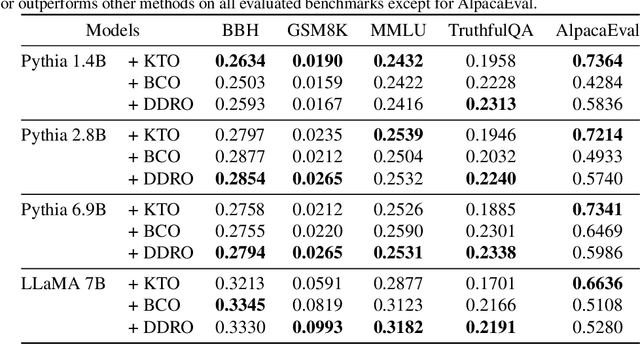
Aligning large language models (LLMs) with human preferences is crucial for safe deployment, yet existing methods assume specific preference models like Bradley-Terry model. This assumption leads to statistical inconsistency, where more data doesn't guarantee convergence to true human preferences. To address this critical gap, we introduce a novel alignment method Direct Density Ratio Optimization (DDRO). DDRO directly estimates the density ratio between preferred and unpreferred output distributions, circumventing the need for explicit human preference modeling. We theoretically prove that DDRO is statistically consistent, ensuring convergence to the true preferred distribution as the data size grows, regardless of the underlying preference structure. Experiments demonstrate that DDRO achieves superior performance compared to existing methods on many major benchmarks. DDRO unlocks the potential for truly data-driven alignment, paving the way for more reliable and human-aligned LLMs.
When Does Metadata Conditioning (NOT) Work for Language Model Pre-Training? A Study with Context-Free Grammars
Apr 24, 2025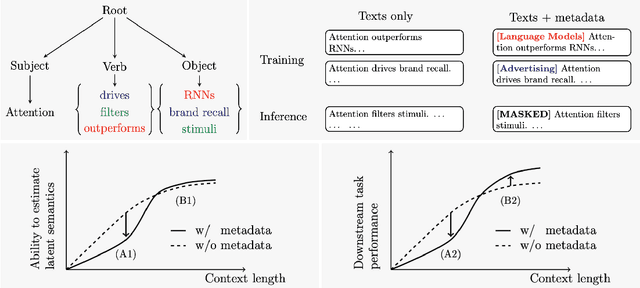
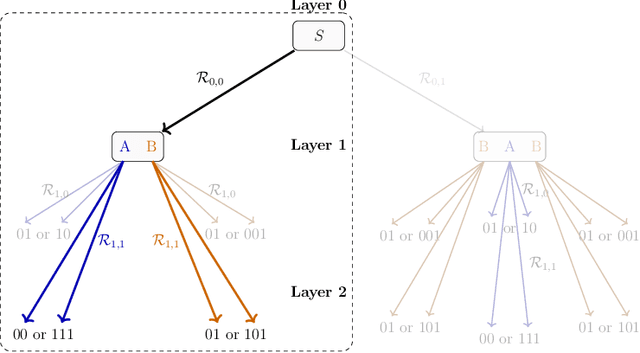
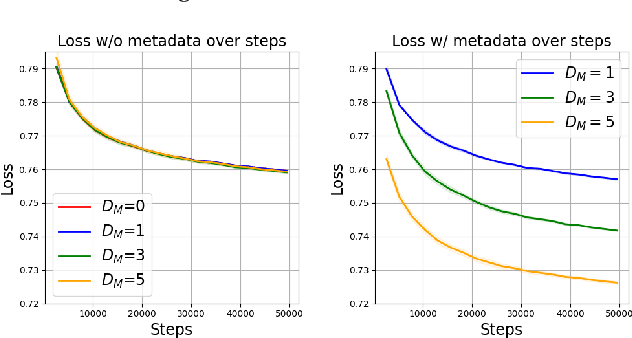

The ability to acquire latent semantics is one of the key properties that determines the performance of language models. One convenient approach to invoke this ability is to prepend metadata (e.g. URLs, domains, and styles) at the beginning of texts in the pre-training data, making it easier for the model to access latent semantics before observing the entire text. Previous studies have reported that this technique actually improves the performance of trained models in downstream tasks; however, this improvement has been observed only in specific downstream tasks, without consistent enhancement in average next-token prediction loss. To understand this phenomenon, we closely investigate how prepending metadata during pre-training affects model performance by examining its behavior using artificial data. Interestingly, we found that this approach produces both positive and negative effects on the downstream tasks. We demonstrate that the effectiveness of the approach depends on whether latent semantics can be inferred from the downstream task's prompt. Specifically, through investigations using data generated by probabilistic context-free grammars, we show that training with metadata helps improve model's performance when the given context is long enough to infer the latent semantics. In contrast, the technique negatively impacts performance when the context lacks the necessary information to make an accurate posterior inference.