 Add to Chrome
 Add to Firefox
 Add to Edge
Accurate and Reliable Uncertainty Estimates for Deterministic Predictions Extensions to Under and Overpredictions
Apr 09, 2026
Computational models support high-stakes decisions across engineering and science, and practitioners increasingly seek probabilistic predictions to quantify uncertainty in such models. Existing approaches generate predictions either by sampling input parameter distributions or by augmenting deterministic outputs with uncertainty representations, including distribution-free and distributional methods. However, sampling-based methods are often computationally prohibitive for real-time applications, and many existing uncertainty representations either ignore input dependence or rely on restrictive Gaussian assumptions that fail to capture asymmetry and heavy-tailed behavior. Therefore, we extend the ACCurate and Reliable Uncertainty Estimate (ACCRUE) framework to learn input-dependent, non-Gaussian uncertainty distributions, specifically two-piece Gaussian and asymmetric Laplace forms, using a neural network trained with a loss function that balances predictive accuracy and reliability. Through synthetic and real-world experiments, we show that the proposed approach captures an input-dependent uncertainty structure and improves probabilistic forecasts relative to existing methods, while maintaining flexibility to model skewed and non-Gaussian errors.

Learning local neighborhoods of non-Gaussian graphical models: A measure transport approach
Mar 18, 2025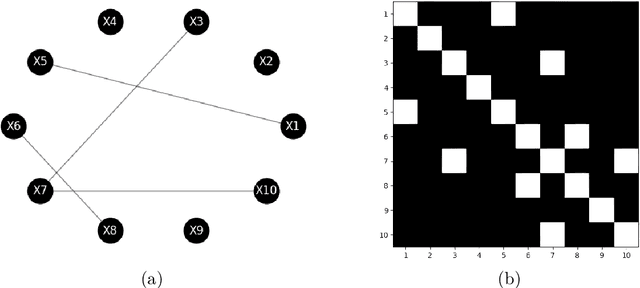
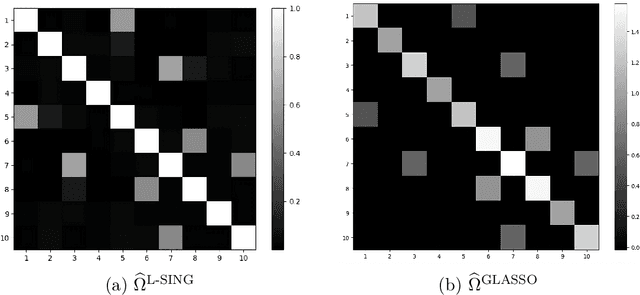
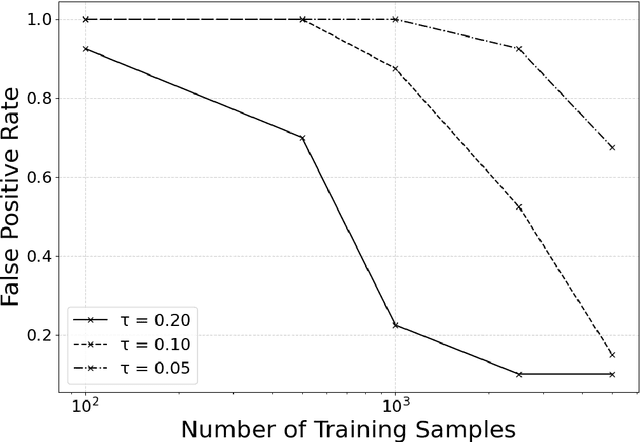
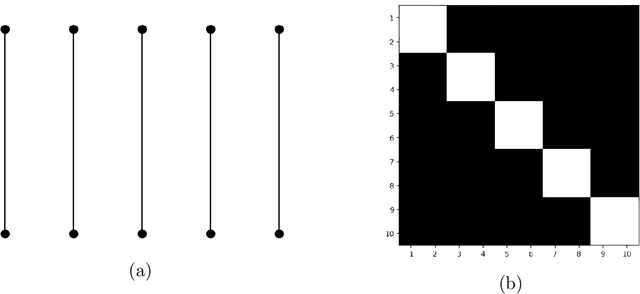
Identifying the Markov properties or conditional independencies of a collection of random variables is a fundamental task in statistics for modeling and inference. Existing approaches often learn the structure of a probabilistic graphical model, which encodes these dependencies, by assuming that the variables follow a distribution with a simple parametric form. Moreover, the computational cost of many algorithms scales poorly for high-dimensional distributions, as they need to estimate all the edges in the graph simultaneously. In this work, we propose a scalable algorithm to infer the conditional independence relationships of each variable by exploiting the local Markov property. The proposed method, named Localized Sparsity Identification for Non-Gaussian Distributions (L-SING), estimates the graph by using flexible classes of transport maps to represent the conditional distribution for each variable. We show that L-SING includes existing approaches, such as neighborhood selection with Lasso, as a special case. We demonstrate the effectiveness of our algorithm in both Gaussian and non-Gaussian settings by comparing it to existing methods. Lastly, we show the scalability of the proposed approach by applying it to high-dimensional non-Gaussian examples, including a biological dataset with more than 150 variables.