 Add to Chrome
 Add to Firefox
 Add to Edge
Time-Aware Prior Fitted Networks for Zero-Shot Forecasting with Exogenous Variables
Mar 16, 2026
In many time series forecasting settings, the target time series is accompanied by exogenous covariates, such as promotions and prices in retail demand; temperature in energy load; calendar and holiday indicators for traffic or sales; and grid load or fuel costs in electricity pricing. Ignoring these exogenous signals can substantially degrade forecasting accuracy, particularly when they drive spikes, discontinuities, or regime and phase changes in the target series. Most current time series foundation models (e.g., Chronos, Sundial, TimesFM, TimeMoE, TimeLLM, and LagLlama) ignore exogenous covariates and make forecasts solely from the numerical time series history, thereby limiting their performance. In this paper, we develop ApolloPFN, a prior-data fitted network (PFN) that is time-aware (unlike prior PFNs) and that natively incorporates exogenous covariates (unlike prior univariate forecasters). Our design introduces two major advances: (i) a synthetic data generation procedure tailored to resolve the failure modes that arise when tabular (non-temporal) PFNs are applied to time series; and (ii) time-aware architectural modifications that embed inductive biases needed to exploit the time series context. We demonstrate that ApolloPFN achieves state-of-the-art results across benchmarks, such as M5 and electric price forecasting, that contain exogenous information.

Zero-shot Forecasting by Simulation Alone
Jan 02, 2026Zero-shot time-series forecasting holds great promise, but is still in its infancy, hindered by limited and biased data corpora, leakage-prone evaluation, and privacy and licensing constraints. Motivated by these challenges, we propose the first practical univariate time series simulation pipeline which is simultaneously fast enough for on-the-fly data generation and enables notable zero-shot forecasting performance on M-Series and GiftEval benchmarks that capture trend/seasonality/intermittency patterns, typical of industrial forecasting applications across a variety of domains. Our simulator, which we call SarSim0 (SARIMA Simulator for Zero-Shot Forecasting), is based off of a seasonal autoregressive integrated moving average (SARIMA) model as its core data source. Due to instability in the autoregressive component, naive SARIMA simulation often leads to unusable paths. Instead, we follow a three-step procedure: (1) we sample well-behaved trajectories from its characteristic polynomial stability region; (2) we introduce a superposition scheme that combines multiple paths into rich multi-seasonality traces; and (3) we add rate-based heavy-tailed noise models to capture burstiness and intermittency alongside seasonalities and trends. SarSim0 is orders of magnitude faster than kernel-based generators, and it enables training on circa 1B unique purely simulated series, generated on the fly; after which well-established neural network backbones exhibit strong zero-shot generalization, surpassing strong statistical forecasters and recent foundation baselines, while operating under strict zero-shot protocol. Notably, on GiftEval we observe a "student-beats-teacher" effect: models trained on our simulations exceed the forecasting accuracy of the AutoARIMA generating processes.
AutoTriggER: Named Entity Recognition with Auxiliary Trigger Extraction
Sep 10, 2021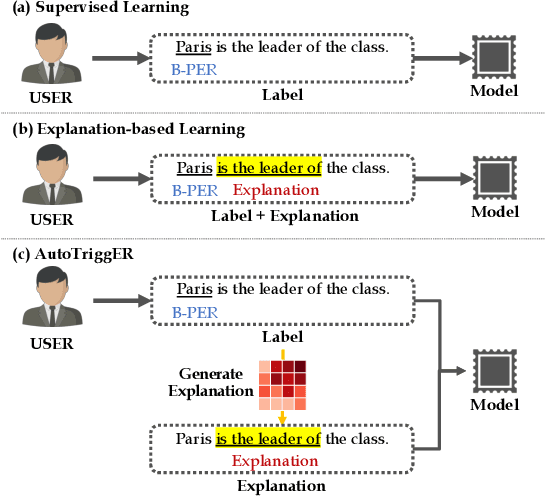
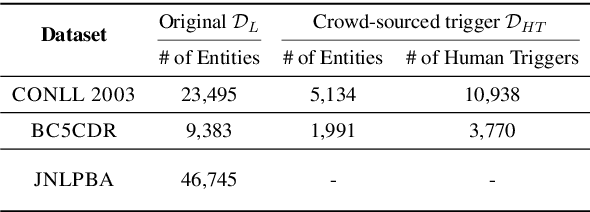
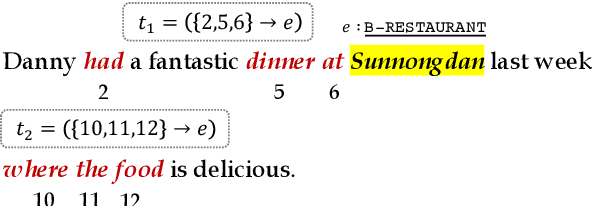
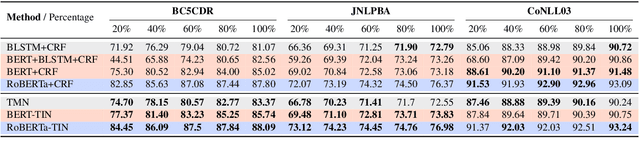
Deep neural models for low-resource named entity recognition (NER) have shown impressive results by leveraging distant super-vision or other meta-level information (e.g. explanation). However, the costs of acquiring such additional information are generally prohibitive, especially in domains where existing resources (e.g. databases to be used for distant supervision) may not exist. In this paper, we present a novel two-stage framework (AutoTriggER) to improve NER performance by automatically generating and leveraging "entity triggers" which are essentially human-readable clues in the text that can help guide the model to make better decisions. Thus, the framework is able to both create and leverage auxiliary supervision by itself. Through experiments on three well-studied NER datasets, we show that our automatically extracted triggers are well-matched to human triggers, and AutoTriggER improves performance over a RoBERTa-CRFarchitecture by nearly 0.5 F1 points on average and much more in a low resource setting.