 Add to Chrome
 Add to Firefox
 Add to Edge
Robust Low-Rank Tensor Completion based on M-product with Weighted Correlated Total Variation and Sparse Regularization
Apr 15, 2026
The robust low-rank tensor completion problem addresses the challenge of recovering corrupted high-dimensional tensor data with missing entries, outliers, and sparse noise commonly found in real-world applications. Existing methodologies have encountered fundamental limitations due to their reliance on uniform regularization schemes, particularly the tensor nuclear norm and $\ell_1$ norm regularization approaches, which indiscriminately apply equal shrinkage to all singular values and sparse components, thereby compromising the preservation of critical tensor structures. The proposed tensor weighted correlated total variation (TWCTV) regularizer addresses these shortcomings through an $M$-product framework that combines a weighted Schatten-$p$ norm on gradient tensors for low-rankness with smoothness enforcement and weighted sparse components for noise suppression. The proposed weighting scheme adaptively reduces the thresholding level to preserve both dominant singular values and sparse components, thus improving the reconstruction of critical structural elements and nuanced details in the recovered signal. Through a systematic algorithmic approach, we introduce an enhanced alternating direction method of multipliers (ADMM) that offers both computational efficiency and theoretical substantiation, with convergence properties comprehensively analyzed within the $M$-product framework.Comprehensive numerical evaluations across image completion, denoising, and background subtraction tasks validate the superior performance of this approach relative to established benchmark methods.

Wavelet-Accelerated Physics-Informed Quantum Neural Network for Multiscale Partial Differential Equations
Dec 09, 2025This work proposes a wavelet-based physics-informed quantum neural network framework to efficiently address multiscale partial differential equations that involve sharp gradients, stiffness, rapid local variations, and highly oscillatory behavior. Traditional physics-informed neural networks (PINNs) have demonstrated substantial potential in solving differential equations, and their quantum counterparts, quantum-PINNs, exhibit enhanced representational capacity with fewer trainable parameters. However, both approaches face notable challenges in accurately solving multiscale features. Furthermore, their reliance on automatic differentiation for constructing loss functions introduces considerable computational overhead, resulting in longer training times. To overcome these challenges, we developed a wavelet-accelerated physics-informed quantum neural network that eliminates the need for automatic differentiation, significantly reducing computational complexity. The proposed framework incorporates the multiresolution property of wavelets within the quantum neural network architecture, thereby enhancing the network's ability to effectively capture both local and global features of multiscale problems. Numerical experiments demonstrate that our proposed method achieves superior accuracy while requiring less than five percent of the trainable parameters compared to classical wavelet-based PINNs, resulting in faster convergence. Moreover, it offers a speedup of three to five times compared to existing quantum PINNs, highlighting the potential of the proposed approach for efficiently solving challenging multiscale and oscillatory problems.
An efficient wavelet-based physics-informed neural networks for singularly perturbed problems
Sep 18, 2024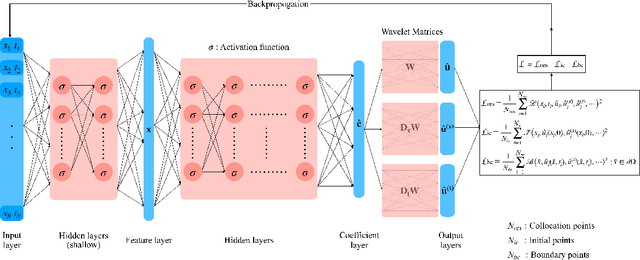
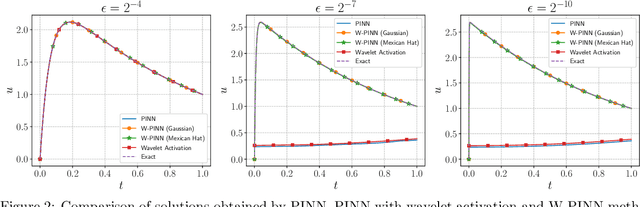
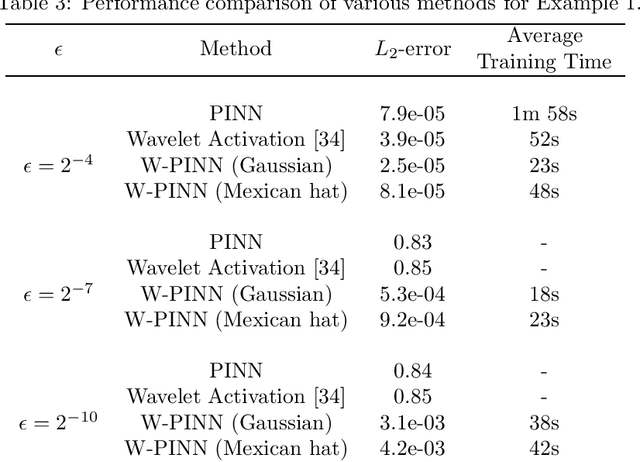
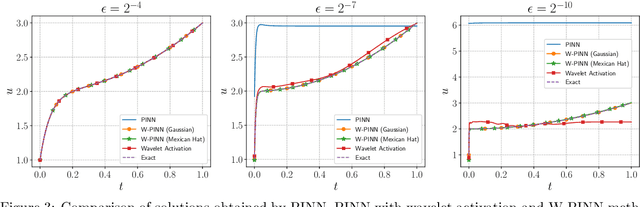
Physics-informed neural networks (PINNs) are a class of deep learning models that utilize physics as differential equations to address complex problems, including ones that may involve limited data availability. However, tackling solutions of differential equations with oscillations or singular perturbations and shock-like structures becomes challenging for PINNs. Considering these challenges, we designed an efficient wavelet-based PINNs (W-PINNs) model to solve singularly perturbed differential equations. Here, we represent the solution in wavelet space using a family of smooth-compactly supported wavelets. This framework represents the solution of a differential equation with significantly fewer degrees of freedom while still retaining in capturing, identifying, and analyzing the local structure of complex physical phenomena. The architecture allows the training process to search for a solution within wavelet space, making the process faster and more accurate. The proposed model does not rely on automatic differentiations for derivatives involved in differential equations and does not require any prior information regarding the behavior of the solution, such as the location of abrupt features. Thus, through a strategic fusion of wavelets with PINNs, W-PINNs excel at capturing localized nonlinear information, making them well-suited for problems showing abrupt behavior in certain regions, such as singularly perturbed problems. The efficiency and accuracy of the proposed neural network model are demonstrated in various test problems, i.e., highly singularly perturbed nonlinear differential equations, the FitzHugh-Nagumo (FHN), and Predator-prey interaction models. The proposed design model exhibits impressive comparisons with traditional PINNs and the recently developed wavelet-based PINNs, which use wavelets as an activation function for solving nonlinear differential equations.