 Add to Chrome
 Add to Firefox
 Add to Edge
PAIR-CI: Calibrated Conditional Independence Testing for Causal Discovery with Incomplete Data
May 06, 2026
The standard constraint-based paradigm for causal discovery with incomplete data -- impute first, test second -- is frequently miscalibrated: any consistent conditional independence (CI) test rejects a true null with probability approaching 1 when imputation error induces spurious conditional dependence. We introduce PAIR-CI, a nonparametric CI test that restores calibration by integrating multiple imputation directly into the inferential procedure via a paired permutation design. PAIR-CI compares cross-validated models that include and exclude the candidate variable while receiving the same imputed conditioning set, forcing imputation error to cancel in their loss difference rather than contaminate the test statistic. A provably consistent variance estimator jointly accounts for uncertainty arising from cross-validation and multiple imputation -- to our knowledge, the first formal unification of these two inferential frameworks. In simulations, existing imputation-based CI tests exhibit false positive rates of 28--45% when data are missing not at random (MNAR), whereas PAIR-CI averages below the nominal 5% level across data-generating processes and missingness mechanisms. These gains are largest in nonlinear settings and grow with causal graph size: when integrated into the PC algorithm, PAIR-CI reduces structural Hamming distance by 8% on 10-variable nonlinear graphs, 15% on 30-variable equivalents, and up to 44% on the 56-variable HAILFINDER network, with stable performance in all settings.

International Governance of Civilian AI: A Jurisdictional Certification Approach
Sep 11, 2023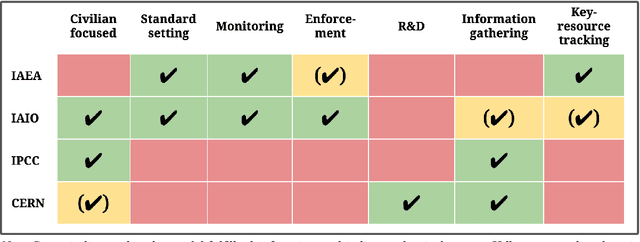
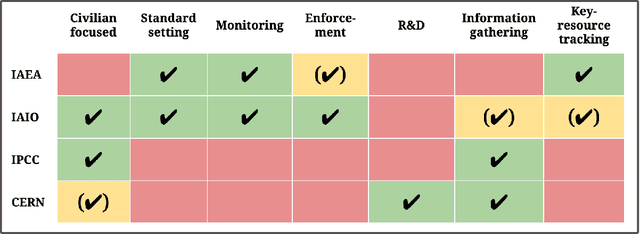

This report describes trade-offs in the design of international governance arrangements for civilian artificial intelligence (AI) and presents one approach in detail. This approach represents the extension of a standards, licensing, and liability regime to the global level. We propose that states establish an International AI Organization (IAIO) to certify state jurisdictions (not firms or AI projects) for compliance with international oversight standards. States can give force to these international standards by adopting regulations prohibiting the import of goods whose supply chains embody AI from non-IAIO-certified jurisdictions. This borrows attributes from models of existing international organizations, such as the International Civilian Aviation Organization (ICAO), the International Maritime Organization (IMO), and the Financial Action Task Force (FATF). States can also adopt multilateral controls on the export of AI product inputs, such as specialized hardware, to non-certified jurisdictions. Indeed, both the import and export standards could be required for certification. As international actors reach consensus on risks of and minimum standards for advanced AI, a jurisdictional certification regime could mitigate a broad range of potential harms, including threats to public safety.