 Add to Chrome
 Add to Firefox
 Add to Edge
Useful nonrobust features are ubiquitous in biomedical images
Apr 24, 2026
We study whether deep networks for medical imaging learn useful nonrobust features - predictive input patterns that are not human interpretable and highly susceptible to small adversarial perturbations - and how these features impact test performance. We show that models trained only on nonrobust features achieve well above chance accuracy across five MedMNIST classification tasks, confirming their predictive value in-distribution. Conversely, adversarially trained models that primarily rely on robust features sacrifice in-distribution accuracy but yield markedly better performance under controlled distribution shifts (MedMNIST-C). Overall, nonrobust features boost standard accuracy yet degrade out-of-distribution performance, revealing a practical robustness-accuracy trade-off in medical imaging classification tasks that should be tailored to the requirements of the deployment setting.

Is network fragmentation a useful complexity measure?
Nov 07, 2024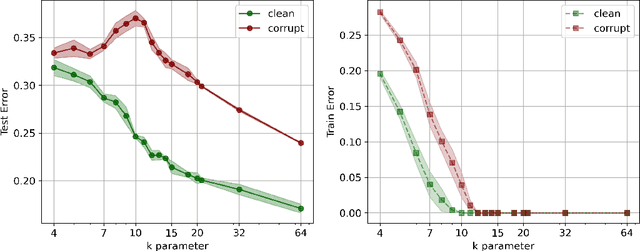
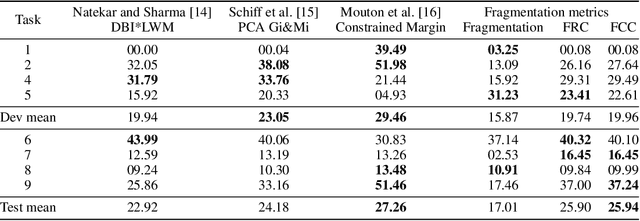
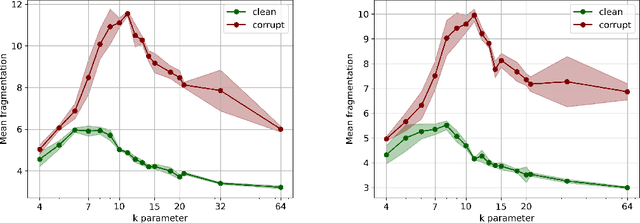
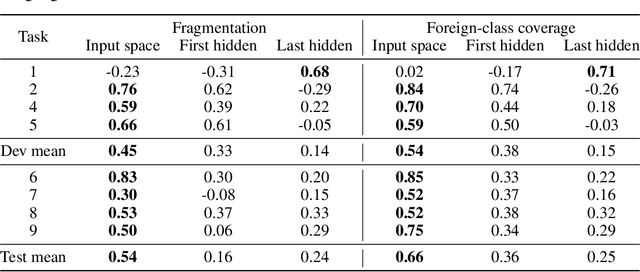
It has been observed that the input space of deep neural network classifiers can exhibit `fragmentation', where the model function rapidly changes class as the input space is traversed. The severity of this fragmentation tends to follow the double descent curve, achieving a maximum at the interpolation regime. We study this phenomenon in the context of image classification and ask whether fragmentation could be predictive of generalization performance. Using a fragmentation-based complexity measure, we show this to be possible by achieving good performance on the PGDL (Predicting Generalization in Deep Learning) benchmark. In addition, we report on new observations related to fragmentation, namely (i) fragmentation is not limited to the input space but occurs in the hidden representations as well, (ii) fragmentation follows the trends in the validation error throughout training, and (iii) fragmentation is not a direct result of increased weight norms. Together, this indicates that fragmentation is a phenomenon worth investigating further when studying the generalization ability of deep neural networks.