 Add to Chrome
 Add to Firefox
 Add to Edge
Real-Time Projected Adaptive Control for Closed-Chain Co-Manipulative Continuum Robots
Apr 05, 2026
In co-manipulative continuum robots (CCRs), multiple continuum arms cooperate by grasping a common flexible object, forming a closed-chain deformable mechanical system. The closed-chain coupling induces strong dynamic interactions and internal reaction forces. Moreover, in practical tasks, the flexible object's physical parameters are often unknown and vary between operations, rendering nominal model-based controllers inadequate. This paper presents a projected adaptive control framework for CCRs formulated at the dynamic level. The coupled dynamics are expressed using the Geometric Variable Strain (GVS) representation, yielding a finite-dimensional model that accurately represents the system, preserves the linear-in-parameters structure required for adaptive control, and is suitable for real-time implementation. Closed-chain interactions are enforced through Pfaffian velocity constraints, and an orthogonal projection is used to express the dynamics in the constraint-consistent motion subspace. Based on the projected dynamics, an adaptive control law is developed to compensate online for uncertain dynamic parameters of both the continuum robots and the manipulated flexible object. Lyapunov analysis establishes closed-loop stability and convergence of the task-space tracking errors to zero. Simulation and experiments on a tendon-driven CCR platform validate the proposed framework in task-space regulation and trajectory tracking.

Hybrid Visual Servoing of Tendon-driven Continuum Robots
Feb 19, 2025

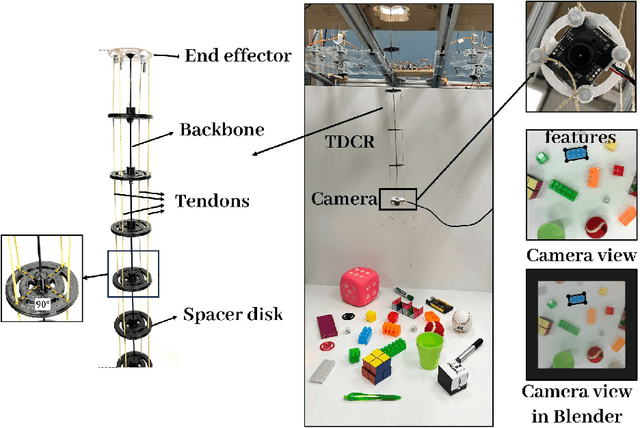

This paper introduces a novel Hybrid Visual Servoing (HVS) approach for controlling tendon-driven continuum robots (TDCRs). The HVS system combines Image-Based Visual Servoing (IBVS) with Deep Learning-Based Visual Servoing (DLBVS) to overcome the limitations of each method and improve overall performance. IBVS offers higher accuracy and faster convergence in feature-rich environments, while DLBVS enhances robustness against disturbances and offers a larger workspace. By enabling smooth transitions between IBVS and DLBVS, the proposed HVS ensures effective control in dynamic, unstructured environments. The effectiveness of this approach is validated through simulations and real-world experiments, demonstrating that HVS achieves reduced iteration time, faster convergence, lower final error, and smoother performance compared to DLBVS alone, while maintaining DLBVS's robustness in challenging conditions such as occlusions, lighting changes, actuator noise, and physical impacts.
Backstepping Control of Tendon-Driven Continuum Robots in Large Deflections Using the Cosserat Rod Model
Dec 16, 2024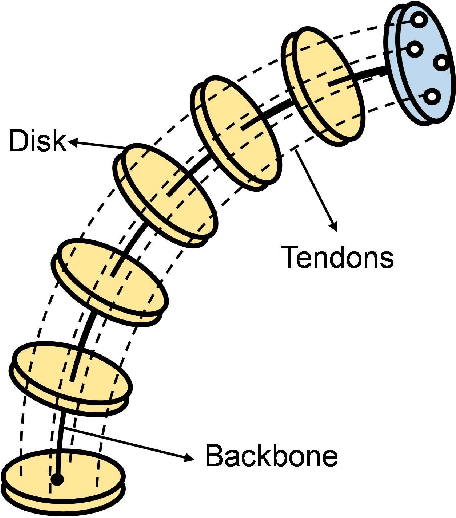
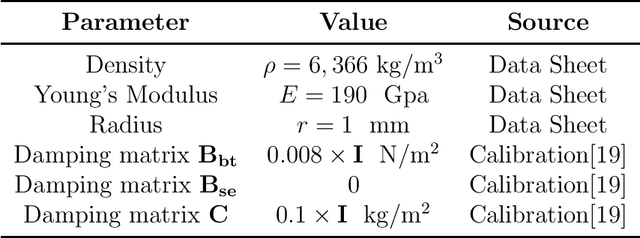
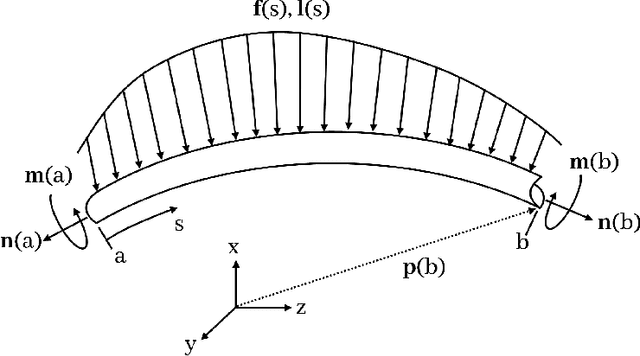
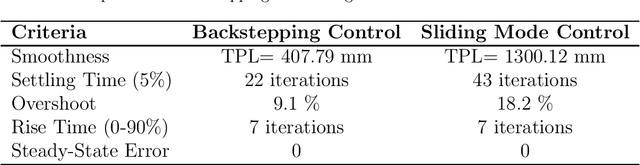
This paper presents a study on the backstepping control of tendon-driven continuum robots for large deflections using the Cosserat rod model. Continuum robots are known for their flexibility and adaptability, making them suitable for various applications. However, modeling and controlling them pose challenges due to their nonlinear dynamics. To model their dynamics, the Cosserat rod method is employed to account for significant deflections, and a numerical solution method is developed to solve the resulting partial differential equations. Previous studies on controlling tendon-driven continuum robots using Cosserat rod theory focused on sliding mode control and were not tested for large deflections, lacking experimental validation. In this paper, backstepping control is proposed as an alternative to sliding mode control for achieving a significant bending. The numerical results are validated through experiments in this study, demonstrating that the proposed backstepping control approach is a promising solution for achieving large deflections with smoother trajectories, reduced settling time, and lower overshoot. Furthermore, two scenarios involving external forces and disturbances were introduced to further highlight the robustness of the backstepping control approach.