 Add to Chrome
 Add to Firefox
 Add to Edge
Effective and Acceptable Eco-Driving Guidance for Human-Driving Vehicles: A Review
Mar 28, 2022


Ecodriving guidance includes courses or suggestions for human drivers to improve driving behaviour, reducing energy use and emissions. This paper presents a systematic review of existing eco-driving guidance studies and identifies challenges to tackle in the future. A standard agreement on the guidance design has not been reached, leading to difficulties in designing and implementing eco-driving guidance for human drivers. Both static and dynamic guidance systems have a great variety of guidance results. In addition, the influencing factors, such as the suggestion content, the displaying methods, and drivers socio-demographic characteristics, have opposite effects on the guidance result across studies, while the reason has not been revealed. Drivers motivation to practice eco behaviour, especially long-term, is overlooked. Besides, the relationship between users acceptance and system effectiveness is still unclear. Adaptive driving suggestions based on drivers habits can improve the effectiveness, while this field is under investigation.

Greenhouse Gas Emission Prediction on Road Network using Deep Sequence Learning
Apr 16, 2020


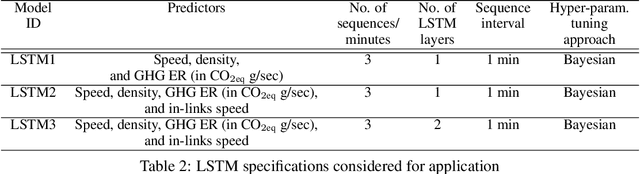
Mitigating the substantial undesirable impact of transportation systems on the environment is paramount. Thus, predicting Greenhouse Gas (GHG) emissions is one of the profound topics, especially with the emergence of intelligent transportation systems (ITS). We develop a deep learning framework to predict link-level GHG emission rate (ER) (in CO2eq gram/second) based on the most representative predictors, such as speed, density, and the GHG ER of previous time steps. In particular, various specifications of the long-short term memory (LSTM) networks with exogenous variables are examined and compared with clustering and the autoregressive integrated moving average (ARIMA) model with exogenous variables. The downtown Toronto road network is used as the case study and highly detailed data are synthesized using a calibrated traffic microsimulation and MOVES. It is found that LSTM specification with speed, density, GHG ER, and in-links speed from three previous minutes performs the best while adopting 2 hidden layers and when the hyper-parameters are systematically tuned. Adopting a 30 second updating interval improves slightly the correlation between true and predicted GHG ERs, but contributes negatively to the prediction accuracy as reflected on the increased root mean square error (RMSE) value. Efficiently predicting GHG emissions at a higher frequency with lower data requirements will pave the way to non-myopic eco-routing on large-scale road networks {to alleviate the adverse impact on the global warming