 Add to Chrome
 Add to Firefox
 Add to Edge
Deep Learning Based Anticipatory Multi-Objective Eco-Routing Strategies for Connected and Automated Vehicles
Jun 30, 2020


This study exploits the advancements in information and communication technology (ICT), connected and automated vehicles (CAVs), and sensing, to develop anticipatory multi-objective eco-routing strategies. For a robust application, several GHG costing approaches are examined. The predictive models for the link level traffic and emission states are developed using long short term memory deep network with exogenous predictors. It is found that anticipatory routing strategies outperformed the myopic strategies, regardless of the routing objective. Whether myopic or anticipatory, the multi-objective routing, with travel time and GHG minimization as objectives, outperformed the single objective routing strategies, causing a reduction in the average travel time (TT), average vehicle kilometre travelled (VKT), total GHG and total NOx by 17%, 21%, 18%, and 20%, respectively. Finally, the additional TT and VKT experienced by the vehicles in the network contributed adversely to the amount of GHG and NOx produced in the network.

Greenhouse Gas Emission Prediction on Road Network using Deep Sequence Learning
Apr 16, 2020


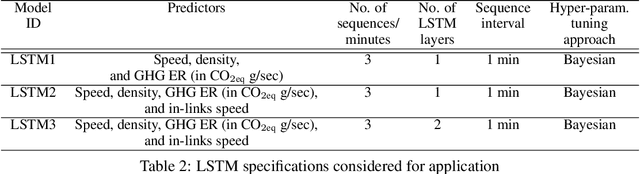
Mitigating the substantial undesirable impact of transportation systems on the environment is paramount. Thus, predicting Greenhouse Gas (GHG) emissions is one of the profound topics, especially with the emergence of intelligent transportation systems (ITS). We develop a deep learning framework to predict link-level GHG emission rate (ER) (in CO2eq gram/second) based on the most representative predictors, such as speed, density, and the GHG ER of previous time steps. In particular, various specifications of the long-short term memory (LSTM) networks with exogenous variables are examined and compared with clustering and the autoregressive integrated moving average (ARIMA) model with exogenous variables. The downtown Toronto road network is used as the case study and highly detailed data are synthesized using a calibrated traffic microsimulation and MOVES. It is found that LSTM specification with speed, density, GHG ER, and in-links speed from three previous minutes performs the best while adopting 2 hidden layers and when the hyper-parameters are systematically tuned. Adopting a 30 second updating interval improves slightly the correlation between true and predicted GHG ERs, but contributes negatively to the prediction accuracy as reflected on the increased root mean square error (RMSE) value. Efficiently predicting GHG emissions at a higher frequency with lower data requirements will pave the way to non-myopic eco-routing on large-scale road networks {to alleviate the adverse impact on the global warming