 Add to Chrome
 Add to Firefox
 Add to Edge
Proofs of Ownership for Machine Learning Models
Jun 29, 2026
With the increasing adoption of Machine Learning, protecting model ownership has become an essential challenge. We initiate a formal study of Proof of Ownership for machine learning models: under what conditions can one prove that a stolen model originated from a particular creator? We model proofs of ownership as a game among three parties: a model owner, a thief, and a judge. The owner transforms the original model into a slightly perturbed model together with a proof of ownership. The thief then obtains the transformed model and attempts to minimally modify it so that it remains useful but escapes detection as owned by the model owner. Finally, the judge receives a model and a proof of ownership, and must decide whether the given model is a modified version of some model created by the model owner, or else the given model was developed independently. Our main result is a dichotomy for classifiers in the black-box setting: Under standard cryptographic assumptions, ownership of models for some concept class can be proven in the above sense {\em if and only if} the concept class is not self-correctable, in a sense close to that of Blum, Luby and Rubinfeld, STOC'90. The result is constructive and extends, with some variations, to a number of related settings.

From Soft Classifiers to Hard Decisions: How fair can we be?
Oct 03, 2018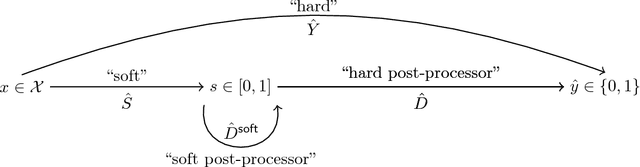
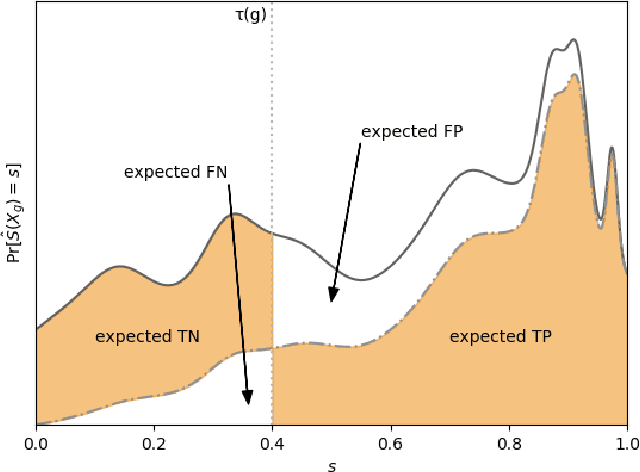
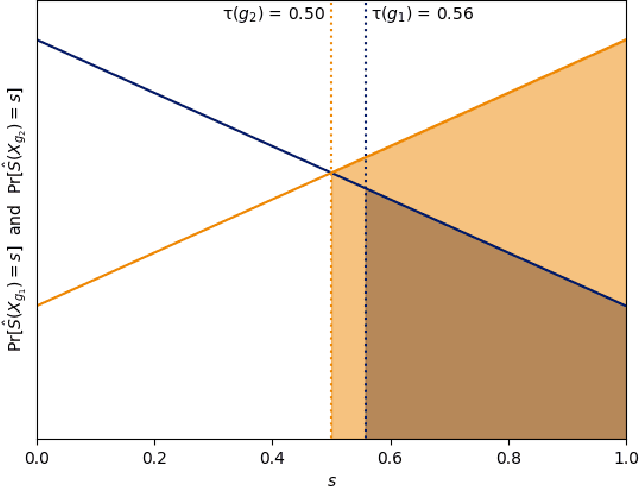
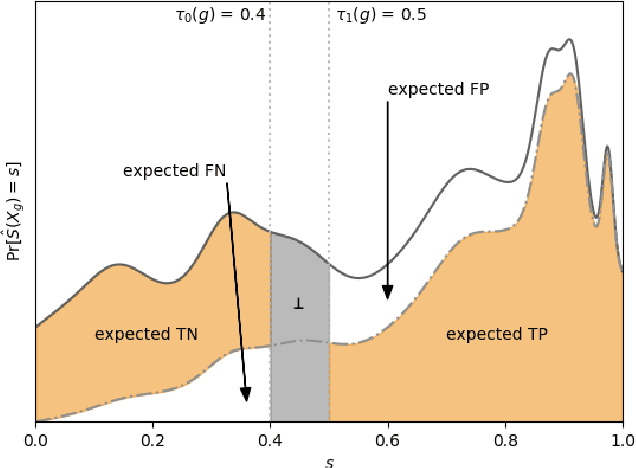
A popular methodology for building binary decision-making classifiers in the presence of imperfect information is to first construct a non-binary "scoring" classifier that is calibrated over all protected groups, and then to post-process this score to obtain a binary decision. We study the feasibility of achieving various fairness properties by post-processing calibrated scores, and then show that deferring post-processors allow for more fairness conditions to hold on the final decision. Specifically, we show: 1. There does not exist a general way to post-process a calibrated classifier to equalize protected groups' positive or negative predictive value (PPV or NPV). For certain "nice" calibrated classifiers, either PPV or NPV can be equalized when the post-processor uses different thresholds across protected groups, though there exist distributions of calibrated scores for which the two measures cannot be both equalized. When the post-processing consists of a single global threshold across all groups, natural fairness properties, such as equalizing PPV in a nontrivial way, do not hold even for "nice" classifiers. 2. When the post-processing is allowed to `defer' on some decisions (that is, to avoid making a decision by handing off some examples to a separate process), then for the non-deferred decisions, the resulting classifier can be made to equalize PPV, NPV, false positive rate (FPR) and false negative rate (FNR) across the protected groups. This suggests a way to partially evade the impossibility results of Chouldechova and Kleinberg et al., which preclude equalizing all of these measures simultaneously. We also present different deferring strategies and show how they affect the fairness properties of the overall system. We evaluate our post-processing techniques using the COMPAS data set from 2016.