 Add to Chrome
 Add to Firefox
 Add to Edge
The Impact of Temporal Context Length and Encoding Strategies on Self-Supervised ECG Representation Learning
Aug 13, 2026
Self-supervised electrocardiogram (ECG) models are often trained on a few seconds of ECG signal and, increasingly, on discretized token sequences. It remains unclear whether these choices sacrifice information needed for rhythm inference and longitudinal consistency in real-world ambulatory recordings. We present a controlled study on the Icentia11k single-lead dataset that varies (i) the input horizon (16 seconds, 1 minute, 5 minutes, and 10 minutes) and (ii) the front-end representation (continuous convolutional patch embeddings vs. fixed vector-quantized tokens), while holding the Transformer backbone and training protocol constant. Representations are assessed by downstream abnormal rhythm detection and by patient-level retrieval that probes cross-session stability. Our results show that increasing temporal context beyond 16-second snapshots yields stronger transfer and higher retrieval accuracy, with the strongest performance achieved by the 5- and 10-minute models, indicating improved capture of slow-varying rhythm dynamics and individual-specific structure. Across all evaluated horizons, continuous patch embeddings outperform discretized tokens, suggesting that quantization can discard clinically relevant waveform detail. These findings motivate ECG foundation models that emphasize extended context and continuous encoders for clinical prediction and similarity-based applications. Our code and pretrained models are publicly available at https://github.com/muha-0/ecg-ssl-representation-learning.

Real, fake and synthetic faces -- does the coin have three sides?
Apr 02, 2024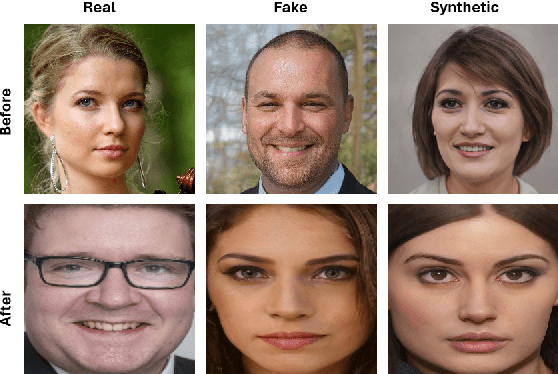
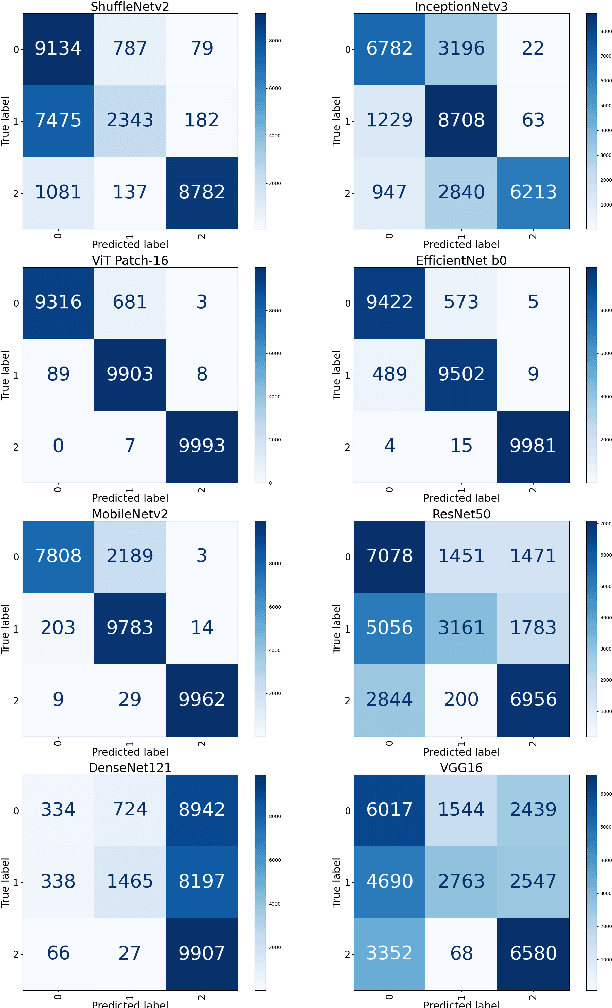
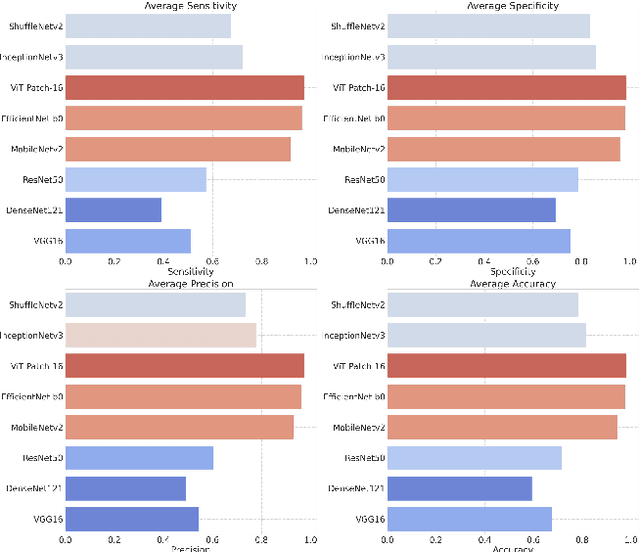
With the ever-growing power of generative artificial intelligence, deepfake and artificially generated (synthetic) media have continued to spread online, which creates various ethical and moral concerns regarding their usage. To tackle this, we thus present a novel exploration of the trends and patterns observed in real, deepfake and synthetic facial images. The proposed analysis is done in two parts: firstly, we incorporate eight deep learning models and analyze their performances in distinguishing between the three classes of images. Next, we look to further delve into the similarities and differences between these three sets of images by investigating their image properties both in the context of the entire image as well as in the context of specific regions within the image. ANOVA test was also performed and provided further clarity amongst the patterns associated between the images of the three classes. From our findings, we observe that the investigated deeplearning models found it easier to detect synthetic facial images, with the ViT Patch-16 model performing best on this task with a class-averaged sensitivity, specificity, precision, and accuracy of 97.37%, 98.69%, 97.48%, and 98.25%, respectively. This observation was supported by further analysis of various image properties. We saw noticeable differences across the three category of images. This analysis can help us build better algorithms for facial image generation, and also shows that synthetic, deepfake and real face images are indeed three different classes.