 Add to Chrome
 Add to Firefox
 Add to Edge
Textual understanding boost in the WikiRace
Nov 13, 2025
The WikiRace game, where players navigate between Wikipedia articles using only hyperlinks, serves as a compelling benchmark for goal-directed search in complex information networks. This paper presents a systematic evaluation of navigation strategies for this task, comparing agents guided by graph-theoretic structure (betweenness centrality), semantic meaning (language model embeddings), and hybrid approaches. Through rigorous benchmarking on a large Wikipedia subgraph, we demonstrate that a purely greedy agent guided by the semantic similarity of article titles is overwhelmingly effective. This strategy, when combined with a simple loop-avoidance mechanism, achieved a perfect success rate and navigated the network with an efficiency an order of magnitude better than structural or hybrid methods. Our findings highlight the critical limitations of purely structural heuristics for goal-directed search and underscore the transformative potential of large language models to act as powerful, zero-shot semantic navigators in complex information spaces.

The Double-Edged Sword of Behavioral Responses in Strategic Classification: Theory and User Studies
Oct 23, 2024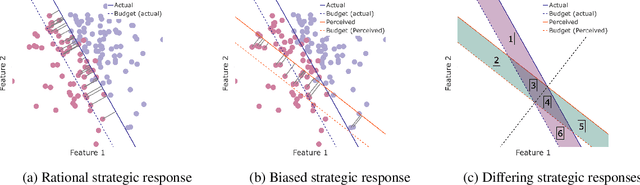
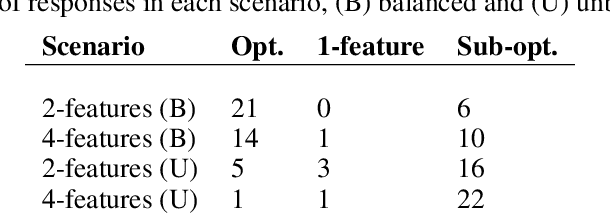
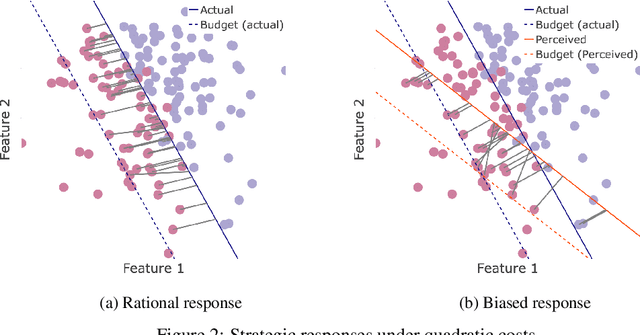

When humans are subject to an algorithmic decision system, they can strategically adjust their behavior accordingly (``game'' the system). While a growing line of literature on strategic classification has used game-theoretic modeling to understand and mitigate such gaming, these existing works consider standard models of fully rational agents. In this paper, we propose a strategic classification model that considers behavioral biases in human responses to algorithms. We show how misperceptions of a classifier (specifically, of its feature weights) can lead to different types of discrepancies between biased and rational agents' responses, and identify when behavioral agents over- or under-invest in different features. We also show that strategic agents with behavioral biases can benefit or (perhaps, unexpectedly) harm the firm compared to fully rational strategic agents. We complement our analytical results with user studies, which support our hypothesis of behavioral biases in human responses to the algorithm. Together, our findings highlight the need to account for human (cognitive) biases when designing AI systems, and providing explanations of them, to strategic human in the loop.