 Add to Chrome
 Add to Firefox
 Add to Edge
ReaLiTy and LADS: A Unified Framework and Dataset Suite for LiDAR Adaptation Across Sensors and Adverse Weather Conditions
Apr 11, 2026
Reliable LiDAR perception requires robustness across sensors, environments, and adverse weather. However, existing datasets rarely provide physically consistent observations of the same scene under varying sensor configurations and weather conditions, limiting systematic analysis of domain shifts. This work presents ReaLiTy, a unified physics-informed framework that transforms LiDAR data to match target sensor specifications and weather conditions. The framework integrates physically grounded cues with a learning-based module to generate realistic intensity patterns, while a physics-based weather model introduces consistent geometric and radiometric degradations. Building on this framework, we introduce the LiDAR Adaptation Dataset Suite (LADS), a collection of physically consistent, transformation-ready point clouds with one-to-one correspondence to original datasets. Experiments demonstrate improved cross-domain consistency and realistic weather effects. ReaLiTy and LADS provide a reproducible foundation for studying LiDAR adaptation and simulation-driven perception in intelligent transportation systems.

Simulating Realistic LiDAR Data Under Adverse Weather for Autonomous Vehicles: A Physics-Informed Learning Approach
Apr 01, 2026Accurate LiDAR simulation is crucial for autonomous driving, especially under adverse weather conditions. Existing methods struggle to capture the complex interactions between LiDAR signals and atmospheric phenomena, leading to unrealistic representations. This paper presents a physics-informed learning framework (PICWGAN) for generating realistic LiDAR data under adverse weather conditions. By integrating physicsdriven constraints for modeling signal attenuation and geometryconsistent degradations into a physics-informed learning pipeline, the proposed method reduces the sim-to-real gap. Evaluations on real-world datasets (CADC for snow, Boreas for rain) and the VoxelScape dataset show that our approach closely mimics realworld intensity patterns. Quantitative metrics, including MSE, SSIM, KL divergence, and Wasserstein distance, demonstrate statistically consistent intensity distributions. Additionally, models trained on data enhanced by our framework outperform baselines in downstream 3D object detection, achieving performance comparable to models trained on real-world data. These results highlight the effectiveness of the proposed approach in improving the realism of LiDAR data and enabling robust perception under adverse weather conditions.
Toward Physics-Aware Deep Learning Architectures for LiDAR Intensity Simulation
Apr 24, 2024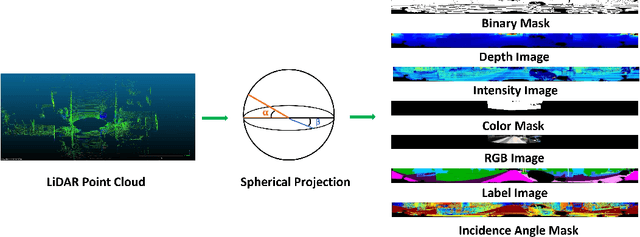
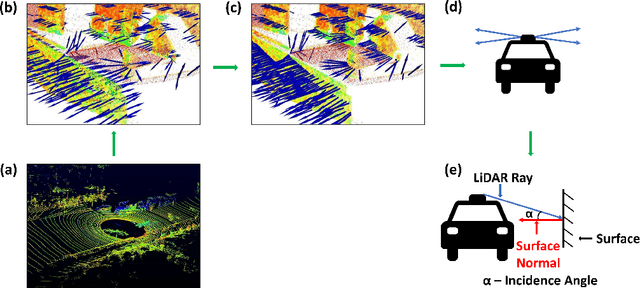
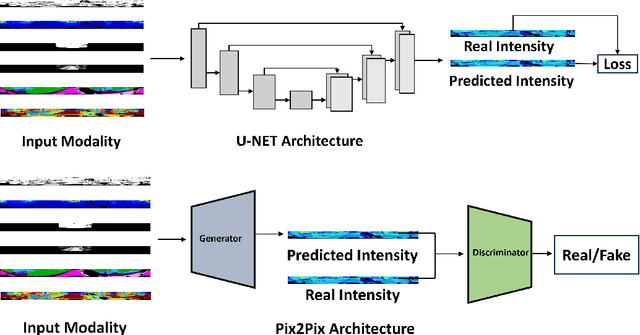
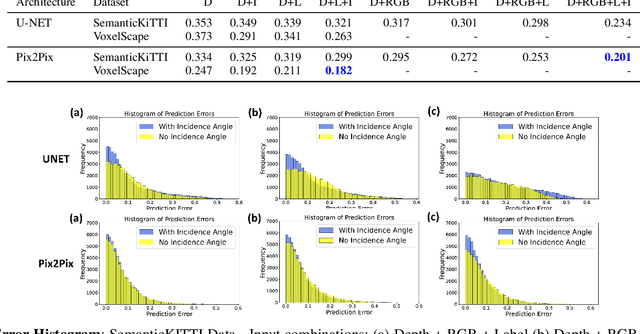
Autonomous vehicles (AVs) heavily rely on LiDAR perception for environment understanding and navigation. LiDAR intensity provides valuable information about the reflected laser signals and plays a crucial role in enhancing the perception capabilities of AVs. However, accurately simulating LiDAR intensity remains a challenge due to the unavailability of material properties of the objects in the environment, and complex interactions between the laser beam and the environment. The proposed method aims to improve the accuracy of intensity simulation by incorporating physics-based modalities within the deep learning framework. One of the key entities that captures the interaction between the laser beam and the objects is the angle of incidence. In this work we demonstrate that the addition of the LiDAR incidence angle as a separate input to the deep neural networks significantly enhances the results. We present a comparative study between two prominent deep learning architectures: U-NET a Convolutional Neural Network (CNN), and Pix2Pix a Generative Adversarial Network (GAN). We implemented these two architectures for the intensity prediction task and used SemanticKITTI and VoxelScape datasets for experiments. The comparative analysis reveals that both architectures benefit from the incidence angle as an additional input. Moreover, the Pix2Pix architecture outperforms U-NET, especially when the incidence angle is incorporated.