 Add to Chrome
 Add to Firefox
 Add to Edge
Filtered Vector Search in a Disaggregated Lakehouse: Composing Table-Format Pruning with Per-File ANN
Aug 05, 2026
Approximate nearest-neighbor (ANN) search increasingly runs alongside structured data - "find the 10 nearest documents where tenant='acme' AND lang='en'" - yet similarity and filtering are usually bolted together: a specialized vector index for one, a separate filter step for the other. We ask what happens when both live inside an open lakehouse table (Apache Iceberg over Parquet on object storage), where the engine already owns a mature file-pruning stack (partition pruning, zone-maps, a bitmap index). We embed an IVF index in place in each Parquet file's footer and make filtered vector queries fast not with a new filtering algorithm but by composing the table's existing file pruning with per-file ANN: the planner prunes data files by the predicate first, then runs IVF only over the survivors. The index is built distributed and non-destructively - a metadata-only Iceberg replace that every other engine still reads - and a rendezvous-hashed per-file cache keeps object-store read latency from swamping the algorithmic win. The payoff comes entirely from file pruning. On an 11.5M x 768 table, warm IVF search is ~32x faster than brute force at recall@10 >= 0.90, a selective predicate having pruned 355 of 444 data files before ANN runs; on 5M real IBM Granite embeddings, a filter arriving across a join prunes four of five region partitions and runs nearly two orders of magnitude (~94x: 14.7 s -> 157 ms) faster than the query-time join at identical top-k, once the reduction is materialized into a region-partitioned layout. We characterize when the composition pays off - it requires file-level locality on the filter column, and the residual predicate is only safe to push into the search over a provably pure (partitioned) column, not a merely sorted one - and report the failure modes we hit bolting ANN onto a lakehouse engine.

Design of an Efficient, Ease-of-use and Affordable Artificial Intelligence based Nucleic Acid Amplification Diagnosis Technology for Tuberculosis and Multi-drug Resistant Tuberculosis
Apr 14, 2021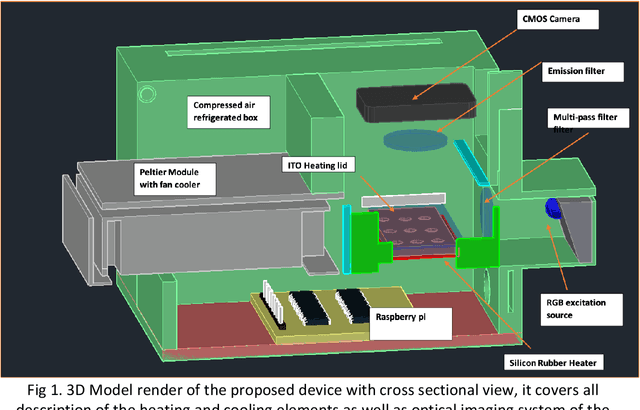
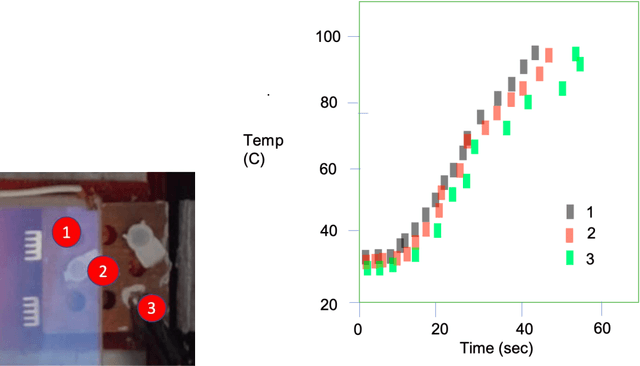
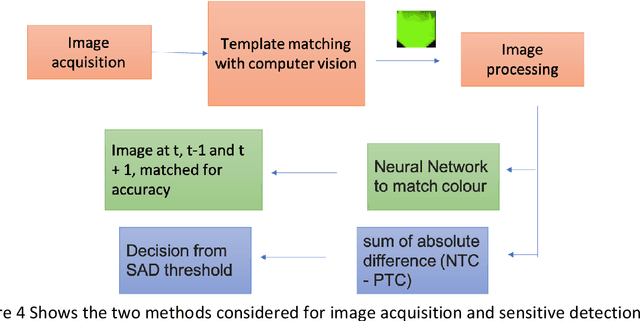
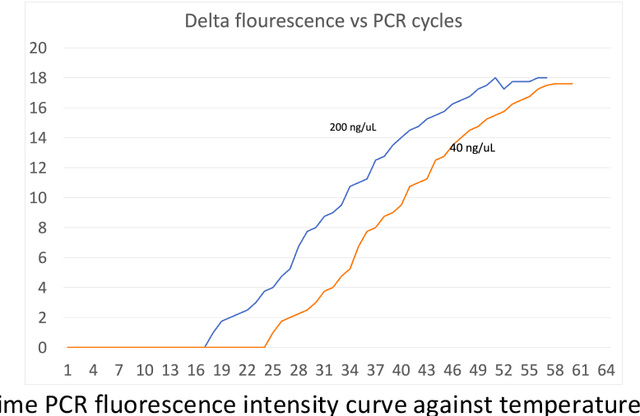
Current technologies that facilitate diagnosis for simultaneous detection of Mycobacterium tuberculosis and its resistance to first-line anti-tuberculosis drugs (Isoniazid and Rifampicim) are designed for lab-based settings and are unaffordable for large scale testing implementations. The suitability of a TB diagnosis instrument, generally required in low-resource settings, to be implementable in point-of-care last mile public health centres depends on manufacturing cost, ease-of-use, automation and portability. This paper discusses a portable, low-cost, machine learning automated Nucleic acid amplification testing (NAAT) device that employs the use of a smartphone-based fluorescence detection using novel image processing and chromaticity detection algorithms. To test the instrument, real time polymerase chain reaction (qPCR) experiment on cDNA dilution spanning over two concentrations (40 ng/uL and 200 ng/uL) was performed and sensitive detection of multiplexed positive control assay was verified.