 Add to Chrome
 Add to Firefox
 Add to Edge
A Novel Hybrid PID-LQR Controller for Sit-To-Stand Assistance Using a CAD-Integrated Simscape Multibody Lower Limb Exoskeleton
Apr 04, 2026
Precise control of lower limb exoskeletons during sit-to-stand (STS) transitions remains a central challenge in rehabilitation robotics owing to the highly nonlinear, time-varying dynamics of the human-exoskeleton system and the stringent trajectory tracking requirements imposed by clinical safety. This paper presents the systematic design, simulation, and comparative evaluation of three control strategies: a classical Proportional-Integral-Derivative (PID) controller, a Linear Quadratic Regulator (LQR), and a novel Hybrid PID-LQR controller applied to a bilateral lower limb exoskeleton performing the sit-to-stand transition. A high-fidelity, physics-based dynamic model of the exoskeleton is constructed by importing a SolidWorks CAD assembly directly into the MATLAB/Simulink Simscape Multibody environment, preserving accurate geometric and inertial properties of all links. Physiologically representative reference joint trajectories for the hip, knee, and ankle joints are generated using OpenSim musculoskeletal simulation and decomposed into three biomechanical phases: flexion-momentum (0-33%), momentum-transfer (34-66%), and extension (67-100%). The proposed Hybrid PID-LQR controller combines the optimal transient response of LQR with the integral disturbance rejection of PID through a tuned blending coefficient alpha = 0.65. Simulation results demonstrate that the Hybrid PID-LQR achieves RMSE reductions of 72.3% and 70.4% over PID at the hip and knee joints, respectively, reduces settling time by over 90% relative to PID across all joints, and limits overshoot to 2.39%-6.10%, confirming its superiority over both baseline strategies across all evaluated performance metrics and demonstrating strong translational potential for clinical assistive exoskeleton deployment.

A Comprehensive Review of Current Robot- Based Pollinators in Greenhouse Farming
Oct 31, 2024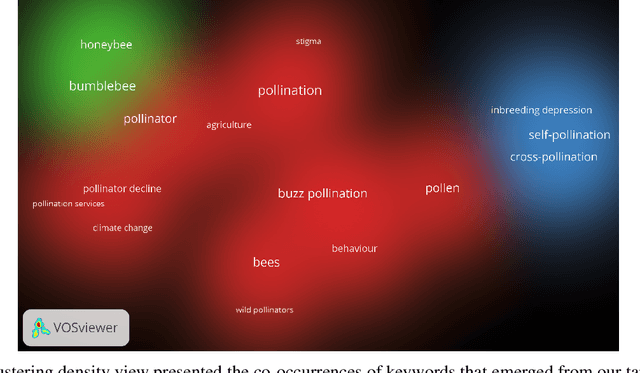
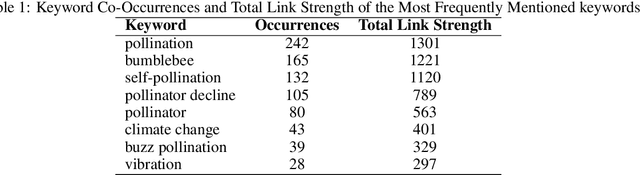
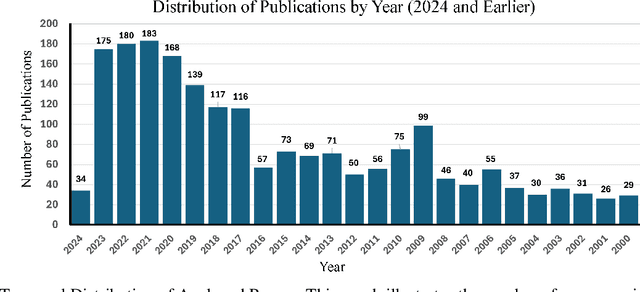

The decline of bee and wind-based pollination systems in greenhouses due to controlled environments and limited access has boost the importance of finding alternative pollination methods. Robotic based pollination systems have emerged as a promising solution, ensuring adequate crop yield even in challenging pollination scenarios. This paper presents a comprehensive review of the current robotic-based pollinators employed in greenhouses. The review categorizes pollinator technologies into major categories such as air-jet, water-jet, linear actuator, ultrasonic wave, and air-liquid spray, each suitable for specific crop pollination requirements. However, these technologies are often tailored to particular crops, limiting their versatility. The advancement of science and technology has led to the integration of automated pollination technology, encompassing information technology, automatic perception, detection, control, and operation. This integration not only reduces labor costs but also fosters the ongoing progress of modern agriculture by refining technology, enhancing automation, and promoting intelligence in agricultural practices. Finally, the challenges encountered in design of pollinator are addressed, and a forward-looking perspective is taken towards future developments, aiming to contribute to the sustainable advancement of this technology.
Movement Optimization of Robotic Arms for Energy and Time Reduction using Evolutionary Algorithms
Jun 08, 2023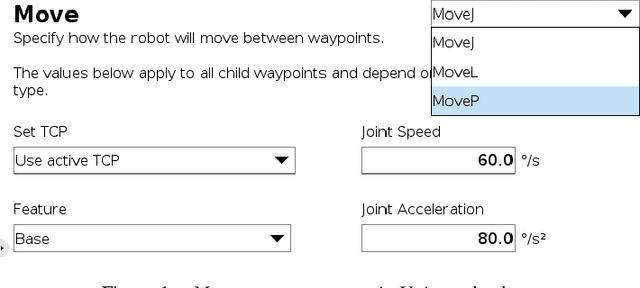
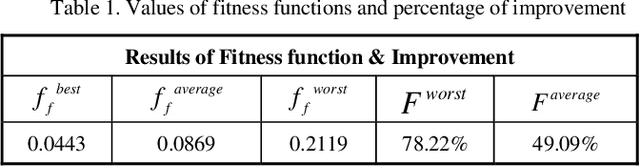
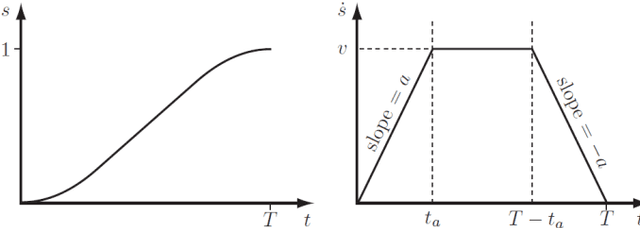
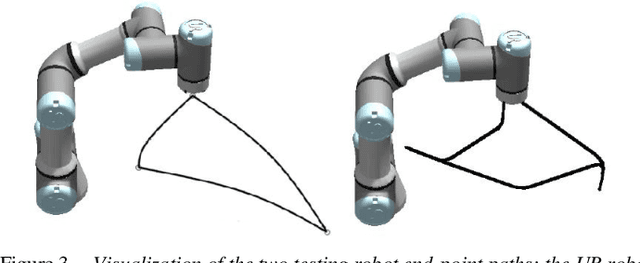
Trajectory optimization of a robot manipulator consists of both optimization of the robot movement as well as optimization of the robot end-effector path. This paper aims to find optimum movement parameters including movement type, speed, and acceleration to minimize robot energy. Trajectory optimization by minimizing the energy would increase the longevity of robotic manipulators. We utilized the particle swarm optimization method to find the movement parameters leading to minimum energy consumption. The effectiveness of the proposed method is demonstrated on different trajectories. Experimental results show that 49% efficiency was obtained using a UR5 robotic arm.
LSTM-based Preceding Vehicle Behaviour Prediction during Aggressive Lane Change for ACC Application
May 05, 2023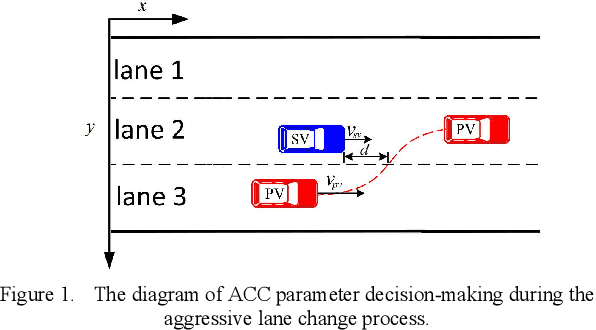
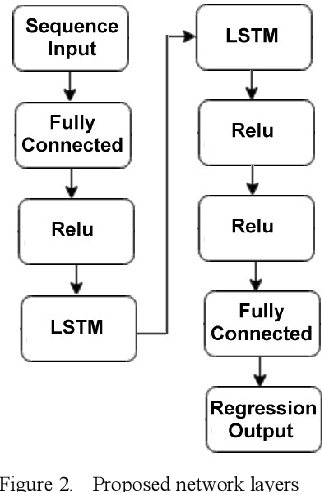
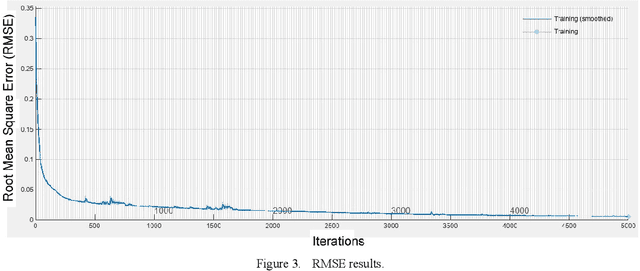

The development of Adaptive Cruise Control (ACC) systems aims to enhance the safety and comfort of vehicles by automatically regulating the speed of the vehicle to ensure a safe gap from the preceding vehicle. However, conventional ACC systems are unable to adapt themselves to changing driving conditions and drivers' behavior. To address this limitation, we propose a Long Short-Term Memory (LSTM) based ACC system that can learn from past driving experiences and adapt and predict new situations in real time. The model is constructed based on the real-world highD dataset, acquired from German highways with the assistance of camera-equipped drones. We evaluated the ACC system under aggressive lane changes when the side lane preceding vehicle cut off, forcing the targeted driver to reduce speed. To this end, the proposed system was assessed on a simulated driving environment and compared with a feedforward Artificial Neural Network (ANN) model and Model Predictive Control (MPC) model. The results show that the LSTM-based system is 19.25% more accurate than the ANN model and 5.9% more accurate than the MPC model in terms of predicting future values of subject vehicle acceleration. The simulation is done in Matlab/Simulink environment.