 Add to Chrome
 Add to Firefox
 Add to Edge
Detecting Sentiment Steering Attacks on RAG-enabled Large Language Models
Mar 17, 2026
The proliferation of large-scale IoT networks has been both a blessing and a curse. Not only has it revolutionized the way organizations operate by increasing the efficiency of automated procedures, but it has also simplified our daily lives. However, while IoT networks have improved convenience and connectivity, they have also increased security risk due to unauthorized devices gaining access to these networks and exploiting existing weaknesses with specific attack types. The research proposes two lightweight deep learning (DL)-based intelligent intrusion detection systems (IDS). to enhance the security of IoT networks: the proposed convolutional neural network (CNN)-based IDS and the proposed long short-term memory (LSTM)-based IDS. The research evaluated the performance of both intelligent IDSs based on DL using the CICIoT2023 dataset. DL-based intelligent IDSs successfully identify and classify various cyber threats using binary, grouped, and multi-class classification. The proposed CNN-based IDS achieves an accuracy of 99.34%, 99.02% and 98.6%, while the proposed LSTM-based IDS achieves an accuracy of 99.42%, 99.13%, and 98.68% for binary, grouped, and multi-class classification, respectively.

Multi-model approach for autonomous driving: A comprehensive study on traffic sign-, vehicle- and lane detection and behavioral cloning
Mar 10, 2026Deep learning and computer vision techniques have become increasingly important in the development of self-driving cars. These techniques play a crucial role in enabling self-driving cars to perceive and understand their surroundings, allowing them to safely navigate and make decisions in real-time. Using Neural Networks self-driving cars can accurately identify and classify objects such as pedestrians, other vehicles, and traffic signals. Using deep learning and analyzing data from sensors such as cameras and radar, self-driving cars can predict the likely movement of other objects and plan their own actions accordingly. In this study, a novel approach to enhance the performance of selfdriving cars by using pre-trained and custom-made neural networks for key tasks, including traffic sign classification, vehicle detection, lane detection, and behavioral cloning is provided. The methodology integrates several innovative techniques, such as geometric and color transformations for data augmentation, image normalization, and transfer learning for feature extraction. These techniques are applied to diverse datasets,including the German Traffic Sign Recognition Benchmark (GTSRB), road and lane segmentation datasets, vehicle detection datasets, and data collected using the Udacity selfdriving car simulator to evaluate the model efficacy. The primary objective of the work is to review the state-of-the-art in deep learning and computer vision for self-driving cars. The findings of the work are effective in solving various challenges related to self-driving cars like traffic sign classification, lane prediction, vehicle detection, and behavioral cloning, and provide valuable insights into improving the robustness and reliability of autonomous systems, paving the way for future research and deployment of safer and more efficient self-driving technologies.
ALINA: Advanced Line Identification and Notation Algorithm
Jun 13, 2024
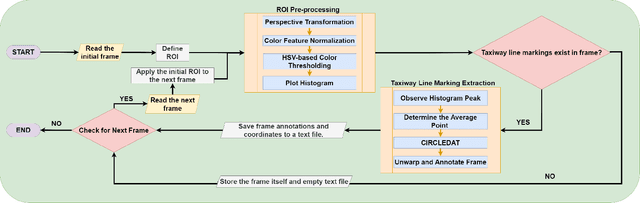

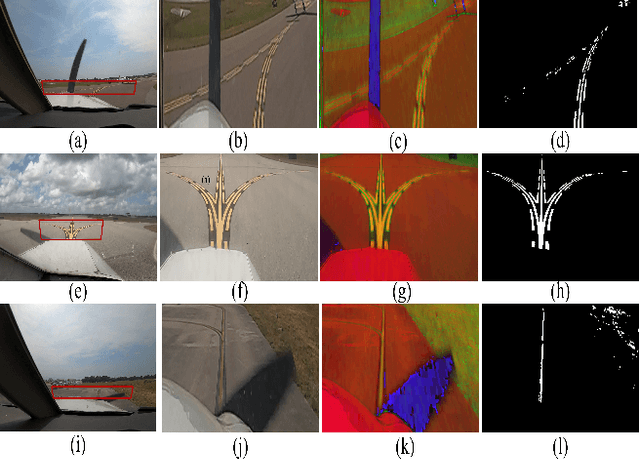
Labels are the cornerstone of supervised machine learning algorithms. Most visual recognition methods are fully supervised, using bounding boxes or pixel-wise segmentations for object localization. Traditional labeling methods, such as crowd-sourcing, are prohibitive due to cost, data privacy, amount of time, and potential errors on large datasets. To address these issues, we propose a novel annotation framework, Advanced Line Identification and Notation Algorithm (ALINA), which can be used for labeling taxiway datasets that consist of different camera perspectives and variable weather attributes (sunny and cloudy). Additionally, the CIRCular threshoLd pixEl Discovery And Traversal (CIRCLEDAT) algorithm has been proposed, which is an integral step in determining the pixels corresponding to taxiway line markings. Once the pixels are identified, ALINA generates corresponding pixel coordinate annotations on the frame. Using this approach, 60,249 frames from the taxiway dataset, AssistTaxi have been labeled. To evaluate the performance, a context-based edge map (CBEM) set was generated manually based on edge features and connectivity. The detection rate after testing the annotated labels with the CBEM set was recorded as 98.45%, attesting its dependability and effectiveness.