 Add to Chrome
 Add to Firefox
 Add to Edge
The Llama 4 Herd: Architecture, Training, Evaluation, and Deployment Notes
Jan 15, 2026
This document consolidates publicly reported technical details about Metas Llama 4 model family. It summarizes (i) released variants (Scout and Maverick) and the broader herd context including the previewed Behemoth teacher model, (ii) architectural characteristics beyond a high-level MoE description covering routed/shared-expert structure, early-fusion multimodality, and long-context design elements reported for Scout (iRoPE and length generalization strategies), (iii) training disclosures spanning pre-training, mid-training for long-context extension, and post-training methodology (lightweight SFT, online RL, and lightweight DPO) as described in release materials, (iv) developer-reported benchmark results for both base and instruction-tuned checkpoints, and (v) practical deployment constraints observed across major serving environments, including provider-specific context limits and quantization packaging. The manuscript also summarizes licensing obligations relevant to redistribution and derivative naming, and reviews publicly described safeguards and evaluation practices. The goal is to provide a compact technical reference for researchers and practitioners who need precise, source-backed facts about Llama 4.

JARVix at SemEval-2022 Task 2: It Takes One to Know One? Idiomaticity Detection using Zero and One Shot Learning
Feb 04, 2022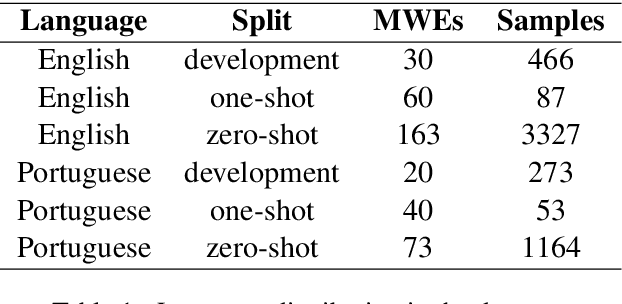
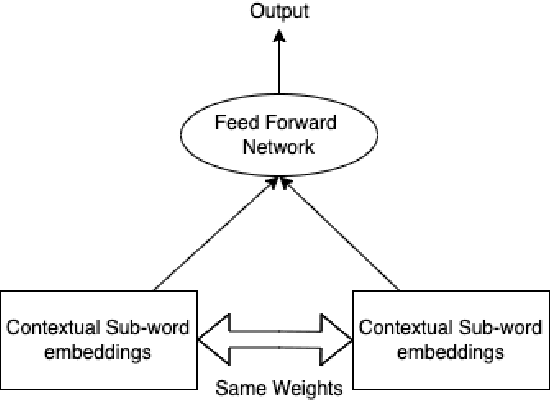
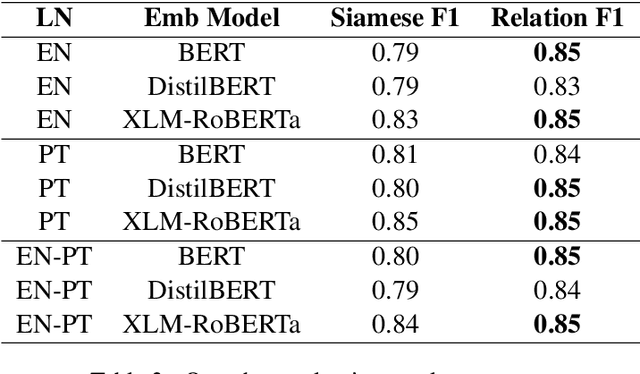
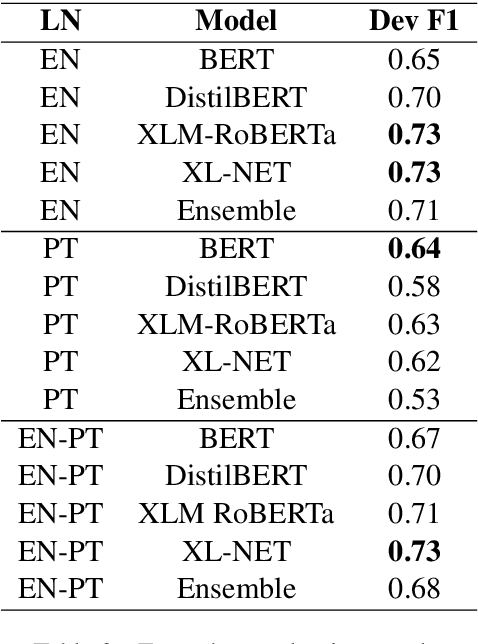
Large Language Models have been successful in a wide variety of Natural Language Processing tasks by capturing the compositionality of the text representations. In spite of their great success, these vector representations fail to capture meaning of idiomatic multi-word expressions (MWEs). In this paper, we focus on the detection of idiomatic expressions by using binary classification. We use a dataset consisting of the literal and idiomatic usage of MWEs in English and Portuguese. Thereafter, we perform the classification in two different settings: zero shot and one shot, to determine if a given sentence contains an idiom or not. N shot classification for this task is defined by N number of common idioms between the training and testing sets. In this paper, we train multiple Large Language Models in both the settings and achieve an F1 score (macro) of 0.73 for the zero shot setting and an F1 score (macro) of 0.85 for the one shot setting. An implementation of our work can be found at https://github.com/ashwinpathak20/Idiomaticity_Detection_Using_Few_Shot_Learning .