 Add to Chrome
 Add to Firefox
 Add to Edge
Georeferencing Non-Gazetteered Place Names using Biological Specimen Records
Aug 07, 2026
Biological specimen records collected by natural history institutions constitute a rich source of temporal geographic knowledge, capturing biodiversity information about regional landscapes as they were recorded at different times. Using digitised data from the Allan Herbarium (New Zealand), this study identifies place names in these specimen locality descriptions that are absent from current gazetteers; we refer to these as non-gazetteer place names (NGPs). These place names are typically historical, vernacular, or colloquial and were used as landmarks to describe a specimen's location at the time of collection. We then investigate the problem of georeferencing the NGPs using only the limited information available in the specimen records. To resolve this, we leverage repeated occurrences of the same place name across specimen records with different specimen locations and spatial relation terms, extracting and inverting these relations to derive constraints on NGP locations. This approach is instantiated within deterministic, probabilistic, and LLM-based methods, enabling a comparative analysis of their strengths and limitations for text-based spatial inference. On a pseudo-NGP benchmark, probabilistic inference achieves the highest accuracy (median error 1.43 km; A@1 km 36%), while the LLM yields competitive but less precise estimates (median error 1.80 km; A@1 km 31%), indicating that, despite advances in LLMs, traditional modelling remains advantageous when high spatial precision is required.

Georeferencing complex relative locality descriptions with large language models
Dec 16, 2025Georeferencing text documents has typically relied on either gazetteer-based methods to assign geographic coordinates to place names, or on language modelling approaches that associate textual terms with geographic locations. However, many location descriptions specify positions relatively with spatial relationships, making geocoding based solely on place names or geo-indicative words inaccurate. This issue frequently arises in biological specimen collection records, where locations are often described through narratives rather than coordinates if they pre-date GPS. Accurate georeferencing is vital for biodiversity studies, yet the process remains labour-intensive, leading to a demand for automated georeferencing solutions. This paper explores the potential of Large Language Models (LLMs) to georeference complex locality descriptions automatically, focusing on the biodiversity collections domain. We first identified effective prompting patterns, then fine-tuned an LLM using Quantized Low-Rank Adaptation (QLoRA) on biodiversity datasets from multiple regions and languages. Our approach outperforms existing baselines with an average, across datasets, of 65% of records within a 10 km radius, for a fixed amount of training data. The best results (New York state) were 85% within 10km and 67% within 1km. The selected LLM performs well for lengthy, complex descriptions, highlighting its potential for georeferencing intricate locality descriptions.
The Effectiveness of Social Media Engagement Strategy on Disaster Fundraising
Oct 19, 2022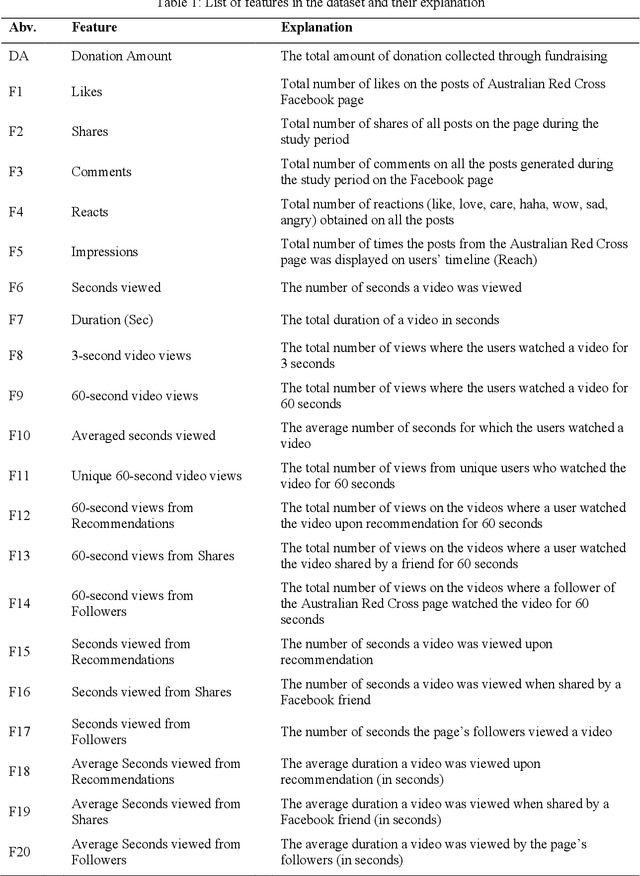
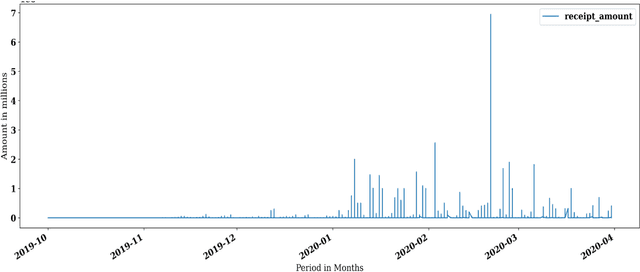
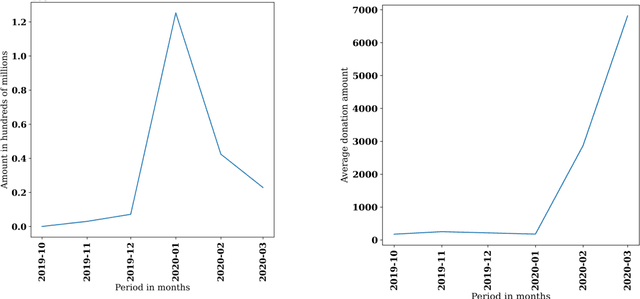
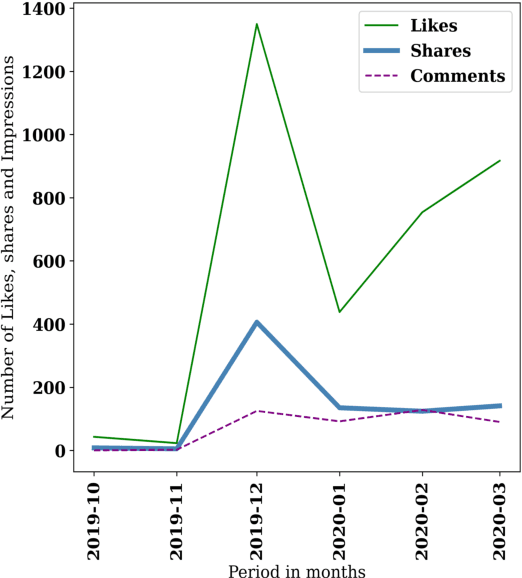
Social media has been a powerful tool and an integral part of communication, especially during natural disasters. Social media platforms help nonprofits in effective disaster management by disseminating crucial information to various communities at the earliest. Besides spreading information to every corner of the world, various platforms incorporate many features that give access to host online fundraising events, process online donations, etc. The current literature lacks the theoretical structure investigating the correlation between social media engagement and crisis management. Large nonprofit organisations like the Australian Red Cross have upscaled their operations to help nearly 6,000 bushfire survivors through various grants and helped 21,563 people with psychological support and other assistance through their recovery program (Australian Red Cross, 2021). This paper considers the case of bushfires in Australia 2019-2020 to inspect the role of social media in escalating fundraising via analysing the donation data of the Australian Red Cross from October 2019 - March 2020 and analysing the level of public interaction with their Facebook page and its content in the same period.