 Add to Chrome
 Add to Firefox
 Add to Edge
From Knowledge to Action: Outcomes of the 2025 Large Language Model (LLM) Hackathon for Applications in Materials Science and Chemistry
May 04, 2026
Large language models (LLMs) are rapidly changing how researchers in materials science and chemistry discover, organize, and act on scientific knowledge. This paper analyzes a broad set of community-developed LLM applications in an effort to identify emerging patterns in how these systems can be used across the scientific research lifecycle. We organize the projects into two complementary categories: Knowledge Infrastructure, systems that structure, retrieve, synthesize, and validate scientific information; and Action Systems, systems that execute, coordinate, or automate scientific work across computational and experimental environments. The submissions reveal a shift from single-purpose LLM tools toward integrated, multi-agent workflows that combine retrieval, reasoning, tool use, and domain-specific validation. Prominent themes include retrieval-augmented generation as grounding infrastructure, persistent structured knowledge representations, multimodal and multilingual scientific inputs, and early progress toward laboratory-integrated closed-loop systems. Together, these results suggest that LLMs are evolving from general-purpose assistants into composable infrastructure for scientific reasoning and action. This work provides a community snapshot of that transition and a practical taxonomy for understanding emerging LLM-enabled workflows in materials science and chemistry.

MLRegTest: A Benchmark for the Machine Learning of Regular Languages
Apr 16, 2023
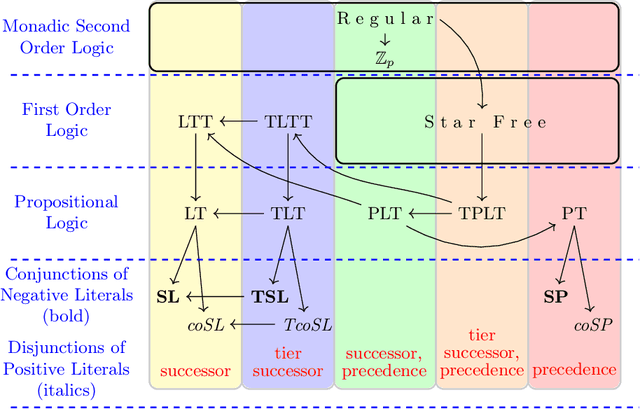
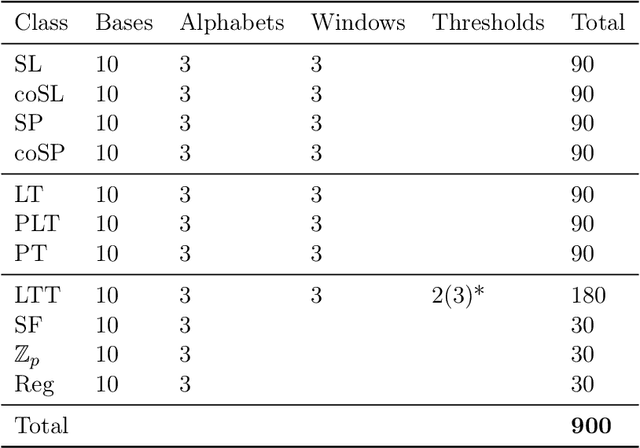
Evaluating machine learning (ML) systems on their ability to learn known classifiers allows fine-grained examination of the patterns they can learn, which builds confidence when they are applied to the learning of unknown classifiers. This article presents a new benchmark for ML systems on sequence classification called MLRegTest, which contains training, development, and test sets from 1,800 regular languages. Different kinds of formal languages represent different kinds of long-distance dependencies, and correctly identifying long-distance dependencies in sequences is a known challenge for ML systems to generalize successfully. MLRegTest organizes its languages according to their logical complexity (monadic second order, first order, propositional, or monomial expressions) and the kind of logical literals (string, tier-string, subsequence, or combinations thereof). The logical complexity and choice of literal provides a systematic way to understand different kinds of long-distance dependencies in regular languages, and therefore to understand the capacities of different ML systems to learn such long-distance dependencies. Finally, the performance of different neural networks (simple RNN, LSTM, GRU, transformer) on MLRegTest is examined. The main conclusion is that their performance depends significantly on the kind of test set, the class of language, and the neural network architecture.