 Add to Chrome
 Add to Firefox
 Add to Edge
Long-Horizon AI Research for Grothendieck Constant: A Case Study in Human-AI Mathematical Collaboration
Aug 11, 2026
AI agents are increasingly used in mathematics research, but it is often unclear how to use them effectively. Towards this, we present an extensive case study of how AI was used to improve bounds on the Grothendieck constant $K_G$, which captures the hardness between combinatorial problems and their continuous relaxations. Specifically, while the precise value of $K_G$ is not known, we recently tightened the best known bounds to \[ \frac{6π}{11} \;\le\; K_G \;\le\; \fracπ{2\log(1+\sqrt2)} - 10^{-4}. \] Crucially, these improvements were achieved using an AI research system that could arrive at insights deemed novel by domain experts. We give a detailed discussion of our experience using AI for mathematics research, particularly touching upon its strengths and weaknesses, as well as our experience with creating ideal conditions for AI to arrive at breakthrough insights.

GeoAI-based post-segmentation quality validation of building footprints via spatial feature engineering
Aug 10, 2026Deep learning-based building footprint extraction from high-resolution imagery often produces topologically inconsistent vectors unfit for direct GIS database ingestion. To address this, we present a multidomain GeoAI quality control framework that automates error detection to systematically purify vector footprint databases. Candidate footprints were generated across five UAV survey sites in Bangladesh using U-Net (ResNet-34) and SAM-LoRA (ViT-B). The extracted raster masks were vectorized, geometrically regularized, and consolidated under a spatial-exclusivity constraint to eliminate duplicate representations. We used twenty-four predictors capturing geometric, spatial-contextual, and raster-derived spectral and texture properties. Machine Learning (ML) classifiers were trained on a development partition (Sites B-D) and rigorously validated on a spatially independent test set (Site E) excluded from hyperparameter tuning and class balancing. The experimental results demonstrate that geometric and spatial-contextual predictors using Decision Tree (DT) provide the most effective discriminatory evidence for identifying object-level boundary deformations. DT achieved an accuracy of 95.31%, an F1-score of 91.06%, and a Matthews correlation coefficient (MCC) of 0.880 on the unseen testing site. At the database level, this framework successfully identified 87.34% of erroneous footprints while maintaining 98.31% of acceptable structures, reducing the residual error proportion from 27.32% to 4.62% and improving final database purity to 95.38%. This translates into a relative error reduction of 83.09%. The findings indicate that post-segmentation object-level ML provides a highly transferable, robust mechanism for automated quality assurance in production-ready geographic information system (GIS) workflows.
Learning Interestingness in Automated Mathematical Theory Formation
Nov 05, 2025We take two key steps in automating the open-ended discovery of new mathematical theories, a grand challenge in artificial intelligence. First, we introduce $\emph{FERMAT}$, a reinforcement learning (RL) environment that models concept discovery and theorem-proving using a set of symbolic actions, opening up a range of RL problems relevant to theory discovery. Second, we explore a specific problem through $\emph{FERMAT}$: automatically scoring the $\emph{interestingness}$ of mathematical objects. We investigate evolutionary algorithms for synthesizing nontrivial interestingness measures. In particular, we introduce an LLM-based evolutionary algorithm that features function abstraction, leading to notable improvements in discovering elementary number theory and finite fields over hard-coded baselines. We open-source the $\emph{FERMAT}$ environment at this URL(https://github.com/trishullab/Fermat).
LLMSTEP: LLM proofstep suggestions in Lean
Oct 27, 2023We present LLMSTEP, a tool for integrating a language model into the Lean proof assistant. LLMSTEP is a Lean 4 tactic that sends a user's proof state to a server hosting a language model. The language model generates suggestions, which are checked in Lean and displayed to a user in their development environment. We provide a baseline language model, along with code for fine-tuning and evaluation to support further development. We provide server implementations that run on CPU, a CUDA GPU, or a Google Colab notebook, as a step towards fast, effective language model suggestions for any user.
A New Approach Towards Autoformalization
Oct 19, 2023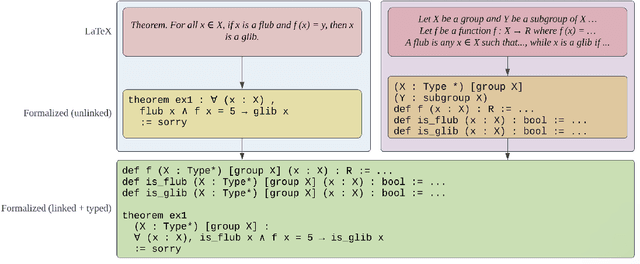
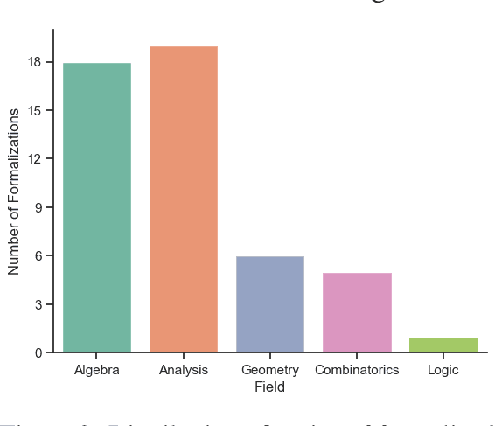
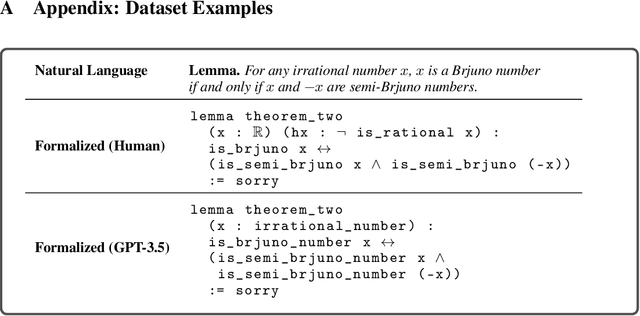
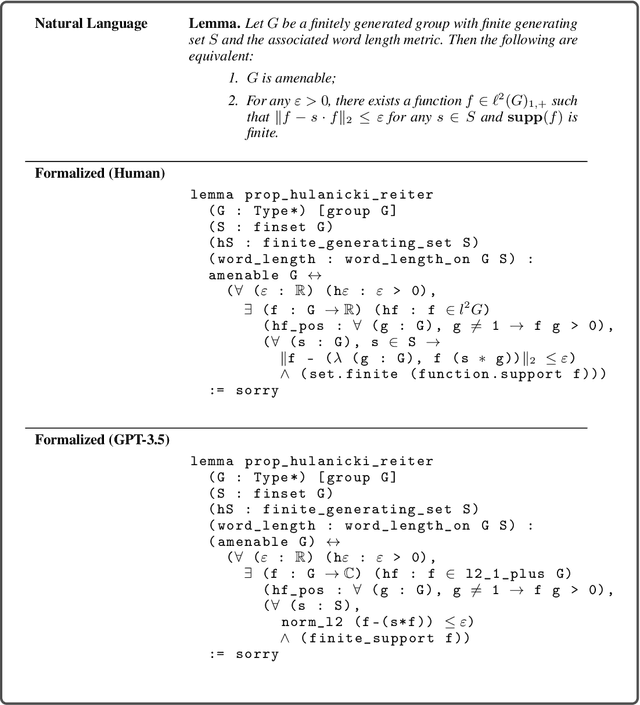
Verifying mathematical proofs is difficult, but can be automated with the assistance of a computer. Autoformalization is the task of automatically translating natural language mathematics into a formal language that can be verified by a program. This is a challenging task, and especially for higher-level mathematics found in research papers. Research paper mathematics requires large amounts of background and context. In this paper, we propose an avenue towards tackling autoformalization for research-level mathematics, by breaking the task into easier and more approachable subtasks: unlinked formalization (formalization with unlinked definitions and theorems), entity linking (linking to the proper theorems and definitions), and finally adjusting types so it passes the type checker. In addition, we present arXiv2Formal, a benchmark dataset for unlinked formalization consisting of 50 theorems formalized for the Lean theorem prover sampled from papers on arXiv.org. We welcome any contributions from the community to future versions of this dataset.